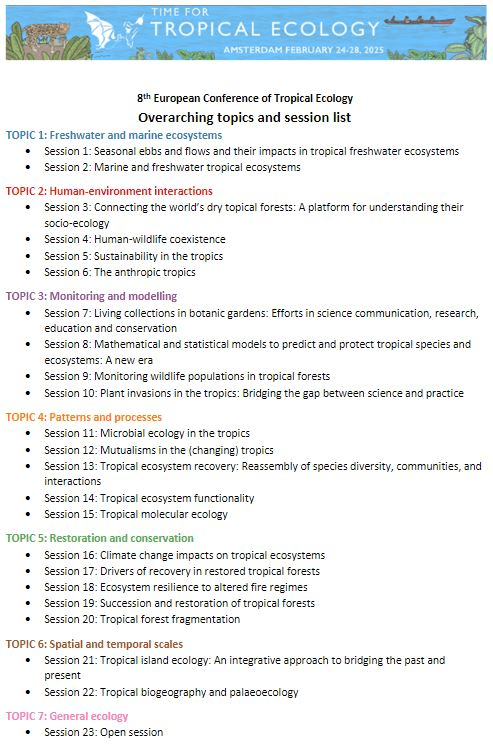
The European Conference of Tropical Ecology will take place in Amsterdam between 24 and 28 February 2025. The event will be centered around thematic oral and poster sessions. There are twenty-three different thematic sessions organized into seven broad topics:
The Mapping Ancient Africa (MAA) project is currently (late 2023 until early 2024) in the process of collecting submissions for a special issue of the INQUA (our sponsors) journal Quaternary International. The special issue will showcase research developed at the MAA workshop in Rome, and presented at the MAA sessions at the INQUA Rome congress. However, the editorial team is open to considering manuscripts relevant to the MAA goals that come from people not already involved in the project – so please contact us if you have ideas.
The process of developing articles for the special issue will be supported by the MAA community through a series of events. The first of these was a online workshop (2 October 2023) set out the frame of reference for the special issue, and included a short presentation on tips for structing a scientific article for this journal. If you missed the event and are thinking about writing an article for the special issue, or in a similar style, you can catch up with this on the Ecology of the Past YouTube channel. In person writing workshops are planned for 2024 in Africa. As full details emerge information will be published here.
The thirteenth Mapping Ancient Africa seminar was delivered by Andrea Manica on the 18th May 2023. In the seminar Andrea introduced the pastclim R package and gave examples of how it can be applied to address questions related to human evolution and dispersal.
The MSc Earth Sciences at the University of Amsterdam has a new look for the start of the next academic year (starting September 2023). Drawing on the international research expertise of our staff it is now possible to tailor your studies within two complementary tracks:
Earth System Science: Focused on fundamental aspects of Earth science, such as biogeochemical cycles, climate dynamics, and past environmental change. Our education follows our research in exploring how abiotic and biotic elements of the Earths system interact through time and across the globe.
Environmental Management: Focused on the interface between Earth science and society, key topics include: management of coastal systems, ecosystem dynamics in urban environments, and the relationship between science policy and ethics. During your internship you will have the opportunity to engage with societal partners to develop skills and projects.
For both tracks education is delivered through lectures, field courses, laboratory practical’s, and data analysis. Furthermore, you will get the chance to develop your own research agenda by conducting a project with one of our scientists, or at an external partner or university. In addition to expert knowledge our graduates have transferable skills in data handeling, numerical analysis, and science communication.
To find out more about our program visit click here to visit the MSc Earth Sciences pages on the University of Amsterdam web site.
I am pleased to announce two new vacancies within the Department of Ecosystem & Landscape Dynamics at the University of Amsterdam. These position are part of a recruitment drive across the Institute for Biodiversity & Ecosystem Dynamics triggered by new funding from the Dutch government (Earth & Environmental Science Sector Plan). Both positions will be at the Assistant Professor level (either Tenure Track, or directly tenured following a period of probation; dependent upon the experience of the successful candidate). For full detail, and how to apply, check out the below links:
These positions are designed to compliment, and strengthen, existing expertise within the department in biogeochemistry, Earth surface science, landscape ecology and palaeoecology. We are looking for scientists who are engaged with laboratory, field and/or modelling focused research, have a proven track record of publishing, and are looking for a base to build their own research group. We are looking for enthusiastic and innovative educators keen to lead and develop practical and field based courses and projects for students in our BSc Future Planet Studies and MSc Earth Sciences degree programs.
If you have any question please do not hesitate to get in contact with me directly: William D. Gosling
If you are interested to join IBED but feel you do not fit to one of these position check out our other vacancies at by clicking here.
The University of Amsterdam “Environments Through Time” course is currently underway. This cross-disciplinary course is part of the MSc Biological Sciences program and also attracts many students from the MSc Earth Sciences. During the course students gain an understanding of the importance of having a long-term (centennial to millennial) context to understanding environmental problems, and how datasets can be generated that are relevant to these timescales. To gain an understanding of uncertainty in reconstructing past environmental change students conduct a re-analysis of previously published datasets (such as those archived in Neotoma) and assess if the findings of those papers was robust. To do this students develop skills in data mining, Bayesian probability modelling, multi-variate statistical analysis, and change-point analysis. At the end of the course students have gained experience in the critical evaluation of the scientific literature, transferable numerical skills, and a greater appreciation of Earth history and past environmental change.
Crystal McMichael making statistics fun with the Environments Through Time class of 2022!
The 2022 edition of the Environments Through Time course is taught by:
If you would like to learn more about past environmental change and its relevance to ongoing societal, climatic and ecological change sign up for the MSc Biological Sciences or MSc Earth Sciences and take this course. If this course sparks further your interest in exploring past environmental change then further opportunities exist to take on masters projects in this field with our team.
I am pleased to announce the next seminar series from the Palynologische Kring“Dutch Palynologists Then and Now: A brief history or Frans Florschütz, and new research from scientists who have been working abroad”
The meeting will take place on the afternoon of the 19th May at the Institute for Biodiversity & Ecosystem Dynamics (University of Amsterdam); if you are not a member of the society and want to follow the talk online or attend in person please contact me for details.Full program below.
The fourth of a seminars in the Mapping Ancient African project took place on Tuesday 1 March 2022 and was given by Minchao Wu (Uppsala University). You can watch the seminar now on the Ecology of the Past YouTube channel. Seminar details can be found here.
Gomes, V.H.F., Mayle, F.E., Gosling, W.D., Vieira, I.C.G., Salomão, R.P. & ter Steege, H. (2020) Modelling the distribution of Amazonian tree species in response to long-term climate change during the Mid-Late Holocene. Journal of Biogeography DOI: 10.1111/jbi.13833





 Ecology of the past