Clement, C.R., Denevan, W.M., Heckenberger, M.J., Junqueira, A.B., Neves, E.G., Teixeira, W.G. & Woods, W.I. (2015) The domestication of Amazonia before European conquest. Proceedings of the Royal Society of London B: Biological Sciences 282. DOI: 10.1098/rspb.2015.0813
Oliver, T.H., Heard, M.S., Isaac, N.J.B., Roy, D.B., Procter, D., Eigenbrod, F., Freckleton, R., Hector, A., Orme, C.D., Petchey, O.L., Proenca, V., Raffaelli, D., Suttle, K.B., Mace, G.M., Martin-Lopez, B., Woodcock, B.A. & Bullock, J.M. Biodiversity and Resilience of Ecosystem Functions. Trends in Ecology & Evolution. DOI: 10.1016/j.tree.2015.08.009
Watkins, C. (2015) Oliver Rackham OBE FBA 1939–2015. Landscape History 36, 5-8. DOI: 10.1080/01433768.2015.1044280
COMMENT: One of the books that inspired me to enter this field of research was Rackham’s Trees and woodlands in the British landscape; published the year I was born…
Bush, M.B. (1995) Neotropical plant reproductive strategies and fossil pollen representation. American Naturalist 145, 594-609. Stable URL: http://www.jstor.org/stable/2462970
Cárdenas, M.L., Gosling, W.D., Sherlock, S.C., Poole, I., Pennington, R.T. & Mothes, P. (2011) The response of vegetation on the Andean flank in western Amazonia to Pleistocene climate change. Science 331, 1055-1058. DOI: 10.1126/science.1197947
Logan, A.L. & D’Andrea, A.C. (2012) Oil palm, arboriculture, and changing subsistence practices during Kintampo times (3600–3200 BP, Ghana). Quaternary International 249, 63-71. DOI: 10.1016/j.quaint.2010.12.004
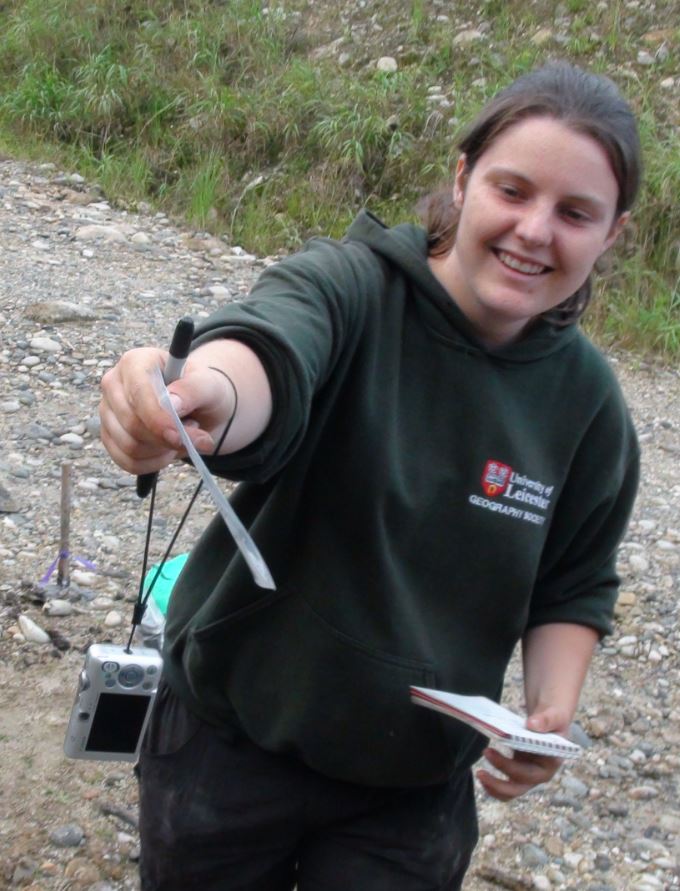
Hayley Keen getting excited about sediments during fieldwork in Ecuador (2012). Photo: J. Malley
Keen, H.F. (2015) Past environmental change on the eastern Andean flank, Ecuador. PhD Thesis, Department of Environment, Earth & Ecosystems, The Open University.
Abstract The eastern Andean flank of Ecuador (EAF) contains some of the world’s most biodiverse ecosystems. Andean montane forests are threatened due to anthropogenic pressures and both current and projected climate change. This thesis examines the palaeoecological history of two stratigraphic sequences (Mera Tigre West [MTW] and Mera Tigre East [MTE]) obtained from the Ecuadorian modern lower montane forest. The sediments preserved were analysed using eight analytical techniques, allowing an insight into the ecosystem’s potential response to projected changes derived from their past responses. Palaeoecological studies on the EAF are rare, and those that do exist are debated relating to: i) the inference of robust ecological data from pollen records in floristically diverse locations, and ii) the past source area of sediments preserved in fluvially exposed sequences, potentially leading to contamination with older material.
A statistical sub-sampling tool was developed (debate i), capable of producing statistically robust count sizes for each pollen sample; MTW and MTE count sizes ranged from 196-982 showing the diversity within sequences. The depositional environment of MTE was analysed, investigating sediment provenance throughout (debate ii). Results found that large scale volcanic events were critical in the preservation of the sediments, whereas fluvial influence caused a regional sediment source area in the upper stratigraphy, impacting on the palynological interpretation of MTE. Pollen records demonstrated the presence of a diverse vegetation community with no modern analogue at MTE (abundant taxa (>15 %): Hedyosmum, Wettinia, Ilex) and upper montane forest at MTW (Alnus, Hedyosmum, Podocarpus). Fire was not the main driver for the vegetation reassortment at either site (MTW correlation coefficient: -0.37, MTE: 0.16). The two sites have demonstrated the EAF plays host to floristically dynamic ecosystems, susceptible to drivers of change (fire and landscape) and should be considered when predicting the montane forests’ future response to environmental change.
The month-long palaeoecology module at UvA is coming to an end. We have had two weeks of lectures and microscope work, an introduction to quantitative palaeoecology, and we just finished a week of fieldwork in Twente, which is in the easternmost part of the Netherlands.
Students working in the field (photo: M. Groot)
Will Gosling and I tried something new for the field excursion this year. We split the class into eight groups, and gave each group a set of pollen and phytolith samples from an ‘unknown location’. Unknown in this context means being from one of the eight primary sites that we would visit during the field excursion. The students were required to perform vegetation surveys and characterize soils at each of the primary sites that we visited. The goal of each group was to figure out which location their set of ‘unknown’ samples came from. Basically, we had them doing forensic palynology, with idea that they could then better visualize the different vegetation assemblages seen in the palaeoecological records. Continue Reading
Characterization of Neotropical ecosystems by their modern pollen spectra and organic chemical composition
Develop skills in pollen identification, pollen chemical characterization, and the analysis of organic biomarkers.
Examine ecological variation across an altitudinal gradient of nearly 4000 meters on the tropical western Andean flank.
Improve understanding of how ecosystems function in a biodiversity hotspot, and how they might be identified in the fossil record.
The considerable biodiversity of Neotropical ecosystems is under pressure from projected climate change and human activity. Modern ecosystems can be characterized by their pollen rain and organic chemistry, which can in turn provide information about ecosystem health and functioning. However, little is known about how pollen assemblage and chemical composition (of pollen and plants) vary along environmental gradients. Altitudinal transects provide an opportunity to study a range of environments and ecosystems with a relatively small geographic area. By improving our understanding of modern ecosystems we can improve our interpretation of fossil records, and consequently better understand how modern ecosystems came into being.
The main objectives of this PhD project are to:
Generate the first modern pollen assemblage and chemical data set for the Neotropics,
Characterize the landscape-scale variation in pollen assemblage and chemistry composition, and
Identify the key environmental drivers that determines pollen assemblage and chemistry composition variation.
Publication date: 27 July 2015 Closing date: 18 September 2015
Level of education: University (Masters)
Hours: 38 hours per week
Salary indication: €2,125 to €2,717 gross per month
Vacancy number: 15-286
Applications should be emailed to application-science@uva.nl, with in the subject line the position you are applying for and vacancy number (15-286). Please make sure all your material is attached in only one pdf. Applications should include a detailed CV including educational experiences, a list of research projects and/or publications, a letter of motivation, relevant work experience, and the names and contact addresses of two academic referees from whom a reference for the candidate can be obtained.
For more details, including information on how to apply, click here (UvA), or here (via academic transfer).
It’s very nice to be invited to write something for this blog, let me introduce myself a little bit.
I am a MSc Earth Sciences student at the University of Amsterdam. Currently I am working on my master thesis at Naturalis Biodiversity Center, under supervision of Niels Raes, Willem Renema and William Gosling. We are looking at species migration between Australia and Asia during the Miocene, and we compare it to migration between N and S America at the dawn of the Great American Biotic Interchange. To do so I’m analysing data on fossil occurrences in Australia and Southeast Asia. Hopefully this research will lead to interesting new insights.
Before starting my MSc Earth Sciences I did a bachelor in Biology at Leiden University. I decided to do a master’s in Earth Sciences because it offered a broader perspective of the natural world and its processes.
I like analysing and sorting out data like I’m currently doing for my thesis with fossil occurrence data. It also played a major role in my internship at TNO – Caribbean Branche Office, where I was involved in starting a database containing information on Aruba’s subsurface. During my internship I also experienced the “Green Aruba” conference and was involved in organising a geological excursion for some of the attendants. I am very interested in environmental issues and solutions, such as the transition to renewable energy. New technologies spike my interest a lot and I like being aware of innovations in a whole lot of fields.
Hopefully I will have my thesis ready within a couple of months, and can give an update about some of the findings.
University of Amsterdam Palaeoecology & Landscape Ecology researcher Stefan Engels explains his research into the fossil record from Lake Uddelermeer on Vroege Vogels, to watch Stefan in action visit: Boren in het Uddelermeer.
Valencia Castillo, B.G. (2014) From glacial to modern conditions: Vegetation and climate change under human influence in the Central Andes. PhD Thesis, Department of Environment, Earth & Ecosystems, The Open University.
Abstract
Conservation, restoration and management strategies are employed to maintain Earth’s biological diversity and physical environment to a near “natural” state. However, the concept of “natural” is generally inexact and may include degraded landscapes. In absence of long-term empirical data of natural baselines, impacted assemblages (human altered baselines) could be falsely assumed to be natural and set as conservation or restoration goals. Therefore, the identification of long-term ecological baselines becomes a pressing requirement especially in threatened biodiversity hotspots such as the tropical Andes that were under human pressure for several millennial.
This thesis aims to identify ecological baselines for tropical Andean ecosystems based on multi-proxy palaeoecological reconstructions from three Andean lakes. Trends of vegetation change are used to identify when landscapes became anthropogenic in the Andes. Because vegetation assemblages at c. 10 ka experienced negligible anthropogenic impacts and had modern-like climate condition, this time was considered the most recent period likely to provide insight into natural ecological baseline conditions.
Changes in vegetation assemblages were evaluated over time departing from 10 ka around Miski and Huamanmarca, two sites that remained virtually impervious to human impacts. Baselines in Miski and Huamanmarca drifted continuously over time and showed that baselines are dynamic entities. The vegetation assemblages derived from Miski and Huamanmarca suggest that that human impact was not homogeneous throughout the Andean landscape.
Once baselines were defined it was possible to evaluate if the spatial distribution of Andean woodlands represented by Polylepis was a product of human impacts. A MaxEnt model generated based on 22 modern environmental variables and 13 palaeoecological vegetation reconstructions showed that Polylepis woodlands were naturally fragmented before humans arrived in South America (14 ka). However, the influence of humans during the mid and late Holocene enhanced the patchiness of the forest generating a hyper-fragmented landscape.
Two weeks ago I attended the biannual International Biogeography Society (IBS) conference in Bayreuth, together with 600+ other people from more than 50 different countries. This IBS conference, my first IBS meeting, proved to be an exciting event during which I met scientists from many different disciplines and heard talks on cutting-edge biogeographical research.
The IBS conference was held in the Bavarian city of Bayreuth, in the middle of the biodiverse landscape of Upper Franconia. This landscape provided the training ground for Alexander von Humboldt, the founder of the field of biogeography. The 4-day conference included a wide variety of symposia and many, many posters. The conference dinner in the German Steam Train Museum was highly memorable. The conference was closed by a lecture from Daniel Simberloff, once a doctorate student of Edward O. Wilson, who received the Wallace Award for his outstanding contributions to invasion ecology.
I had a talk in the plenary symposium of ‘Ecosystem response to past climate change’, organized by David Nogués-Bravo and Francisco Rodríguez-Sánchez. The symposium covered the dangers of climate change to biodiversity and tried to assess if the range and rate of adaptation, migration, persistence, or extirpation, that are registered in deep-time records, palaeorecords, and the recent past, are adequate responses for predicted climate change in the future. I addressed this issue from the point of view of a small remote island, where migration is obviously a limiting factor. I showed how I reconstructed climate and its effect on island biota during the last 40,000 years using long-term palaeoecological records from Mauritius (de Boer et al, 2013 & 2014). These records show that different climate regimes result in different ecosystem response to climate change in the past. Local extirpation or population collapse of larger vertebrates was a natural phenomenon in the lowlands of Mauritius due to frequent climate extremes (I will discuss this in more detail in my next blog; de Boer, 2015). Despite these population collapses, island biota have always (in the timeframe of my records) survived natural climate change. Therefore, my take home message was not to focus on the effects of (future) climate change alone. Other key components of global change, such as invasive species and habitat destruction, are more imminent threats to the biodiversity of many islands. For more information on my research, including publications, click here.
More information on the IBS read on (below) or visit the IBS website or blog. All abstracts and other details of the IBS conference in Bayreuth can be found here. The next IBS meeting will take place in Salvador, Bahia (Brazil) in March 2017.







 Ecology of the past