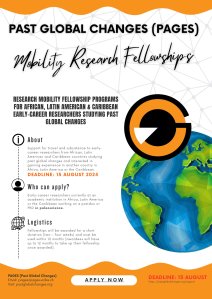
The call for the PAst Global changES (PAGES) research mobility fellowships for African, Latin American and Caribbean early career researchers studying past global changes is currently open.
The 10th Mapping Ancient Africa seminar took place on Tuesday 7th February 2023. The seminar was delivered by Cecile Blanchet (Helmholtz-Zentrum Potsdam) and highlighted recent work linking river sediments from the Nile with change in global climate systems, including El Nino.
Blanchet, C.L., Osborne, A.H., Tjallingii, R., Ehrmann, W., Friedrich, T., Timmermann, A., Brückmann, W. & Frank, M. (2021) Drivers of river reactivation in North Africa during the last glacial cycle. Nature Geoscience 14, 97-103. DOI: 10.1038/s41561-020-00671-3
Blanchet, C.L., Tjallingii, R., Schleicher, A.M., Schouten, S., Frank, M. & Brauer, A. (2021) Deoxygenation dynamics on the western Nile deep-sea fan during sapropel S1 from seasonal to millennial timescales. Climate of the Past 17, 1025-1050. DOI: 10.5194/cp-17-1025-2021
Blanchet, C.L., Ionita, M., Ramisch, A., Tjallingii, R., Brauer, A., Laruelle, L., Bagge, M. & Klemann, V. (2023) Pacemakers of extreme floods during warmer and wetter climates of the “Wild Nile” stage. PREPRINT (Version 1) available at Research SquareDOI: 10.21203/rs.3.rs-3051876/v1
The International Union for Quaternary Research (INQUA) supports a number of commissions which focus on more specific aspects of Quaternary research. One of these, the Human & Biosphere Commission, or HABCOM, has recently launched a podcast introducing its members and activities. To find out more about HABCOM listen to the podcast below, or click this link to visit the related INQUA web pages.
Attention Dutch biologists: The deadline for submission of nominations for the Hugo de Vries Prijs is closing soon (31 January 2024). The prize is awarded to the best biology PhD thesis defended at a Dutch university in 2023. The types of thesis considered by the panel within the category on “biology” is broad, and – for readers of this blog – includes (palaeo)ecology.
The Mapping Ancient Africa (MAA) project is currently (late 2023 until early 2024) in the process of collecting submissions for a special issue of the INQUA (our sponsors) journal Quaternary International. The special issue will showcase research developed at the MAA workshop in Rome, and presented at the MAA sessions at the INQUA Rome congress. However, the editorial team is open to considering manuscripts relevant to the MAA goals that come from people not already involved in the project – so please contact us if you have ideas.
The process of developing articles for the special issue will be supported by the MAA community through a series of events. The first of these was a online workshop (2 October 2023) set out the frame of reference for the special issue, and included a short presentation on tips for structing a scientific article for this journal. If you missed the event and are thinking about writing an article for the special issue, or in a similar style, you can catch up with this on the Ecology of the Past YouTube channel. In person writing workshops are planned for 2024 in Africa. As full details emerge information will be published here.
A new funding stream is about to open up (1 December 2023) to support African scientists to carry out PhD research at Dutch universities. The GROW research programme (Graduate Research on Worldwide Challenges) will fund 51 PhD positions to be based at one of five Dutch universities, including with the Institute for Biodiversity & Ecosystem Dynamics, at the University of Amsterdam.
The pollen and phytolith identification quiz! Is that an Asteraceae phytolith I see…???
The University of Amsterdam “Palaeoecology” course commenced this week with lectures getting students up to speed with the fundamental principles and approaches to the subject, and laboratory practicals training students in the identification of micro- and macro-fossils. Once students have gained a basic understanding of pollen and phytolith identification – and demonstrated this by passing the ‘dreaded’ identification quiz – it is time to commence the group project work.
This year the students are trying to identify from which study site their ‘mystery slides’ come from on the basis of the micro-fossil assemblages (pollen and phytoliths) that they contain. The study sites all come from the area around Hilversum (Netherlands) and (could) include: heathland, pine forest, mix-deciduous forest, and birch woodlands. In addition, just to make it more interesting, one group has samples taken from the medieval palaeosol that is found locally.
Next week is field work week and the students will then need to parameterise the vegetation around the Hilversum area in such a way that they: (i) get a representative sample the variation across the landscape, and (ii) can compare the vegetation data with their micro-fossil data. Then, following the number crunching in the third week of the course, we will find out if the different groups can identify the correct study site from which there samples came…
The Palaeoecology course at the University of Amsterdam is part of the BSc Biology program, it is also frequently taken by students on the BSc Future Planet Studies degree. We also welcome students from other programs, such as BSc Béta-Gamma, and international exchange students.
The third instalment of interviews with Mapping Ancient Africa scientists is now available. Watch ‘the final four’ below, and check out the other videos by clicking on the names below:
Mapping Ancient Africa participants on the Rome workshop (2023)
The Mapping Ancient Africa (MAA) project has an open call for contributions to a Special Issue of Quaternary International; the journal of our funder the International Union for Quaternary Research (INQUA). The concept for the special issue is agreed in principle with the journals editor-in-chief so now it is our task to collate a collection of manuscripts suitable to published in this international peer reviewed journal. The special issue will be based around papers discussed and presented at the MAA workshop in Rome and session at the INQUA congress in Rome in July 2023, but we are also happy to consider other manuscripts that fit within the MAA project area.
To find out if your manuscript idea might fit either explore the MAA web pages or contact a member of the editorial team: