I was delighted to be invited to give a seminar as part of the Max Planck Institute for Geoanthropology “Human Palaeo-systems Research Group” series. In case you missed it the seminar is will soon be available to watch online (click here).
To see the full list of seminars in the series click here.
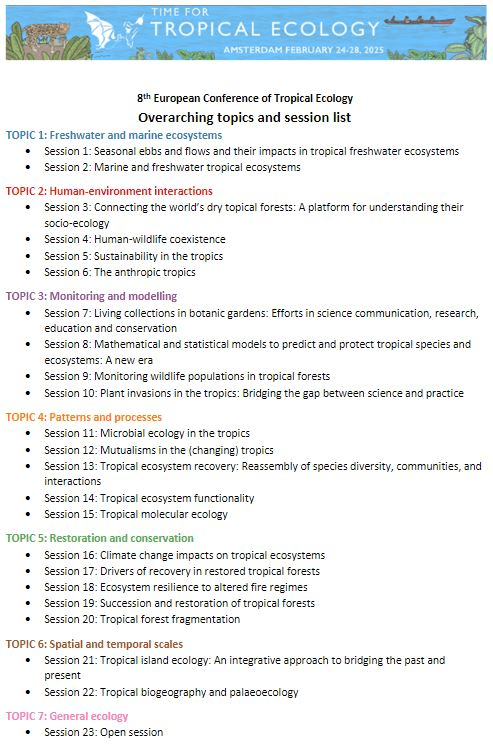
The European Conference of Tropical Ecology will take place in Amsterdam between 24 and 28 February 2025. The event will be centered around thematic oral and poster sessions. There are twenty-three different thematic sessions organized into seven broad topics:
The Mapping Ancient Africa (MAA) project has a double session of talks and a poster session at the INQUA congress in Rome 2023. Our session will be on Wednesday 19 July.
Giosan et al. When the desert was a lake: Providing context for Homo sapiens development in the northern Kalahari
Chase et al. Paleolakes and socioecological implications of glacial “greening” of the South African interior
Biddulph et al. Spatiotemporal variability in the initiation and development of peatlands across the central Congo Basin
Blinkhorn et al. Evaluating refugia in recent human evolution in Africa
Aureli et al. Homo sapiens behaviour and adaptation in East Africa. New evidence from an open-air site in a modern Ethiopian savannah environment: the GOT10 site
Dembele Climatic fluctuations during the last millenium and their impact on political history and human settlements in West Africa
Porchier et al. Annually resolved hydroclimate variability in the East African Rift Valley at a time critical for hominin dispersion
Effiom et al. Late Holocene palaeoecological studies at Lake St Lucia, KwaZulu-Natal
The fifth Mapping Ancient African project took place on Monday 11 April 2022 and focused on the African Pollen Database and past vegetation change in Africa.
The seminar was delivered by Sarah Ivory (Penn State University), Rahab Kinyanjui (National Museums of Kenya), and Lynne Quick (Nelson Mandela University). The seminar covers the principles behind and the working of the African Pollen Database (why make data openly available?) and the latest advances in eastern and southern Africa.
For more about the African Pollen Database check out:
Kaboth-Bahr S, Gosling WD, Vogelsang R, Bahr A, Scerri EML, Asrat A, Cohen AS, Düsing W, Foerster V, Lamb HF, et al. 2021. Paleo-ENSO influence on African environments and early modern humans. Proceedings of the National Academy of Sciences 118(23):e2018277118. https://doi.org/10.1073/pnas.2018277118
Applications are invited from qualified and highly-motivated students for an exciting PhD studentship in the areas of paleoecology and community ecology of South American lowland rainforests.
Palaeoecology and past environmental research central to the work at the Institute for Biodiversity & Ecosystem Dynamics (University of Amsterdam); check out the new institute video, spot the palaeoecology researchers, and see what else is going on at IBED:






 Ecology of the past