The third Mapping Ancient Africa (MAA) workshop took place in South Africa during March 2026. This workshop was supported by the International Union for Quaternary Research as part of the MAA multi-year project. The aim of this work shop was to provide specialist training in developing research projects and writing of scientific articles. During the workshop each participant developed, and progressed, their own personal work plan. These personal programs allowed the training to be tailored to the participants needs. They included a wide range of challenged ranging from the development of project ideas through to dealing with reviewer comments on manuscripts, and inclusivity, equality and diversity issues.
In addition to the academic program, social activities and excursions were designed to help build academic networks and promote informal discussion of past environmental change issues. These included hikes to the Holley Shelter archaeological site (Bader & Conrad, 2023) and Game Pass shelter rock art site (Hoerle, 2005).
During the Mapping Ancient Africa writing workshop in Kenya (3-6 June 2024) Stefanie Kaboth-Bahr conducted a series of short interviews with the scientists attending. During the interviews she asked the participants and instructors to describe their scientific background, what had motivated them to take part in the writing workshop, and what they thought the most important thing they had gained from it. You can now meet the first four of these scientists now by watching the videos below, or catch up with all the latest videos on the Mapping Ancient Africa YouTube Playlist.
The participants (part 1 of 2)
Olugbenga Boboye (University of Ibadan, Nigeria)
Angela Effiom (University of the Witwatersrand, South Africa)
During the Mapping Ancient Africa (MAA) workshop in Kenya (3-6 June 2024) the session delivered by Rahab Kinyanjui (National Museums of Kenya) was recorded for those that could not make it. The seminar was focused on how to deal with reviewer comments. While this was targeted for participants focused on developing their manuscripts for the MAA special issue of Quaternary International (for full details click here). This seminar is relevant to all those facing reviewer comments on their scientific manuscripts.
Dealing with reviewer comments (Rahab Kinyanjui, National Museums of Kenya)
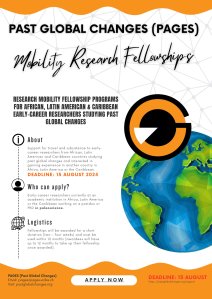
The call for the PAst Global changES (PAGES) research mobility fellowships for African, Latin American and Caribbean early career researchers studying past global changes is currently open.
Applications are invited for a fully-funded three-year PhD to commence in October 2024 with Adele Julier (University of Portsmouth, UK).
The project will focus on disentangling the history of human ignited and natural fire regimes in Britain. This will be achieved through the analysis of charcoal fragments extracted from sedimentary sequences.
On November 17, 2023, Caixia Wei (魏彩霞) accomplished a pivotal milestone by successfully defending her thesis titled “Morphometrics of Modern and Fossil Poaceae Pollen from South America” at the distinguished Agnietenkapel (University of Amsterdam). During the defense ceremony, Caixia showcased her professional knowledge and expertise in the field of paleoecology in a relaxed and cheerful manner. The committee members, promoters (Carina Hoorn, William Gosling, Phillip Jardine), and attendees (~50 people) responded with frequent smiles, laughter, and numerous rounds of applause! After the defense, a delightful reception and dinner were held, where Caixia was showered with an abundance of hugs, kisses, heartfelt wishes, and thoughtful gifts. These wonderful memories will support Caixia on her journey ahead…
For a glimpse into the event, you can watch Caixia’s insightful 10-minute project presentation here:
Additionally, most of Caixia’s thesis is available for download at this link:
At the University of Amsterdam the MSc Earth Science is split into two tracks, one of these is entitled: “Earth System Science”. Earth System Science is a research intensive track focused on understanding the fundamentals of abiotic and biotic interactions across the globe and through time. During this degree you will spend around 6 months studying to pick up specialist knowledge and skills, and around 18 months actively developing yourself – in your key areas of interest – through project work.
The taught part of the Earth System Science track includes courses such as:
The Earth System: Learn how to analyse Earth system function across space and through time.
Analysis & Modelling Lab: Develop skills in data handeling, analysis and modeling relevant to Earth science.
Biogeochemical Cycles in the Earth System: Study how the dynamics of carbon and nitrogen link to societal challenges.
Climate Change: Explore the scientific basis for climate change an its implications for the environment and society.
Environments Through Time: Consider and analyse environmental change on timescale relevant to landscapes, societies and climates.
GIS and Remote Sensing in Ecosystem Dynamics: Learn how to use large remotely sensed datasets to gain insights into geological, geomorphological and soil systems.
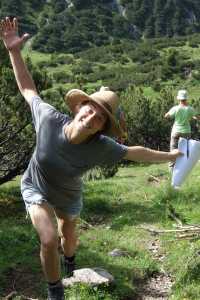
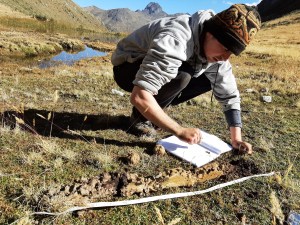
Clare Lee (on one leg, left) during field course in Peru successfully published her literature review which she conducted as part of her MSc in Earth Sciences at the University of Amsterdam.
In addition, free elective courses are possible from across the University of Amsterdam, or at other approved organizations or universities, i.e. it is possible to pick up skills in other specialisms (for example in languages, AI, or programming), or study a course at a university abroad, and have this included within your University of Amsterdam MSc Earth Science degree.
The project part of the Earth System Science track includes two research projects, or one research project and one internship with an external organization (such as a company or NGO). MSc research projects are often closely linked to active research within the Institute for Biodiversity & Ecosystem Dynamics. Some projects and literature reviews conducted by our MSc researchers reach a high enough level to be published in international scientific journals, either on there own or as part of a wider collaboration. Examples of recent papers including MSc researchers (highlighted in bold) are:
Lee, C.M., van Geel, B. & Gosling, W.D. (2022) On the use of spores of coprophilous fungi preserved in sediments to indicate past herbivore presence. Quaternary5, 30. DOI: 10.3390/quat5030030
de Nijs, E.A. & Cammeraat, E.L. (2020) The stability and fate of Soil Organic Carbon during the transport phase of soil erosion. Earth-Science Reviews 201, 103067. DOI: 10.1016/j.earscirev.2019.103067
The MSc Earth Sciences at the University of Amsterdam has a new look for the start of the next academic year (starting September 2023). Drawing on the international research expertise of our staff it is now possible to tailor your studies within two complementary tracks:
Earth System Science: Focused on fundamental aspects of Earth science, such as biogeochemical cycles, climate dynamics, and past environmental change. Our education follows our research in exploring how abiotic and biotic elements of the Earths system interact through time and across the globe.
Environmental Management: Focused on the interface between Earth science and society, key topics include: management of coastal systems, ecosystem dynamics in urban environments, and the relationship between science policy and ethics. During your internship you will have the opportunity to engage with societal partners to develop skills and projects.
For both tracks education is delivered through lectures, field courses, laboratory practical’s, and data analysis. Furthermore, you will get the chance to develop your own research agenda by conducting a project with one of our scientists, or at an external partner or university. In addition to expert knowledge our graduates have transferable skills in data handeling, numerical analysis, and science communication.
To find out more about our program visit click here to visit the MSc Earth Sciences pages on the University of Amsterdam web site.





 Ecology of the past