Wei PhD thesis 2023

April 17, 2024
WDG

Wei, C. (2023) Morphometrics of modern and fossil Poaceae pollen from South America. PhD Thesis, University of Amsterdam, Amsterdam. ISBN:

Abstract

Poaceae (the grass family) is one of the most diverse angiosperm families on Earth, comprising close to 12,000 species. The history of grass-dominated biomes extends back over 20 million years, yet the spatial and temporal development of these biomes and the underlying drivers remains unresolved. This thesis addresses these questions in South America, focusing on modern grass pollen and ancient samples dating from the early Miocene to the present. The thesis reveals several key points: (i) Grass pollen size varies significantly both among genera and species and within species. Pollen size shows no correlation with (a)biotic factors, indicating its limited utility as a generally applicable proxy for reconstructing past vegetation and climate; (ii) Grass pollen exhibits high diverse on surface ornamentation. The morphotypes identified by descriptive terminology are well-supported by a combination of SEM images of pollen surface patterns and computational image analysis. The findings reveal that pollen sculpture is unrelated to (a)biotic variables but is diverse across the phylogeny; (iii) Tropical grass pollen morphology suggests a gradual rather than punctuated evolution, based on the trend toward a less dense ornamentation of the exine since c. 23 Ma. The changes in the exine of grass pollen since the early Miocene might be driven by evolutionary processes (evolutionary drift and/or directional selection), and potentially immigration at the continental scale. In summary, the thesis reveals the trajectory of grass pollen morphological changes over time and examining the drivers that have contributed to their evolution and geographical expansion at the continental scale.

Handle: http://hdl.handle.net/11245.1/1f4f5550-1069-423a-ace3-2192ac4160c6

Teunissen van Manen PhD thesis 2020

April 11, 2024
WDG

Teunissen van Manen, M.L. (2020) Plant wax n-alkane biomarkers in the tropical Andes (Ecuador). PhD Thesis, University of Amsterdam, Amsterdam. ISBN: 9789491407857

Abstract

Developing new applications for plant wax n-alkane biomarkers can deepen our understanding of ecosystem history. In this thesis I study modern and sedimentary n-alkane signals, sourced along the tropical Andes, to better understand how they can be used as a proxy for past environmental change. The overarching question addressed in this thesis is: what do n-alkane patterns extracted from sedimentary records reflect? Specifically, I address:• Do environmental or taxonomic factors dominate the n-alkane signal?• Does the n-alkane signal alter as the plant material degrades?• How much of the n-alkane variability can be explained by our analytical protocols?I find that the taxonomic and environmental signals of n-alkane patterns are entangled, especially in leaf n-alkanes. Soil n-alkane patterns reflect environmental conditions at the site, but the results cannot rule out a taxonomic signal in soil n-alkane patterns. I also find that, as the source material degrades (leaves), the n-alkane patterns are altered. Although the n-alkane signal is recognizable as having plant origin, there is a reduction in n-alkane pattern variability and the metric for degradation becomes an increasingly important descriptor of the n-alkane pattern shifts observed in soils and sediments. I find evidence that the metric for degradation can be used as proxy for past environmental change, but the application of this n-alkane signal proxy is not straightforward. Finally, I find there is little understanding of how much extraction and measurement protocols contribute to the n-alkane pattern variability and what implications this has on interpretations of the n-alkane signal.

Handel: http://hdl.handle.net/11245.1/716e0c42-7bc7-4270-9d76-e4c556c51e1a

Cuesta PhD thesis 2019

April 9, 2024
WDG

Cuesta C., F.X. (2019) Global environmental changes in the high tropical Andes. PhD Thesis, University of Amsterdam, Amsterdam. ISBN: 9789491407758

Abstract

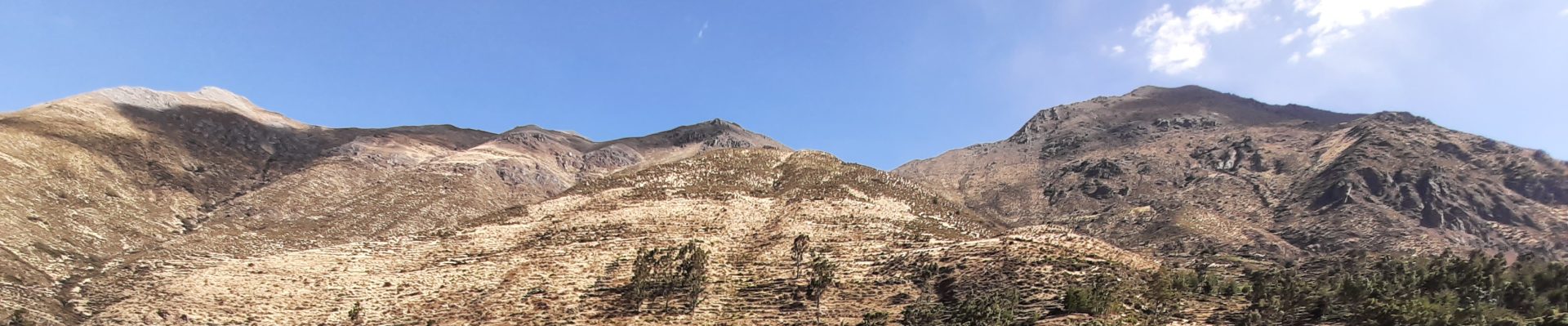
The high tropical Andes harbours vital ecosystems that sustain biodiversity, carbon storage, and environmental service provision for millions of people. They are identified as one of the most vulnerable terrestrial ecosystems to global environmental changes, particularly to climate change and land use conversion. Despite their vulnerability and the importance of global biodiversity conservation and Andean societies, they are among the least studied ecosystems in the world. In this thesis, I studied the patterns of summit plant community’s across the tropical section of the Andes. Further, I studied what environmental factors influence plant community composition, species diversity, and thermal niche traits in high tropical alpine ecosystems. Based on the thermal niche traits, I assessed the potential vulnerability of species and communities to climate warming, considering the effect of the climate variability hypothesis on the species niche breadths. Further, I synthesised the current state of knowledge and assessed the current and projected landscape changes in the high Andes due to the combined effect of glacier retreat and climate warming. I reviewed documented glacier changes and landscape evolution over past decades to millennia and assessed projected future glacier shrinkage until 2100 for two case studies in the Andes of Ecuador and Peru. I also evaluated the capacity of high Andean ecosystems to recover from land use changes using the aptitude to store and take up carbon together with plant diversity. Lastly, I carried out an applied research analysis aimed at informing conservation policy formulation in continental Ecuador through defining critical areas for biodiversity conservation.

Handel: http://hdl.handle.net/11245.1/c97e30b0-90d7-4363-9d33-50d288089712

What has biogenic silica ever done for us?

April 3, 2024
WDG

Siliceous Microfossils Meeting

  • Date: Friday 24 May 2024
  • Location: Institute for Biodiversity & Ecosystem Dynamics, University of Amsterdam

Program

  • 13:00-14:00 – Palynologische Kring society annual meeting
  • 14:00-14:15 – Coffee
  • 14:15-15:45 – Seminar series
    • Using phytolith analysis to detect palm enrichment in Amazonia Nina Witteveen (University of Amsterdam)
    • Starch grains as indicators of plant food consumption in Neanderthals and Early Modern Humans Amanda Henry (University of Leiden)
    • Paleoenvironmental history of an archaeological lagoon in Central Italy: Insights from diatom analysis Majoi Nacimiento, Teye Aukes & Jan Sevink (University of Amsterdam)
  • 15:45-17:30 – Laboratory activities
    • Advances in topical phytolith identification Nina Witteveen (University of Amsterdam)
    • Finding Suitable Grounds – combining the on/off site approach through phytolith investigation in Flevoland Ana Smuk (Rijksuniversiteit Groningen)

If you are not already a member and would like to attend please contact the society via email or the web portal: https://www.palynologischekring.nl/contact/

To find out more about the Palynologische Kring click here to visit the web site.

PhD Thesis: Morphometrics of modern and fossil Poaceae pollen from South America

December 19, 2023
WDG

On November 17, 2023, Caixia Wei (魏彩霞) accomplished a pivotal milestone by successfully defending her thesis titled “Morphometrics of Modern and Fossil Poaceae Pollen from South America” at the distinguished Agnietenkapel (University of Amsterdam). During the defense ceremony, Caixia showcased her professional knowledge and expertise in the field of paleoecology in a relaxed and cheerful manner. The committee members, promoters (Carina Hoorn, William Gosling, Phillip Jardine), and attendees (~50 people) responded with frequent smiles, laughter, and numerous rounds of applause! After the defense, a delightful reception and dinner were held, where Caixia was showered with an abundance of hugs, kisses, heartfelt wishes, and thoughtful gifts. These wonderful memories will support Caixia on her journey ahead…

For a glimpse into the event, you can watch Caixia’s insightful 10-minute project presentation here:

Additionally, most of Caixia’s thesis is available for download at this link:

Continue Reading

New funding opportunity for African researchers

November 8, 2023
WDG

A new funding stream is about to open up (1 December 2023) to support African scientists to carry out PhD research at Dutch universities. The GROW research programme (Graduate Research on Worldwide Challenges) will fund 51 PhD positions to be based at one of five Dutch universities, including with the Institute for Biodiversity & Ecosystem Dynamics, at the University of Amsterdam.

To find out more click here.

Applications open 1 December 2023 and close 31 January 2024.

Spatial and temporal abilities of proxies used to detect pre-Columbian Indigenous human activity in Amazonian ecosystems

November 2, 2023
WDG

Open access:

McMichael, C.N.H., Levis, C., Gosling, W.D., Junqueira, A.B., Piperno, D.R., Neves, E.G., Mayle, F., Peña-Claros, M. & Bongers, F. (2023) Spatial and temporal abilities of proxies used to detect pre-Columbian Indigenous human activity in Amazonian ecosystems. Quaternary Science Reviews 321, 108354. DOI: 10.1016/j.quascirev.2023.108354

Palaeoecology course 2023

September 6, 2023
WDG

The pollen and phytolith identification quiz! Is that an Asteraceae phytolith I see…???

The University of Amsterdam “Palaeoecology” course commenced this week with lectures getting students up to speed with the fundamental principles and approaches to the subject, and laboratory practicals training students in the identification of micro- and macro-fossils. Once students have gained a basic understanding of pollen and phytolith identification – and demonstrated this by passing the ‘dreaded’ identification quiz – it is time to commence the group project work.

This year the students are trying to identify from which study site their ‘mystery slides’ come from on the basis of the micro-fossil assemblages (pollen and phytoliths) that they contain. The study sites all come from the area around Hilversum (Netherlands) and (could) include: heathland, pine forest, mix-deciduous forest, and birch woodlands. In addition, just to make it more interesting, one group has samples taken from the medieval palaeosol that is found locally.

Next week is field work week and the students will then need to parameterise the vegetation around the Hilversum area in such a way that they: (i) get a representative sample the variation across the landscape, and (ii) can compare the vegetation data with their micro-fossil data. Then, following the number crunching in the third week of the course, we will find out if the different groups can identify the correct study site from which there samples came…

The Palaeoecology course at the University of Amsterdam is part of the BSc Biology program, it is also frequently taken by students on the BSc Future Planet Studies degree. We also welcome students from other programs, such as BSc Béta-Gamma, and international exchange students.

Lost forests of the Netherlands

June 13, 2023
WDG

The June 2023 meeting of the Dutch palynological society (Palynologische Kring) took place at the offices of the Dutch National Cultural Heritage Agency (Rijksdienst Cultureel Erfgoed) in Amersfoort. The focus of this meeting was the past forest landscape of the Netherlands. The meeting included the annual report of the society, three scientific talks, and a prize giving for the best MSc thesis.

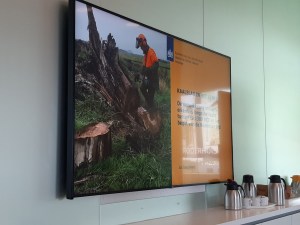
Presentation of Jos Bazelmans showed the huge amount of woody material extracted from Dutch peat bogs.

The annual report of the society showed a healthy finances and membership (>100 members). Two key events from last year were the award of the societies highest award, the Jongmanspenning, to Margaret Collinson for her massive contribution to the field, and the annual excursion; in 2022 this was to Leiden and included visits to Roman archaeological sites.

Kelly van Leeuwen winner of the 2023 Florschütz Award

The scientific part of the meeting was kicked off my Roy van Beek who presented results from his ongoing project on the peatlands of the Netherlands which suggest peatland expansion occurred between 5500 and 3500 years ago (van Beek et al., 2023). The second talk was by our host, Otto Brinkkemper, and traced the history of woodlands across the Netherlands on the basis of macrofossil finds; including huge tree stumps remarkably preserved in peatlands (Bazelmans et al., 2021; Kooistra et al., 2006). The final talk was given by Jos Bazelmans who showed the remarkably high volume of tree stumps that have been recovered from the Netherlands, and how tree rings from these 100s of record are being used to reconstruct forest histories and past climate change. It was interesting to hear that the average age of the tree stumps found was around 250 years, and that some of the trees had lived to around 400 years in exceptional cases.

Kelly with her proud supervisors Stefan Uitdehaag (right), and I (left)

The final section of the meeting was the prize giving. Corrie Barkels, on behalf of the independent judging panel, announced Kelly van Leeuwen as the winner for her thesis entitled “Using soils samples and footwear to improve forensic palynology”. Her thesis was conducted at the University of Amsterdam as part of her MSc Earth Sciences degree and was conducted in collaboration with the Netherlands Forensic Institute. Congratulations Kelly!

Continue Reading

Engaging people with pollen data

May 11, 2023
WDG

Educational activities include use of the Neotoma Database

On Wednesday 11 May 2023 I was delighted to give a online seminar for the African Pollen Database group on integrating palaeoecological data into educational programs. Thanks to Sarah Ivory, Chris Kiahtipes, and Alejandra Domic for inviting me and organizing this series.

I covered topics including the motivation of students, designing a MSc level course, and setting up BSc/MSc research projects. My presentation was centered around my personal experience of running courses for BSc Biology and Future Plant Studies students (Palaeoecology), and for MSc Earth Science and Biological Science students (Environments Through Time) at the University of Amsterdam. It was nice to get a wider perspective from discussion with the audience and to pick up some additional ideas and advice. If you have other thoughts on this topic please feel free to comment on this post.

The entire African Pollen Database online seminar series is now available to watch via the associated YouTube channel. So to find more click here.

Blog at WordPress.com.