Abstract submission is now open for INQUA 2019 in Dublin Ireland (25-31 July 2019). Please consider submitting to the special session I am co-organizing on landscape change in the tropics. Submissions welcome from the fields of biogeography, palaeoecology, geomorphology, volcanology, and archaeology. Click here to submit your abstract.TITLE: The changing tropical landscape
ORGANIZERS: William D. Gosling and Crystal N.H. McMichael (University of Amsterdam)
Eighteenth century explorers marveled at the diversity of tropical ecosystems seemingly untouched by human activity. As a result of these observations, the notion of tropical stability, in terms of vegetation and climate, came to underpin theories of evolution, ecology, and biogeography. Gradually, however, it has become apparent that tropical landscapes have changed markedly through time in response to global climate cycles, (a)biotic factors, and human activity. For example, Continue Reading
Castilla-Beltrán, A., Hooghiemstra, H., Hoogland, M.L.P., Pagán-Jiménez, J., van Geel, B., Field, M.H., Prins, M., Donders, T., Malatesta, E.H., Hung, J.U., McMichael, C.H., Gosling, W.D. & Hofman, C.L. Columbus’ footprint in Hispaniola: a paleoenvironmental record of Indigenous and Colonial impacts on the landscape of the central Cibao Valley, northern Dominican Republic. Anthropocene. DOI: 10.1016/j.ancene.2018.05.003
On Jan 1, 2018 I (Crystal McMichael) get to ring in the New Year in the best way possible by heading off to the tropics to do fieldwork! And this time I get to take two students with me. Britte Heijink and Veerle Vink are both in the Biological Sciences MSc program (Ecology and Evolution track), and they are going to work on research projects that are associated with a recent grant that I was awarded through the Smithsonian Tropical Research Institute CTFS-ForestGEO Research Grants Program.
Veerle examines a cliff exposure during the Palaeoecology course, and has loved microfossils ever since!
Britte (far left) raises her first sediment core during the Palaeoecology course in 2016!
We are seeking to recruit a Neotropical palaeoecologist to join the recently funded “The past peoples of Amazonia: Assessing ecological legacies” project(PIDr. Crystal McMichael, funding NWO, based within the Department of Ecosystem & Landscape Dynamics). The project aims to reconstruct cultural histories from lake sediments in northwestern Amazonia, and link past human activities with modern ecological observations. The project involves analyzing microfossils (including pollen, phytoliths, and charcoal), and the development of a transfer function that estimates past human impacts in tropical forest systems.
We are particularly looking for a candidate with expertise and experience, in:
Fieldwork in remote areas.
Neotropical pollen.
Quantitative analysis, including familiarity with R and Geographical Information Systems.
Scales of change (ecological, geological, and human).
Humans as drivers of environmental change.
Extra-terrestrial forcing of environmental change.
Earth system feedbacks.
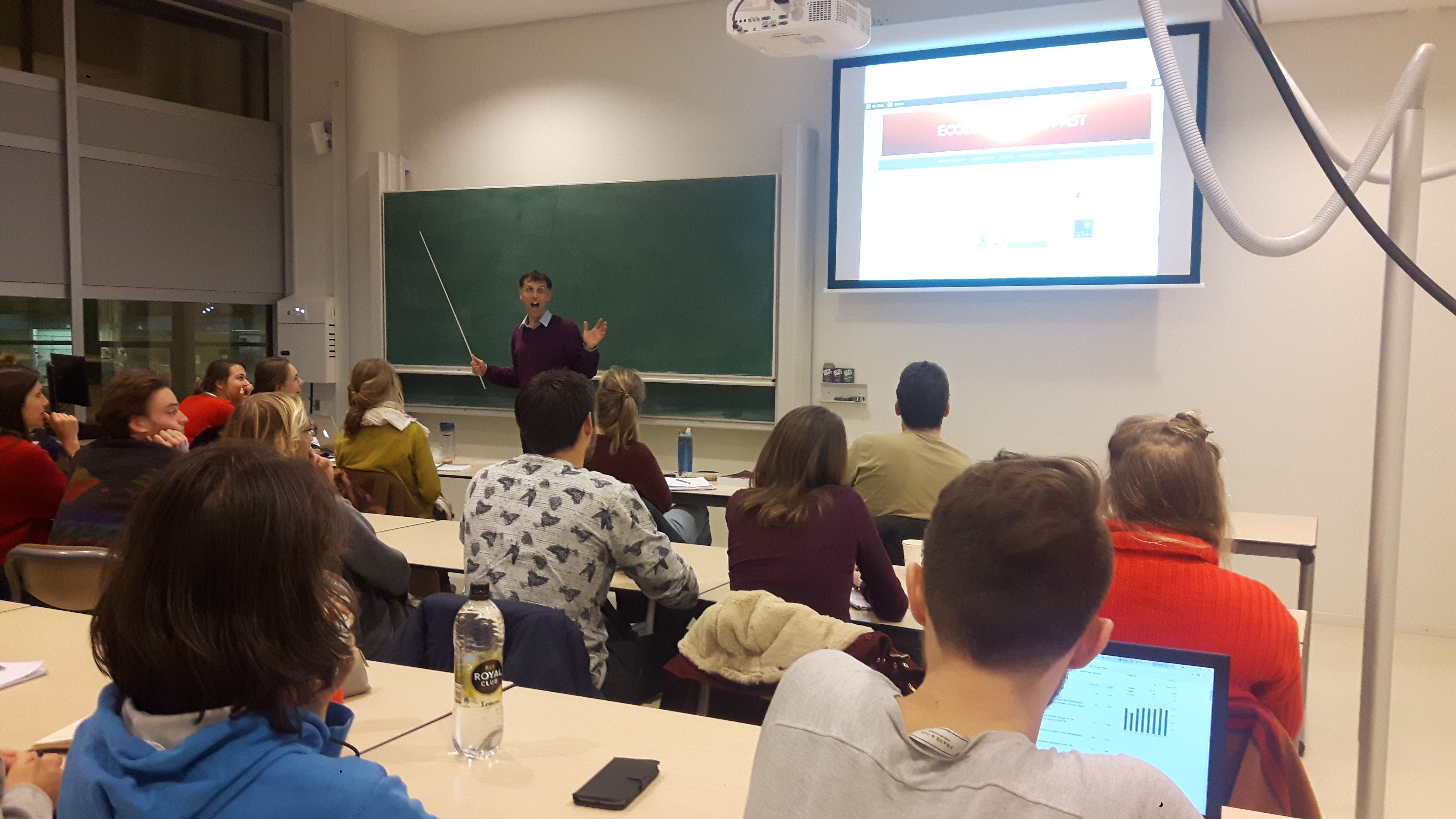
The week was completed with each student giving a three (3) minute presentation of their favourite paper. The papers presented ranged from the extinction of giant sharks, through forest-savannah transitions, to how climate change thwarted Ghengis Kahn. Next week we continue by disecting how chronologies are constructed.
The Llanos de Moxos in Bolivia is an area the size of England that has one of the highest densities of archaeological sites in the Amazon basin. I travelled there for the first time earlier this month for the fourth International Meeting of Amazonian Archaeology. As the airplane crossed from the Andes into the Amazon plains, I could tell this was a very different ‘Amazonia’ compared with the forests that I know from Peru, Ecuador, and western Brazil. The Llanos de Moxos is a seasonally flooded savanna and it was so…open! I immediately realized that the perception of ‘Amazonia’ varies widely among individuals, and I think that is one of the reasons why those of us who study the human history of Amazonia tend to disagree so frequently.
McMichael, C.H., Feeley, K.J., Dick, C.W., Piperno, D.R. & Bush, M.B. (2017) Comment on “Persistent effects of pre-Columbian plant domestication on Amazonian forest composition”. Science 358. DOI: 10.1126/science.aan8347
Junqueira, A.B., Levis, C., Bongers, F., Peña-Claros, M., Clement, C.R., Costa, F. & ter Steege, H. (2017) Response to Comment on “Persistent effects of pre-Columbian plant domestication on Amazonian forest composition”. Science 358. DOI: 10.1126/science.aan8837
Gosling, W.D., de Kruif, J.*, Norder, S.J., de Boer, E.J., Hooghiemstra, H., Rijsdijk, K.F. & McMichael, C.N.H. (2017) Mauritius on fire: Tracking historical human impacts on biodiversity loss. Biotropica. DOI: 10.1111/btp.12490
* This paper evolved from the BSc Future Planet Studies thesis of Jona de Kruif (2015) “Multi-proxy analysis of the effect of climate and human activity on the environment of Mauritius during the Holocene” at the University of Amsterdam. Jona was supervised by William Gosling and Erik de Boer.
BSc student Henk Cornelissen presents his thesis work on identifying charcoal characteristics that represent specific fire parameters, such as burn temperature. Photo: C. McMichael
Wimbledon tennis fortnight is on its way, but we’ve had our own palaeoecology fortnight here at the Institute for Biodiversity & Ecosystem Dynamics at the University of Amsterdam. We’ve seen seminars on reconstructing past landscapes and climates on timescales of decades to millions of years, and on spatial scales ranging from single sites to the entire Earth. Our presenters included our BSc students, MSc students, PhD candidates, faculty members, guest researchers, and even an internationally known palaeoclimatologist and contributor to the IPCC (Intergovernmental Panel on Climate Change) reports!
BSc student Isa Mulder presents her thesis on reconstructing glacial-aged fire histories from the Andes. Photo: C. McMichael
We began with a three-day series of presentations from our BSc students in the Future Planet studies program. William Gosling and I had four students that presented their final theses. We continued with a seminar series organized by the Palynologische Kring (the Dutch palynology society). Eric Grimm, a guest researcher at UvA, presented a high resolution record of hydrological variability, vegetation, and fire from the Great Plains of the United States. Guest researcher Carina Hoorn showed us how the Amazon River formed, and the associated plant turnover that occurred during the Neogene. PhD student Keith Richards explained to us why the Arctic seal became land-locked in the Caspian Sea over 2.6 million years ago. PhD student Suzette Flantua presented a multi-proxy approach to exploring the biogeographic history of the Andes Mountains. She came back the following day to present her PhD thesis entitled, “Ecosystems in Pleistocene Latin America”. And we are happy to report that Suzette is now Dr. Flantua!!
Suzette Flantua highlights the work in her PhD thesis. Congratulations Suzette! Photo: C. McMichael
Dr. William Gosling and Prof. Jonathan Overpeck discuss the future of palaeoecology and upcoming collaborations. Photo: C. McMichael
Our presenters included males and females from multiple countries at an array of career stages. I am glad to have been a part of this fortnight, and I am glad that our current students got to see such a diverse integration of people and palaeoecology. My hope is at least one of these students has been inspired by these seminars, and will develop the same passion for palaeoecology as what we’ve seen here over the last two weeks.
Bush, M.B. & McMichael, C.N.H. (2016) Holocene variability of an Amazonian hyperdominant. Journal of Ecology online. DOI: 10.1111/1365-2745.12600

 20th Congress of the International Union for Quaternary Research (INQUA)
 TITLE: The changing tropical landscape




 Ecology of the past