Scales of change (ecological, geological, and human).
Humans as drivers of environmental change.
Extra-terrestrial forcing of environmental change.
Earth system feedbacks.
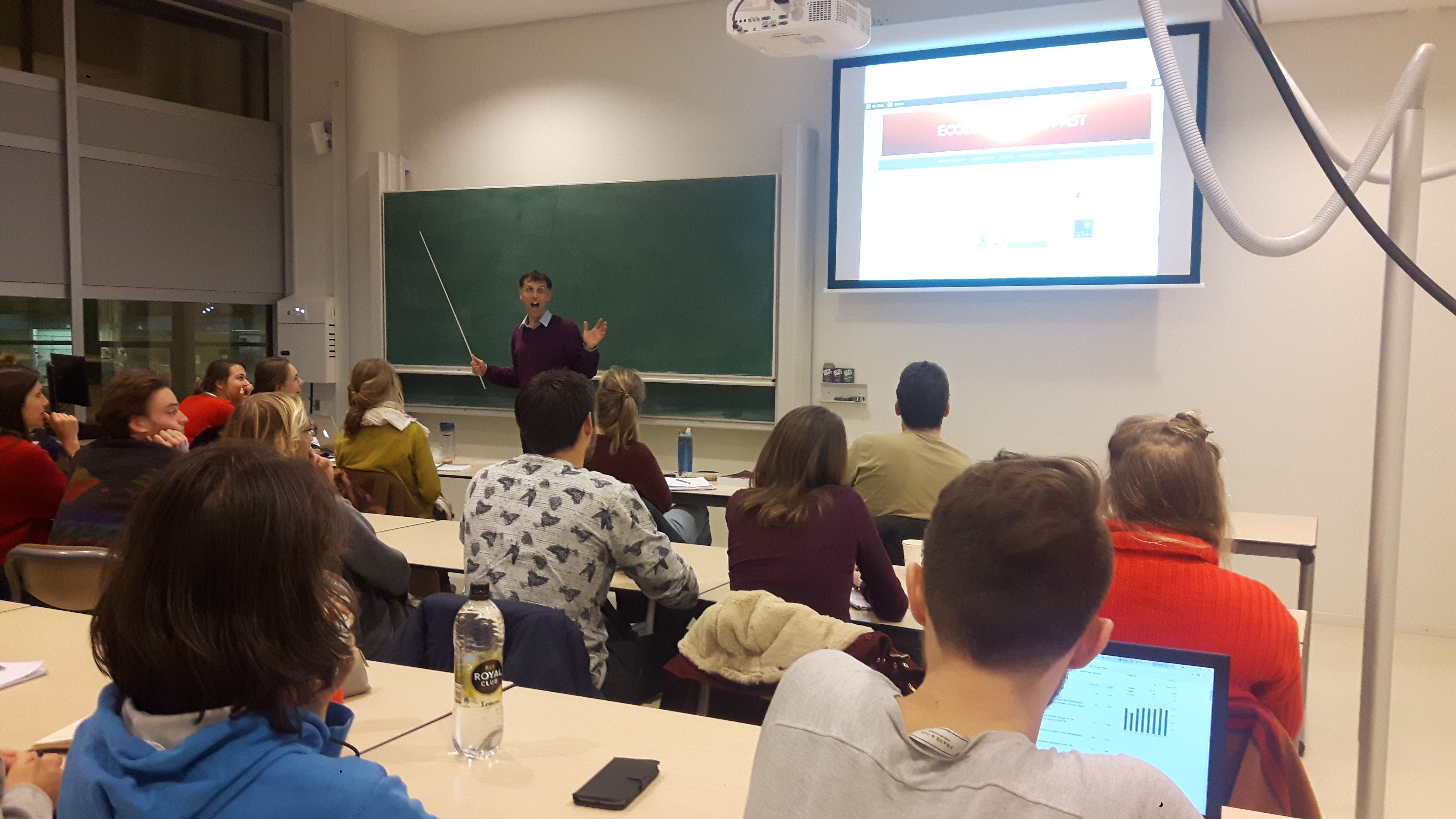
The week was completed with each student giving a three (3) minute presentation of their favourite paper. The papers presented ranged from the extinction of giant sharks, through forest-savannah transitions, to how climate change thwarted Ghengis Kahn. Next week we continue by disecting how chronologies are constructed.
The Llanos de Moxos in Bolivia is an area the size of England that has one of the highest densities of archaeological sites in the Amazon basin. I travelled there for the first time earlier this month for the fourth International Meeting of Amazonian Archaeology. As the airplane crossed from the Andes into the Amazon plains, I could tell this was a very different ‘Amazonia’ compared with the forests that I know from Peru, Ecuador, and western Brazil. The Llanos de Moxos is a seasonally flooded savanna and it was so…open! I immediately realized that the perception of ‘Amazonia’ varies widely among individuals, and I think that is one of the reasons why those of us who study the human history of Amazonia tend to disagree so frequently.
When I first heard about this class in Peru, I had no idea that I was going to experience so much in such a short period. Our goal was to visit two lakes in Peru and raise sediment cores for paleoecology. The first lake that we went to was Laguna Huayabamba, which sits at about 3250 m elevation in the La Libertad region of the Peruvian Andes.
However, getting to this lake was no easy task. Before the hike even started, we had to obtain the necessary permits and permission from the local people. After several days of visiting different town officials and waiting for approval, we could set out on our adventure.
IBEDs Crystal McMichael hard at work sampling sediments in the Andes
Insights into recent field work in Ecuador by a team lead by Crystal McMichael can be found in a recent blog from our collaborators at the Instituto Geofisico, Escuela Politecnica Nacional, Quito (Ecuador).
Each project was set up to test a particular ecological or biogeographic hypothesis. Investigations included the exploration of the role of humans in modifying ecosystems in Amazon, the nature of the pre-farming landscape in the the Netherlands, and how to chemically identify fossil charcoal. In undertaking their projects individual students had the opportunity to variously develop skills in microscopy, spatial modelling, or analytical chemistry. The high quality of the data produced means that hopefully many of these data sets can be used in future scientific publications. Well done to all!
If you are interested in conducting a similar project (at any academic level) with us please do not hesitate to get in contact. For further details of ongoing research within the Department of Ecosystems & Landscape Dynamics visit our web pages by clicking here.
BSc student Henk Cornelissen presents his thesis work on identifying charcoal characteristics that represent specific fire parameters, such as burn temperature. Photo: C. McMichael
Wimbledon tennis fortnight is on its way, but we’ve had our own palaeoecology fortnight here at the Institute for Biodiversity & Ecosystem Dynamics at the University of Amsterdam. We’ve seen seminars on reconstructing past landscapes and climates on timescales of decades to millions of years, and on spatial scales ranging from single sites to the entire Earth. Our presenters included our BSc students, MSc students, PhD candidates, faculty members, guest researchers, and even an internationally known palaeoclimatologist and contributor to the IPCC (Intergovernmental Panel on Climate Change) reports!
BSc student Isa Mulder presents her thesis on reconstructing glacial-aged fire histories from the Andes. Photo: C. McMichael
We began with a three-day series of presentations from our BSc students in the Future Planet studies program. William Gosling and I had four students that presented their final theses. We continued with a seminar series organized by the Palynologische Kring (the Dutch palynology society). Eric Grimm, a guest researcher at UvA, presented a high resolution record of hydrological variability, vegetation, and fire from the Great Plains of the United States. Guest researcher Carina Hoorn showed us how the Amazon River formed, and the associated plant turnover that occurred during the Neogene. PhD student Keith Richards explained to us why the Arctic seal became land-locked in the Caspian Sea over 2.6 million years ago. PhD student Suzette Flantua presented a multi-proxy approach to exploring the biogeographic history of the Andes Mountains. She came back the following day to present her PhD thesis entitled, “Ecosystems in Pleistocene Latin America”. And we are happy to report that Suzette is now Dr. Flantua!!
Suzette Flantua highlights the work in her PhD thesis. Congratulations Suzette! Photo: C. McMichael
Dr. William Gosling and Prof. Jonathan Overpeck discuss the future of palaeoecology and upcoming collaborations. Photo: C. McMichael
Our presenters included males and females from multiple countries at an array of career stages. I am glad to have been a part of this fortnight, and I am glad that our current students got to see such a diverse integration of people and palaeoecology. My hope is at least one of these students has been inspired by these seminars, and will develop the same passion for palaeoecology as what we’ve seen here over the last two weeks.
The British Ecological Society (BES) annual meeting for 2016 has come to an end. It has seemed like a long week (and it is only Thursday) because it has been so action packed. For me it commenced on Sunday when I helped out with the introduction session for early career researchers (MSc, PhD and post-docs), and the marathon council meeting. I think the length, and intensity, of the council meeting highlighted the need for the structural review that our president, Sue Hartley, has just initiated. The main program commenced on Monday and has been mainly a mix of workshops, posters and talks, with a side order of special interest group meetings, carol singers, and a gala dinner.
I would like to highlight two of the scientific talks that stuck in my head in particular:
Steven Sylvester“Shifting perspectives on natural ecosystems in the high Andes”; showed how remote regions of the high Andes may still contain the vestigaes of ‘pristine’ ecosystems dating from before human arrival, and
Stefano Allesina“Higher-order interactions stabilize dynamics in a generalized rock-paper-scissors game”; showed (theoretically) how ecosystem complexity plays a role in ecosystem stability.
An excellent and exciting meeting was capped for me by my PhD student Nick Loughlin for being awarded the BES Public Engagement award! Well done Nick (@PalaeoNick).
REFERENCES
Sylvester, S.P., Sylvester, M.D.P.V. & Kessler, M. (2014) Inaccessible ledges as refuges for the natural vegetation of the high Andes. Journal of Vegetation Science 25, 1225-1234. DOI: 10.1111/jvs.12176
Preparing my lecture for the new Scientific Methods in Archaeology course for VU Amsterdam and University of Amsterdam students studying a minor in Geoarchaeology. The focus will be on detecting human activity in the past, to illustrate this I will include Easter Island/Rapa Nui as a case study. We will focus on how palaeoecological evidence can be used to gain insights into past human activity. Whilst putting this together I discovered these nice documentaries looking at humans and their environmental impacts on Easter Island/Rapa Nui which I wanted to share, they show how much effort people would have had to put into altering their landscape:
For further information see also:
Rull, V., Cañellas-Boltà, N., Saez, A., Margalef, O., Bao, R., Pla-Rabes, S., Valero-Garcés, B. & Giralt, S. (2013) Challenging Easter Island’s collapse: The need for interdisciplinary synergies. Frontiers in Ecology and Evolution 1, DOI: 10.3389/fevo.2013.00003
This is my first time attending the European Conference of Tropical Ecology and my second visit to Germany. The conference attracted c. 350 delegates; big enough to have plenty of interesting science, and yet small enough to find everyone you wanted to. The keynote speakers chosen to head the days provided some exciting insights into various new developments across the tropics, including: the importance of biogeography (Richard Corlett), metabolism and carbon cycles (Yadvinder Malhi), diversity and resilience (Lourens Poorter), tropical peatlands (Sue Page), agricultural landscapes (Ravi Prabhu), and mutualism of figs and fig wasps (Martine Hossaert-McKay).
From the many other interesting talks five in particular grabbed my attention, these were:



 Ecology of the past