Zoe and William just after the graduation ceremony (UvA)
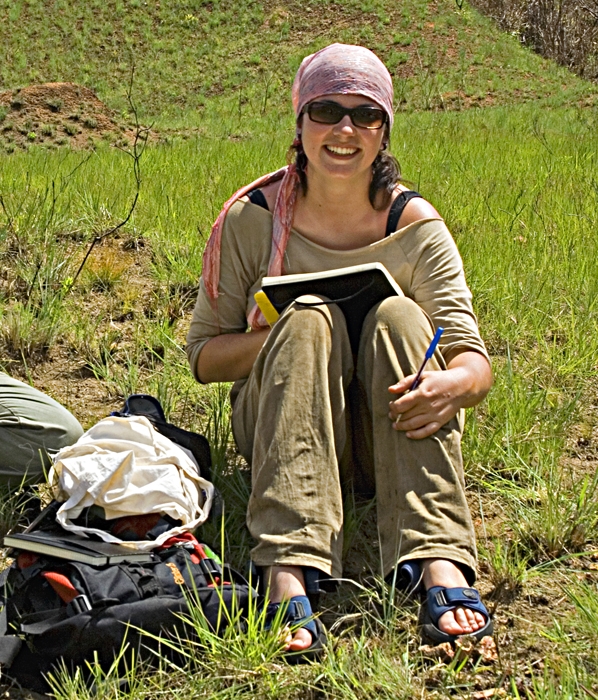
Two students (Zoe van Kemenade and Tessa Driessen) have recently completed projects looking at past environmental change on Samoa working in the Research Group of Palaeoecology & Landscape Ecology at the University of Amsterdam (UvA). Zoe’s project, part of her BSc Future Planet Studies (major Earth Sciences) at UvA, was entitled “A multi‐proxy analysis on the effect of climate and human activity on the environment of Samoa during the Holocene” and investigated charcoal, macro-fossils, and algae. Tessa’s project, “Biodiversity, fire and human dynamics on Samoa over the last 9200 years”, was completed as an internship during her MSc in Environmental Biology at Utrecht University (UU) that was co-supervised by Rike Wagner-Cremer. Tessa focused on the fossil pollen record to reconstruct past vegetation change. Both projects were conducted in cooperation with Jon Hassel and David Sear (both University of Southampton) who provided access to the Samoan sediments; for more on the Southampton Pacific Islands projects check out their blog Palaeoenvironmental Laboratory at the University of Southampton.
The results from both projects, and work by the University of Southampton team, will be presented at this years GTO conference (European conference of tropical ecology) in Gottingen next week.
William giving his personal view on the work of Tessa at her gradation ceremony (UU)
Posted on behalf of Thomas Giesecke:
EUROPEAN POLLEN DATABASE
Meeting and training workshops
1-3/06/2016
Aix-en-Provence, France
We offer exciting keynote lectures, an extensive poster session to showcase your research, and two days of training with experts in software, databases, and modelling.
We want your opinion on how to develop the European Pollen Database (EPD) to make it a better resource for research, education, and data storage.
NO registration fee
Workshop topics include:
Plotting and archiving palaeoecological data, using Tilia and Neotoma
Charcoal analysis software and database
How to use modern surface samples for ‘analogue’ reconstructions of the past
Hi I’m Tessa and really excited to introduce myself here!
I’m an Environmental Biology Master student from Utrecht University (UU) doing a research internship in Amsterdam with William Gosling and Rike Wagner of the UU. Most people would describe me as a typical biologist because I like identifying plants and know some birds by their name. Personally I disagree because I lack the beard and hardly wear woollen socks. Besides looking at birds and plants I’m also interested in biodiversity and palaeoecology, and I will try to combine these interests in my research project on a sediment core from Samoa. I will be working on lake sediment cores from Samoa and hope fossil record can give me an overview of the natural history of the island (past c. 10,000 years); and an insight into what impact human colonisation had on the biodiversity. To explore the islands natural history I will be looking at pollen, charcoal and non pollen palynomorphs.
The sediment core on which I will be working has already been recovered and currently resides in beautiful Southampton (UK). So I’m spared of a 30 hour trip to tropical Samoa and the opportunity to return with some Samoan tattoo’s and a tan… So thanks to David Sear and his team at the University of Southampton with whom I will be collaborating for this project.
I have a long standing interest in tropical islands. Before commencing this research internship I did my first masters internship at WWF Indonesia. For my WWF internship I spent three months in the tropics collecting baseline ecological data on timber companies located in a new reserve in Sumatra. Furthermore, during my bachelor degree, I did a research internship at Naturalis Biodiversity Center investigating the “Correlation between higher altitudes and endemic plant species” in the Malayan archipelago. Our results turned out much better then we hoped for and fingers crossed our article will be accepted soon!
In three weeks I will be starting in the lab in Amsterdam and hopefully in a few months will be able to post an update about my results here.
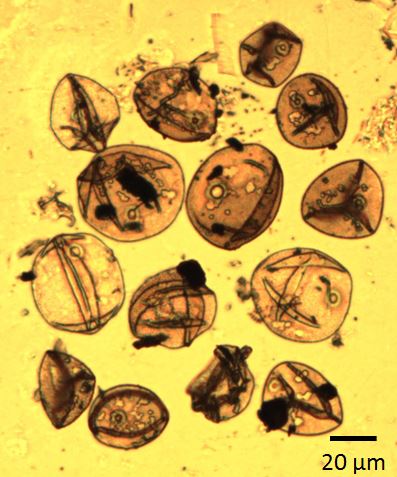
Grass pollen from Lake Bosumwti picked for individual chemical analysis
Abstract submission is now open for the XIX International Union for Quaternary Research (INQUA) Congress. “Ecology of the past” researchers will be there and are hosting a special session, entitled Organisms and environments: Frontiers in palaeoecological technique development, at which we hope to bring together a wide range of palaeoecologists working on novel proxy development. Members of the “Ecology of the past” group will be showcasing recent findings on the environmental significance of pollen chemistry change through time; linked to the 500,000 years of solar irradiance, climate and vegetation change in tropical West Africa project (Fraser et al., 2014). Please take a look at our session and consider submitting YOUR abstract today!
For information on abstract submission click here. Closing date for abstract submission 20 December 2014.
For further information on our session click here, or “Continue reading” below…
I am delighted to be organizing a focus session at the first AfQUA meeting. The session seeks to bring together ecologists and palaeoecologists working in Africa. If you are interested in getting involved please contact me (William Gosling) directly. For further information on the conference visit the AfQUA website or twitter feed.
Focus session 1: African ecology in context
The African continent spans over 80 degrees of latitude, nearly 6000 m of altitude and around 30 million km2 consequently it contains a vast array of unique ecosystems. Many of the African ecosystems are under direct pressure from human activity and are threatened by on-going and projected climate change. However, management and conservation of the modern African ecosystems is hampered by a paucity of data on their natural history. Studies of observations of ecosystems spanning >30 years are rare so we are heavily reliant on examination of the fossil record to place modern ecology in a long-term (>50 year) context. Information on past ecosystems can be extracted through the examination of a range of biological indicators (e.g. pollen, carbon isotopes, charcoal) found within marine and lake sediments. However, interpretation of the sediments and the proxies they contain with the ecosystems observed today is challenging because of timescale and interpretation issues. The aim of this session is to bring together modern ecologists and paleo-ecologists working in Africa to present the state-of-the-art understanding of ecosystems past and present, and explore how we can improve understanding of timescales and proxy interpretation to place these threatened ecosystems in context.
Williams, J.J. (2011) Human and climate impacts on tropical Andean ecosystems. PhD Thesis, Department of Earth & Environmental Sciences, The Open University.
JJW Bolivia (2007)
Abstract:
Population growth and predicted global climate change are applying new, and increasing, pressure to mountain environments, but the consequences of these changes upon the biodiverse and vulnerable Tropical Andean ecosystems are poorly understood. This thesis explores past human-climate-ecosystem interactions using multi-proxy palaeolimnological investigations (fossil pollen, spore, charcoal and Chironomidae (midges); elemental abundance, colour spectra and magnetic susceptibility) of two sites in the eastern Bolivian Andes (Lake Challacaba and Laguna Khomer Kocha Upper) over the last c. 18,000 years. During the deglaciation and Holocene ecosystems were exposed to varying climatic stress levels, and pressures imposed by the development of human cultures.
Examination of preserved ecological assemblages, including the first assessment of subfossil central Andean Chironomidae, reveals ecosystem sensitivity to changes in temperature, moisture, fire regime, lake level and salinity. Charcoal analysis from Laguna Khomer Kotcha Upper reveals changes in burning at c. 14,500, 10,100 and 6,400 cal yr BP. Concomitant palynological shifts shows this climatically controlled fire regime was a transformative agent of Andean vegetation, particularly for the threatened, high elevation, Polylepis woodlands. Pollen and geochemical data from Lake Challacaba indicate two periods of aridity (c. 4000−3370 and 2190−1020 cal yr BP), these broadly correlated to El Niño/Southern Oscillation variations. Increased Sporormiella abundance after c. 1,340 cal yr BP indicate changes in trade routes and agricultural practices; demonstrating human adaption to environmental change and interconnectivity to Tiwanaku and Inca civilizations.
The long-term response of the terrestrial and aquatic ecosystems, reconstructed from these lakes, has provided insights into how Tropical Andean ecosystems may respond to future changes in temperature, precipitation and human interference. The palaeoenvironmental data has implications for conservation management; it indicates that spatial and temporal variations in site sensitivity, exposure and resilience should be assessed, and that planting strategies should mimic the present day natural patchy distribution of Polylepis woodlands.
Montoya, E. (2011) Paleocology of the southern Gran Sabana (SE Venezuela) since the Late Glacial to the present. PhD Thesis, Department of Animal Biology, Plant Biology and Ecology, Unitersitat Autonoma de Barcelona.
EM Venezuela (2007)
Abstract:
This thesis is aimed to study the paleoecology of the southern Gran Sabana region (GS; SE Venezuela) since the Late Glacial to the present. This region is characterized nowadays by the occurrence of large extent of savannas in a climate suitable for rainforests. For this purpose, three sequences (two from peat bogs and one from lake sediments) have been analyzed for pollen and spores, non-pollen palynomorphs (NPP), and microscopic charcoal particles. Among the sequences analyzed, two of them are located currently within treeless savannas (Lakes Chonita and Encantada); whereas the third one is placed in the boundary between GS savannas and Amazon forests (El Paují). The Late Glacial interval of Lake Chonita was characterized by a shrubland that was replaced by a treeless savanna at the end of Younger Dryas (YD) and the onset of the Holocene, linked to the occurrence of regional fires since ca. 12.4 cal kyr BP. The beginning of local fires was dated synchronous with the vegetation replacement, ca. 11.7 cal kyr BP. A similar shrubland, though not identical, is located nowadays around 200 m elevation above the lake, so the replacement by surrounding savannas was interpreted as a probably upward displacement of the former vegetation and an increase in average temperatures of approximately 0.7 ‐1.5ºC. This section represents the oldest interval analyzed for GS so far, and the presence of fires during the Late Pleistocene is among the oldest fire records documented for northern South America. The peat bog records of Lake Encantada and El Paují showed the main vegetation trends of the last 8 cal kyr BP, which were characterized by the continuous occurrence of regional fires. In Lake Encantada, the presence of treeless savannas was reported during the whole interval analyzed as the dominant vegetation type, despite variations in forest abundance and composition taxa of the community also occurred. The vegetation changes in this record were interpreted as mainly due to climatic shifts until the Late Holocene. At El Paují, the occurrence of forests and savanna/forest mosaics was reported during the same interval, and fire was postulated to have been the major driver of the vegetation shifts. In this sequence, a treeless savanna was not recorded as the dominant vegetation of the landscape until the last millennia, and the presence of two different indigenous cultures was postulated as responsible of the shifts in fire regime registered, with an interval of human land abandonment between them. This interval was characterized by the cessation of fires, and the establishment of a secondary dry forest. The Late Holocene was characterized, in the three sequences studied, by a sudden increase of fires, which likely favored the expansion of savannas and the establishment of the present GS landscape.
The join interpretation of the records presented in this thesis, together with previous analyses in the region, highlighted some key aspects for understanding the main trends of GS landscape and vegetation, e.g., the appearance and establishment of morichales (Mauritia palm stands typical of current southern GS landscapes) has been restricted to the last two millennia, synchronous with the increase in fire incidence. Moreover, it has been possible to gather empirical evidence for testing some previous hypothesis regarding GS. For example, the proposal of an extended aridity prior the Holocene has been rejected, whereas the hypothesis about the postglacial expansion of morichales has been supported. In this sense, with all the available information to date, some suggestions have been proposed: (i) Climate and fire have been the major forcing factors operating in the GS; (ii) During the Late Glacial and the beginning of the Early Holocene, the landscape of southern GS was likely formed by a mosaic of forests, shrubs, and savannas, without the current supremacy of the last vegetation type, which only established during the last 2 cal kyr BP onwards; (iii) Some general climatic trends have been inferred for the study area, as for example an increase in average temperatures around the Late Glacial/Early Holocene transition, a dry interval from 8 to 5 cal kyr BP, and a wetter phase during the Mid-Holocene centered around 4 cal kyr BP; (iv) The establishment of Mauritia in the region has been likely driven by a synergism between biogeographical, climatic and anthropogenic factors, as well as the likely pyrophilous nature of this palm given its synchronous appearance with the increase of fires; (v) The settlement of the modern indigenous culture (Pemón) occurred at least since around ca. 2000 cal yr BP onwards, 1500 yr earlier than previously thought, but previous human presence in the region has been also documented; and (vi) The fire activity observed in the long-term has caused a huge impact on GS landscape.






 Ecology of the past