9:00-9:30 Marian Cabrera (UvA): Paramo response to human influence: A trait-based approach.
9:30-10:00 Caterina Cúcio (UvA): The seagrass rhizobiome and its role in the sulfur cycle.
10:00-10:30 Vitor Gomes (Naturalis): Endangered tree species future in Amazon.
Coffee Break
11:00-11:30 Catarina Jacovac (WUR): Effects of land use on forest succession in the Amazon.
11:30-12:00 Andre van Proosdij (WUR/Naturalis): Assessing botanical diversity patterns in Gabon using Species Distribution Models: methods & applications.
12.00-12.30 André Junqueira (WUR): Legacies of anthropogenic soils on forests and cultivation systems in Amazonia.
The month-long palaeoecology module at UvA is coming to an end. We have had two weeks of lectures and microscope work, an introduction to quantitative palaeoecology, and we just finished a week of fieldwork in Twente, which is in the easternmost part of the Netherlands.
Students working in the field (photo: M. Groot)
Will Gosling and I tried something new for the field excursion this year. We split the class into eight groups, and gave each group a set of pollen and phytolith samples from an ‘unknown location’. Unknown in this context means being from one of the eight primary sites that we would visit during the field excursion. The students were required to perform vegetation surveys and characterize soils at each of the primary sites that we visited. The goal of each group was to figure out which location their set of ‘unknown’ samples came from. Basically, we had them doing forensic palynology, with idea that they could then better visualize the different vegetation assemblages seen in the palaeoecological records. Continue Reading
Characterization of Neotropical ecosystems by their modern pollen spectra and organic chemical composition
Develop skills in pollen identification, pollen chemical characterization, and the analysis of organic biomarkers.
Examine ecological variation across an altitudinal gradient of nearly 4000 meters on the tropical western Andean flank.
Improve understanding of how ecosystems function in a biodiversity hotspot, and how they might be identified in the fossil record.
The considerable biodiversity of Neotropical ecosystems is under pressure from projected climate change and human activity. Modern ecosystems can be characterized by their pollen rain and organic chemistry, which can in turn provide information about ecosystem health and functioning. However, little is known about how pollen assemblage and chemical composition (of pollen and plants) vary along environmental gradients. Altitudinal transects provide an opportunity to study a range of environments and ecosystems with a relatively small geographic area. By improving our understanding of modern ecosystems we can improve our interpretation of fossil records, and consequently better understand how modern ecosystems came into being.
The main objectives of this PhD project are to:
Generate the first modern pollen assemblage and chemical data set for the Neotropics,
Characterize the landscape-scale variation in pollen assemblage and chemistry composition, and
Identify the key environmental drivers that determines pollen assemblage and chemistry composition variation.
Publication date: 27 July 2015 Closing date: 18 September 2015
Level of education: University (Masters)
Hours: 38 hours per week
Salary indication: €2,125 to €2,717 gross per month
Vacancy number: 15-286
Applications should be emailed to application-science@uva.nl, with in the subject line the position you are applying for and vacancy number (15-286). Please make sure all your material is attached in only one pdf. Applications should include a detailed CV including educational experiences, a list of research projects and/or publications, a letter of motivation, relevant work experience, and the names and contact addresses of two academic referees from whom a reference for the candidate can be obtained.
For more details, including information on how to apply, click here (UvA), or here (via academic transfer).
Valencia Castillo, B.G. (2014) From glacial to modern conditions: Vegetation and climate change under human influence in the Central Andes. PhD Thesis, Department of Environment, Earth & Ecosystems, The Open University.
Abstract
Conservation, restoration and management strategies are employed to maintain Earth’s biological diversity and physical environment to a near “natural” state. However, the concept of “natural” is generally inexact and may include degraded landscapes. In absence of long-term empirical data of natural baselines, impacted assemblages (human altered baselines) could be falsely assumed to be natural and set as conservation or restoration goals. Therefore, the identification of long-term ecological baselines becomes a pressing requirement especially in threatened biodiversity hotspots such as the tropical Andes that were under human pressure for several millennial.
This thesis aims to identify ecological baselines for tropical Andean ecosystems based on multi-proxy palaeoecological reconstructions from three Andean lakes. Trends of vegetation change are used to identify when landscapes became anthropogenic in the Andes. Because vegetation assemblages at c. 10 ka experienced negligible anthropogenic impacts and had modern-like climate condition, this time was considered the most recent period likely to provide insight into natural ecological baseline conditions.
Changes in vegetation assemblages were evaluated over time departing from 10 ka around Miski and Huamanmarca, two sites that remained virtually impervious to human impacts. Baselines in Miski and Huamanmarca drifted continuously over time and showed that baselines are dynamic entities. The vegetation assemblages derived from Miski and Huamanmarca suggest that that human impact was not homogeneous throughout the Andean landscape.
Once baselines were defined it was possible to evaluate if the spatial distribution of Andean woodlands represented by Polylepis was a product of human impacts. A MaxEnt model generated based on 22 modern environmental variables and 13 palaeoecological vegetation reconstructions showed that Polylepis woodlands were naturally fragmented before humans arrived in South America (14 ka). However, the influence of humans during the mid and late Holocene enhanced the patchiness of the forest generating a hyper-fragmented landscape.
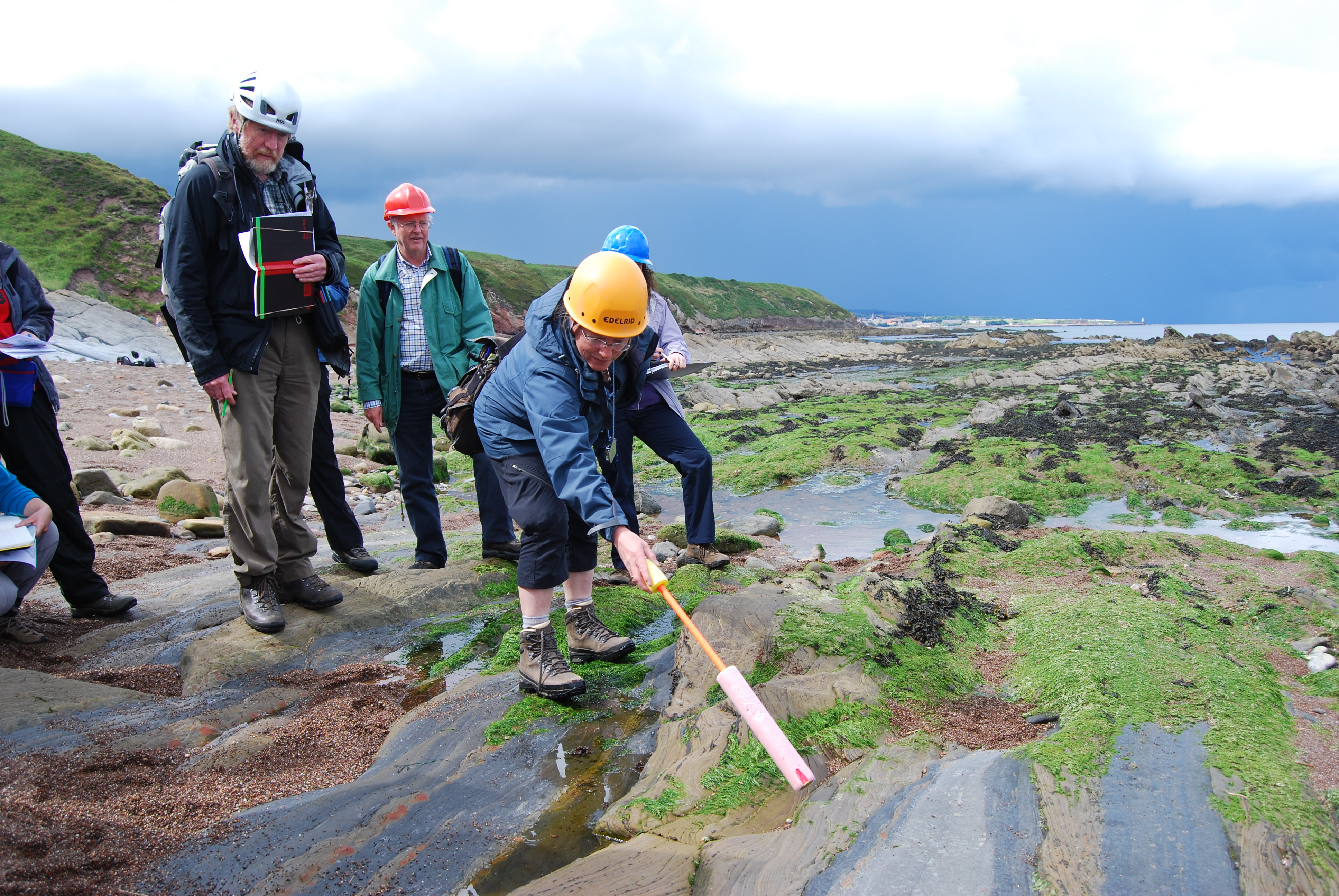
My final teaching job for The Open University was to help deliver the “Sedimentary Rocks & Fossils in the Field” section of the Level 2 Practical Science module (SXG288) offered by the Science Faculty. I have been involved in all three presentations of this section of the SXG288 module, which will now cease to be offered, and a number of other Earth and environmental science residential schools over the last 9 years.
Having the opportunity to engage directly with students and enthuse them face-to-face about the subject I specialise in is a privilege I have gained a lot from. Furthermore, my over-riding impression from the students I have taught is that they feel they benefit greatly from the opportunity to explore first hand the concepts and subjects which they have previously studied in books and online. Based on my experiences on “Sedimentary Rocks and Fossils”, and other modules as both a tutor and a student, I am convinced that to effectively teach geological, geographical, environmental and ecological subjects effectively an element of field-based teaching is required.
Hayley Keen’s video “Past environmental change in the Amazon basin” has been shortlisted for the American Geophysical Union (AGU) student video prize. Please watch and like Hayley’s video; top “Liked” videos will win entry to the AGU 2014 Fall meeting.