By Bouwe Groeneveld (MSc Biological Sciences, track Ecology & Evolution, University of Amsterdam)
From 2 to 6 March, I joined the Mapping Ancient Africa Research and Writing Workshop at Fountainhill Estate near Pietermaritzburg, South Africa. The week brought together focused writing, interdisciplinary exchange, and time in the landscape.
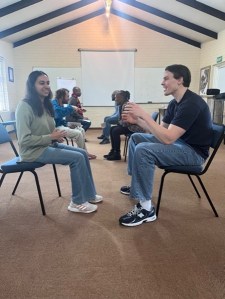
We began with a speed dating session that set an open and collaborative tone. Participants introduced their research backgrounds, ranging from botany and ecology to geography. The group was highly international, with participants from Ghana, Ethiopia, Nigeria, Kenya, South Africa, and the Netherlands. This diversity quickly proved valuable, as different perspectives naturally complemented one another throughout discussions.
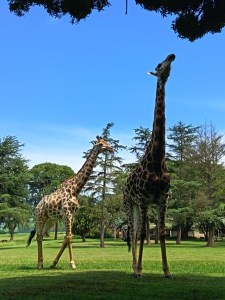
The second day centred on the challenges of academic writing and publishing. Through group conversations and smaller sessions, we reflected on common difficulties such as structuring arguments and navigating the publication process. Later that afternoon, we walked across the estate to the Holley Shelter archaeological site. During the walk, I noticed how the surrounding landscape offered a sense of calm that contrasted with the intensity of writing. Along the way, we encountered a giraffe standing only a few metres from us, quietly feeding on acacia leaves.
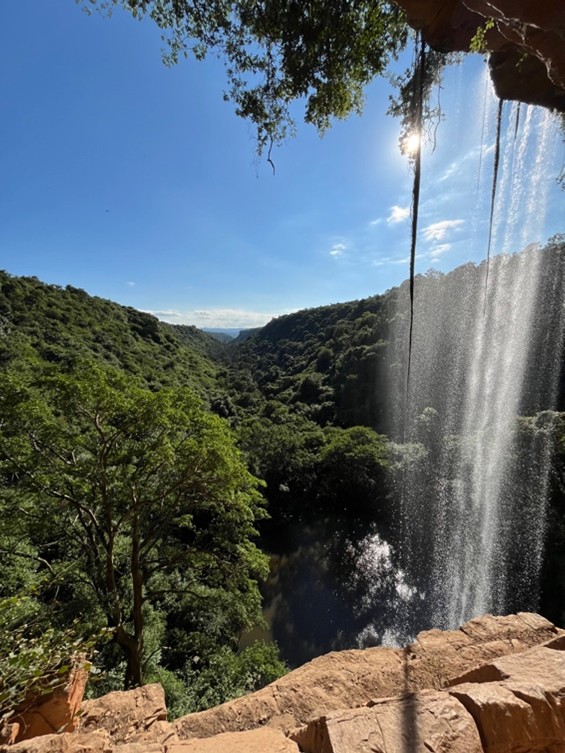
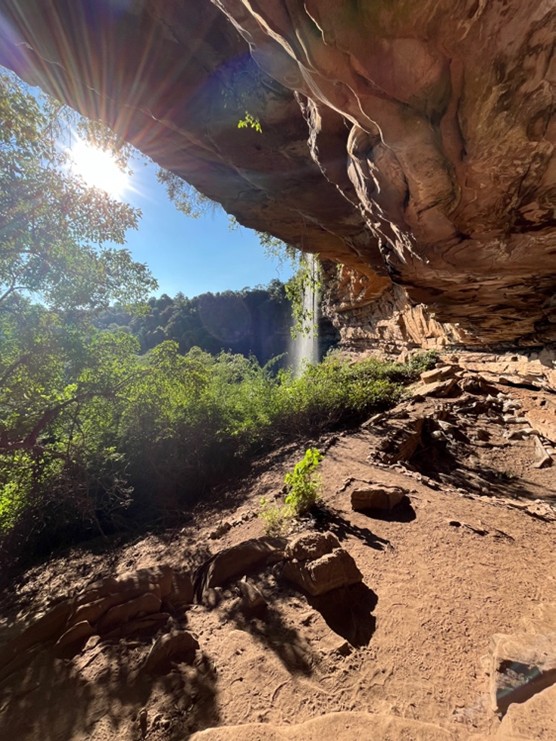
The shelter itself was striking. A clear waterfall flowed down the rock face, catching the sunlight as it filtered into the green valley below. The interplay of water, rock, and light created a remarkably beautiful and tranquil setting, making the site feel both impressive and deeply serene.
Mapping Ancient Africa Quaternary International special issue article #5
Kiely, R.E., Paine, A.R., McMichael, C.H. & Gosling, W.D. (2025) Heat, hydroclimate and herbivory: A late-Pleistocene record of environmental change from tropical western Africa. Quaternary International 717, 109636. DOI: 10.1016/j.quaint.2024.109636
To find the complete list of articles in the Mapping Ancient Africa special issue of Quaternary International click here.
Vinnepand, M., Zeeden, C., Wonik, T., Gosling, W.D., Noren, A., Kück, J., Pierdominici, S., Voigt, S., Abadi, M.S., Ulfers, A., Danour, S., Afrifa, K. & Kaboth-Bahr, S. (2024) An age-depth model for Lake Bosumtwi (Ghana) to reconstruct one million years of West African climate and environmental change. Quaternary Science Reviews325, 108478. DOI: 10.1016/j.quascirev.2023.108478
Gosling, W.D., Miller, C.S., Shanahan, T.M., Holden, P.B., Overpeck, J.T. & van Langevelde, F. (2022) A stronger role for long-term moisture change than for CO2 in determining tropical woody vegetation change. Science 376, 653-656. https://doi.org/10.1126/science.abg4618
To access this article FREE through the Science author referral service click here.
For more on the palaeoecological dataset underpinning this research check out the PhD thesis of Charlotte Miller by clicking here or here.
The second in my series highlighting papers in the recent volume of Palaeoecology of Africa (published entirely open access online) focuses on the research articles. The research articles make up the ‘guts’ of the volume, comprising 10 of the 24 papers. Three of these are from western Africa (Dinies et al.; Gosling et al.; Lemonnier & Lézine), two from eastern Africa (Githumbi et al.; Kinyanjui et al.), two from central Africa (Richards; Gaillard et al.), and three from southern Africa (Chevalier et al.; Hill & Finch, Hill et al.). These research articles present new data and key insights into past environmental change in Africa, which fall into two broad categories, providing information on: (i) how we can extract information from pollen data sets, and (ii) the processes operating to drive vegetation.
We are looking for a researcher with a geosciences background to explore the physical properties of the sediments recovered from Lake Bosumtwi (Ghana). The Lake Bosumtwi sediments we recovered by the International Continental Scientific Drilling Program in 2004 and have been found to span the last c. 1.07 million years (Koerbel et al., 2005). This project will examine the borehole data and relate this ongoing palaeoenvironmental studies at the site (Miller & Gosling, 2014; Miller et al., 2016).



 Ecology of the past