All applications must be pre-approved by the host institution so if you are interested in applying for a project through The Open University expressions of interest are required by 25th January 2013.
Two NERC algorithm funded PhD studentships are currently available with the PCRG. The projects are focused on understanding past environmental change in west tropical Africa and Amazonian-Andean Ecuador. Both projects will involve field work and build on on-going research within the lab.
Closing date 31/01/2013
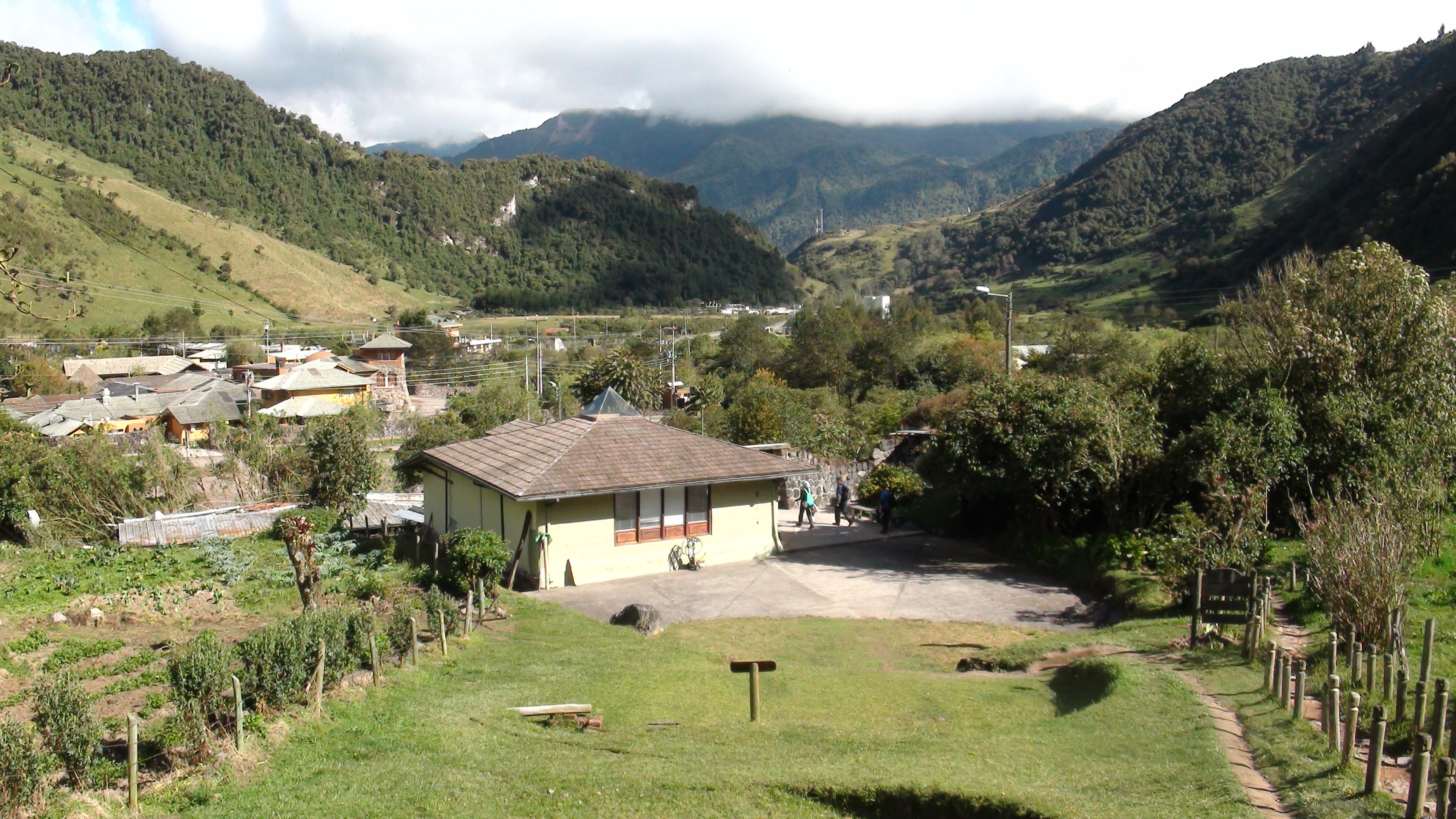
One project will work on samples collected during fieldwork in 2012 near Papallacta (Ecuador).
Further project details and how to apply below… Continue Reading
I am a NERC Research Fellow with a project entitled “Evaluation of forests sensitivity to past climatic changes” (FORSENS), which will be running until September 2015. The project is based on a multi-site, multi-proxy and multi-disciplinary approach to aid the understanding of Neotropical forests’ dynamics since the Last Glacial Maximum (LGM; c. 21,500 years ago).
I presented details in a poster at the recent INTIMATE/CELL-50k Join Workshop this 12-15th November at Budapest, Hungary. Click here to view my poster and find out more details about the project.
Prior my arrival to PCRG, I was working at The Botanical Institute of Barcelona (CSIC-ICUB, Palynology and Paleoecology Lab) and the Autonomous University of Barcelona (Tropical and High Mountain Paleoecology). I am a palaeoecologist mainly focused on Late Glacial environmental change in Neotropics, being interested in the climate-vegetation-human relationships. For this purpose, I mainly use pollen, microscopic charcoal and non-pollen palynomorphs. I am also involved in several editor tasks, as regular referee os several Q1 journals, and the editor of the “Humans and Biosphere Commission” Newsletter.
If you are interested in my project please do not hesitate to get in contact.
The PCRG contribution to the meeting was made by Hayley Keen who presented the first paper related to her doctoral research to an exteral audience entitled “Pollen counting for diverse tropical ecosystems”. The paper presented:
A statistical model (developed by co-author Felix Hanke) which simulaltes pollen counting in order to estimate the size of pollen count required to develop a robust ecological insight from the fossil pollen record, and
compared model predictions with empirical data from a diverse tropopical ecosystem (Mera, Ecuador) to assess the reliablity of the model.
It is hoped the application of the model to fossil pollen counting will allow more efficient and effective use of palynologists time. The paper was very well recieved despite the audible intake of breath when Hayley recommened that to characterize pollen richness (diversity) in some settings pollen counts in excess of 2000 grains might be required!
The back end of September and October has been very busy as I have tried to catch up with the teaching, administration and research activity which somewhat accumulated whilst on field work!
Major tasks have been:
1) the marking and coordination for level 3 Geological Record of Environmental Change (S369) module examination,
2) getting used to my new role as Post Graduate Tutor looking after all things related to a doctoral students in the Department of Environment, Earth & Ecosystems, and
3) trying to find time to finish off three manuscripts for submission!
Other members of the lab have also been busy: * Encarni has arrived from Valenti Rull‘s lab at the Botanical Institute in Barcelona as a NERC Fellow and is settling in to life in Milton Keynes, more details soon…
* Lottie is getting into data analysis and writing up of the Lake Bosumtwi pollen an N isotope data,
* Natalie is writing, crunching numbers and waiting for a machine to be fixed…
* Bryan is working on gelling biogeographic data together in GIS
Imagae of a Toarcian foraminifera taken by Alice Kennedy facilitated by the new cable which allows our microscope camera to talk to a computer – hooray!
* Hayley has been preparing for talking at the Linnean Society palynology meeting on 1st November “Understanding pollen and spore diversity”, and helping “steal” a microtome for sectoning her wood macrofossils,
* Frazer has started to plot Andean and Amazonian midge distributions against temperature, and
* Alice has been taking photos…
In the midst of all this fun I was sent this great video which brightened my day. I hope you enjoy it as well…
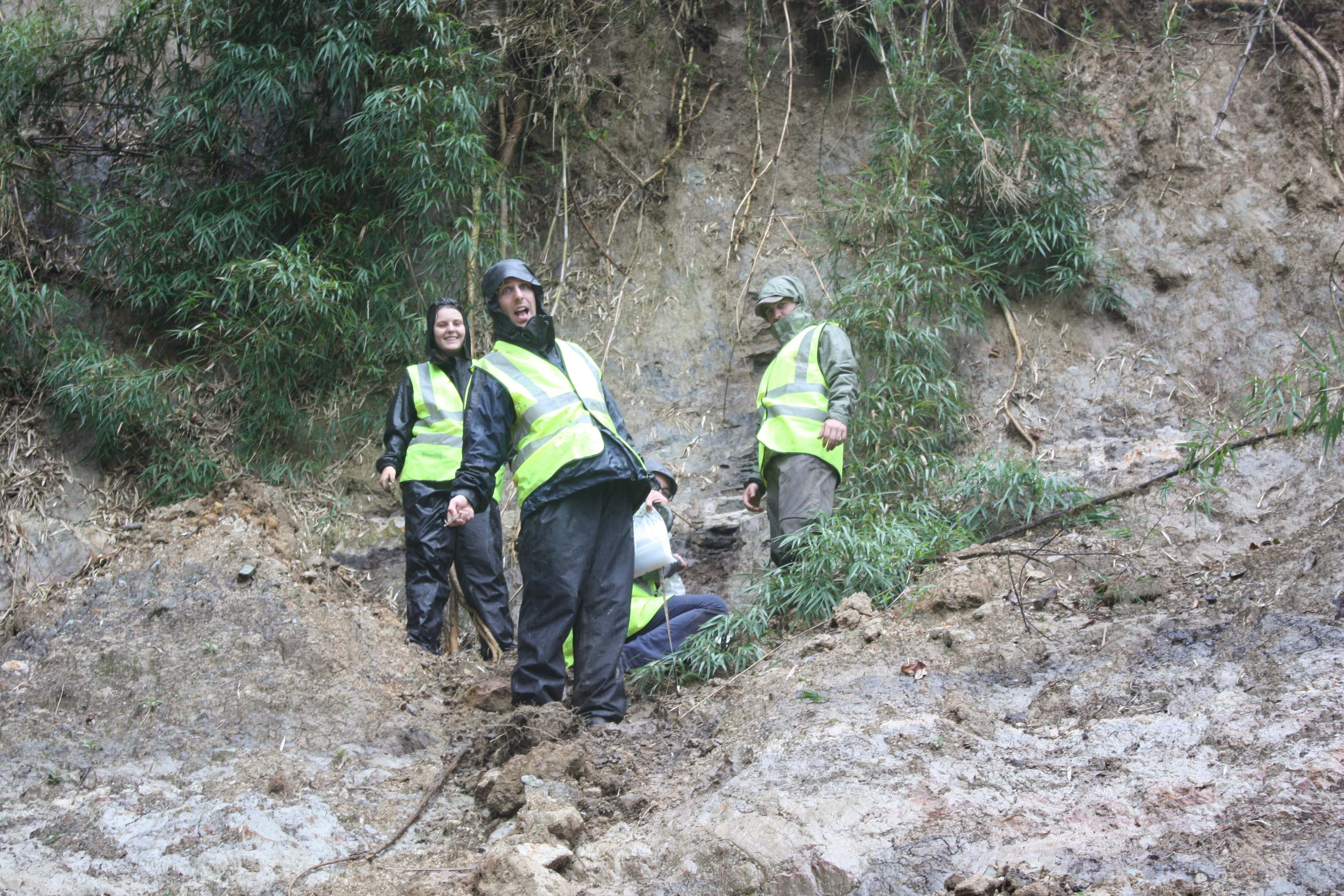
The first half of our field work expedition to Ecuador has now been completed. We had a very successful visit to Mera collecting samples from three new sections and recovered short cores from four lakes.
The sediment sections have yielded many wood macrofossils and samples for pollen analysis. It is anticipated that these will shed light on the nature of tropical vegetation during the last glacial period and before. Some of these samples will be analyzed by Hayley as part of her PhD research.
The sedimentary section found near Mera contained layers of crushed forest beneath volcanic ash. These “forest beds” provide a snapshot of vegetation in the landscape at the time of eruption. Part of plants growing on the landscape thousands of years ago are clearly preserved in the sediment.
A growing body of evidence suggests that plants alter their chemical composition in relation to the amount of incoming solar radiation (“insolation“) they are exposed to during life. Chemical changes are induced in order to provide protection against the deleterious effects of ultraviolet (UV) radiation; a relatively small, but important component of the total solar spectrum. UV radiation is linked with a range of detrimental biological effects, primarily stemming from damaged DNA. As sessile organisms, plants need to employ various mitigation mechanisms to prevent/reduce damage induced by UV radiation. Such mechanisms include effective DNA repair pathways, physiological adaptations, and UV-absorbing compounds. It is this last mechanism, UV-absorbing compounds (UACs), that is discussed here.
Lycopodium spore chemistry can be divided into two distinct groups; aliphatic components and phenolic components.
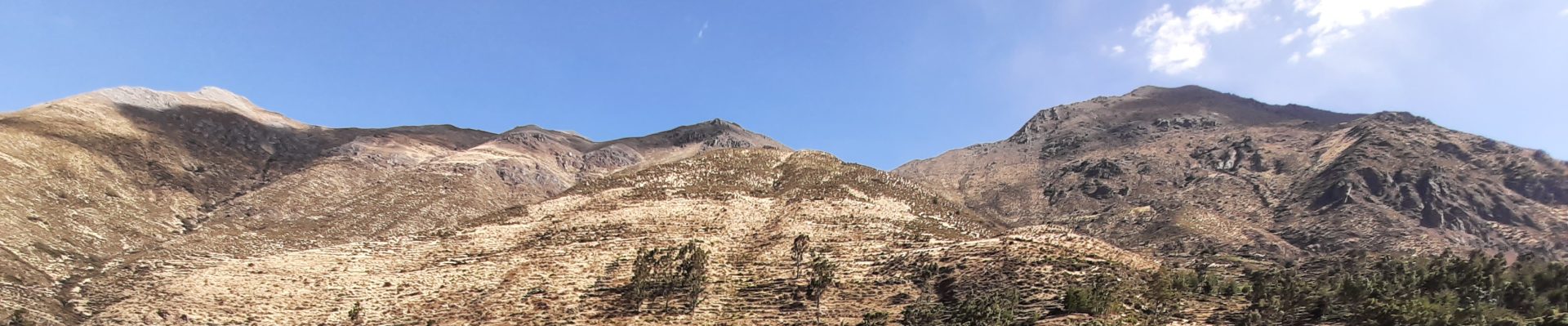
I am delighted to report that Dr Encarnacion Montoya Romo (currently of the Botanical Institute of Barcelona) has been awarded a NERC Fellowship to join the PCRG. The project is entitled “Evaluation of tropical forests sensitivity to past climate change” (FORSENS) and will examine environmental change at four study sites from different regions of the Neotropics: 1) Khomer Kotcha (Bolivia; 17oS, 4100 m above sea level [asl]) [1-3], 2) Consuelo (Peru, 13oS; 1400 m asl) [4-5], 3) Banos (Ecuador; 0oS, 4000 m asl), and 4) a new lowland site from Columbia/Ecuador to be collected during field work during the project.
HOW DO WE UNDERSTANT PAST VEGETATION CHANGE? Our understating of vegetation in the past, and how it has changed through time, comes mainly from the examination of macrofossils (e.g. wood and leaves) and microfossils (e.g. pollen and spores) found in the sedimentary record. The potential for microscopic fossils to provide an insight into past vegetation change on a landscape scale was pioneered by von Post (Von Post, 1916, reprinted 1967) and has been subsequently used to understand changes in regional floras (Godwin, 1956), and address conservation issues (Willis et al., 2007). Analysis of fossil pollen and spores (palynology) is now widely used on late Quaternary timescales to answer ecological questions linking vegetation and wider environmental/climatic change; these include:
Has there been a change in major vegetation type (biome)? For example a change between woodlands and grassland vegetation.
How have the ecosystem dynamics altered? For example the presence or absence of fire.
How has the diversity within the ecosystem changed? For example increase or decrease in sample richness.
Palynological analysis relies on obtaining a sub-sample of the pollen contained within the sediment at a specific depth (time) which allows the vegetation at that time to be reconstructed. This sub-sample is known as a pollen count. To build up a picture of vegetation change through time it is necessary to generate a sequence of pollen counts. The size of the sub-sample (pollen count) required from any particular depth (time period) is dependent on the nature of the vegetation association being investigated and the ecological question being addressed . For example, the amount of pollen analysed to determine if the vegetation was predominantly wooded or grassland is different to that required to provide information on the biological diversity within the vegetation assemblage.
Discussed below are some of the conventions related to choosing an appropriate pollen count size within palynology, with particular reference to the challenges of dealing with diverse tropical floras.


 Ecology of the past