Paine AR, Frieling J, Shanahan TM, Mather TA, McKay N, Robinson SA, Pyle DM, Fendley IM, Kiely R, Gosling WD. 2025. Evidence for millennial-scale interactions between Hg cycling and hydroclimate from Lake Bosumtwi, Ghana. Climate of the Past21(4): 817–839. DOI: 10.5194/cp-21-817-2025
Mapping Ancient Africa Quaternary International special issue article #6
Hlophe B. & Bamford M.K. (2025) Charcoal insights on the vegetation, climate and subsistence patterns at Wonderwerk Cave. Quaternary International728,109755. DOI: 10.1016/j.quaint.2025.109755
To find the complete list of articles in the Mapping Ancient Africa special issue of Quaternary International click here.
Palynologische Kring: Jaarvergadering en lezingenmiddag
Date: 20 June 2025 / 20 juni 2025
Location: Minnaertgebouw, Utrecht Science Park
13.15: arrival / inloop
13.30-14.30: Annual meeting / Jaarvergadering
14.30-14.55: Tobias Vervaart MSc (Universiteit Utrecht): Introducing PhD project ‘Looking back to plan ahead: unfolding the natural heritage of Dutch landscapes’.
14.55-15.15: coffee break
15.15-15.40: Yannick Bats MSc (Universiteit Utrecht): Impact of chemical treatments on the molecular and stable carbon isotopic composition of sporomorphs.
15.40-16.10: Prof Dr. Corrie Bakels (Faculteit der Archeologie, Universiteit Leiden): Results from stable isotope analysis applied to charred grain preserved in two storage rooms found in Tell Damiyah, Jordan.
16.10-16.35: Dr. Otto Brinkkemper (Rijksdienst voor het Cultureel Erfgoed): The optimal sample size of cereal grains for stable isotope research.
I was delighted to be invited to give a seminar as part of the Max Planck Institute for Geoanthropology “Human Palaeo-systems Research Group” series. In case you missed it the seminar is will soon be available to watch online (click here).
To see the full list of seminars in the series click here.
36th Annual Meeting of the Society for Tropical Ecology
24-28 February 2025, Amsterdam
The 8th European Conference of Tropical Ecology took place in Amsterdam (The Netherlands) from 24 to 28 February 2025. This meeting was organized for the Society for Tropical Ecology. The event was hosted by the Institute for Biodiversity & Ecosystem Dynamics (University of Amsterdam), held at Hotel Casa, and the main sponsor was the NWO (Dutch Science Foundation).
During the conference around 250 scientists delivered 150 oral and 69 poster presentations. The science spanned the full breadth of tropical ecology, ranging from interactions of coral dwelling crabs, through carbon cycling dynamics in forests, to the governance of hunting activity. The six keynote speakers were paired under three topics “Human legacies in the tropics”, “Tropical ecosystem dynamics”, and “Protecting tropical ecosystems”. Within each topic we invited a senior scientist and a ‘rising star’ to provide their perspective on a particularly hot-button issue. If you want to find out more about what was presented all the abstracts are now published, open access, in the Society for Tropical Ecology’s journal Ecotropica.
Open access: Gosling, W.D. & McMichael, C.N.H., eds. (2025) Time for tropical ecology: Abstracts of the 8th European Conference of Tropical Ecology, Amsterdam, The Netherlands; 24.-28.2.2025. The Society for Tropical Ecology, Ecotropica, 26 (1-2): 1-222. https://doi.org/10.30427/ECOTROP202501
Chevalier, M., Gosling, W.D., Hooghiemstra, H., Cartapanis, O., Chase, B.M. & Kaboth-Bahr, S. (2025) Eccentricity-driven glacial climate variability and its influence on speciation in the tropical Andes. Quaternary Science Advances 100278. DOI: 10.1016/j.qsa.2025.100278
The next seminar series of the Palynologische Kring (Dutch palynological society) will take place on 24 January 2025, at the Auditorium of TNO Utrecht. If you would like to attend please register by emailing the society (link).
PROGRAMME
13.00-13.15 Arrival
13.15-13.45 Irene Waajen (TNO): Re-evaluation of Early Weichselian pollen zones with new insights from the North Sea.
Mapping Ancient Africa Quaternary International special issue article #5
Kiely, R.E., Paine, A.R., McMichael, C.H. & Gosling, W.D. (2025) Heat, hydroclimate and herbivory: A late-Pleistocene record of environmental change from tropical western Africa. Quaternary International 717, 109636. DOI: 10.1016/j.quaint.2024.109636
To find the complete list of articles in the Mapping Ancient Africa special issue of Quaternary International click here.
This week I will give a lecture on the University of Amsterdam, Institute for Interdisciplinary Studies, BSc Big History course. This course sets out with the large ambition of covering “How the histories of the cosmos, life, Earth and human societies influence each other and shape important aspects of the world together?” The small component of this that I am involved in relates to the understanding of past environmental change and how humans have shaped the landscapes we see around us today.
Related to the topic of past environmental change Prof. Henry Hooghiemstra (University of Amsterdam), and the Big History team, have produced a short video “How are civilizations influenced by climate change?”. In this video a introduction to how we can obtain information on past environmental change from the sedimentary record is given, and examples of changing landscapes and cultures in the Netherlands and Mexico are discussed.
You can find more Big History content in the University of Amsterdam Big History MOOC (Massive Online Open Content) by clicking here.
As part of my MSc Biological Sciences research project at the University of Amsterdam I travelled to Africa, where I first presented the early findings of my research at the SASQUA congress (blog post 1) in Oudtshoorn (Western cape), before heading to the University of Kwa-Zulu Natal (blog post 2). Here I met up with local experts and prepared for the upcoming fieldwork, which the previous parts of this blog series covered. Now, the time has come for the final and best part, about my fieldwork in the absolutely gorgeous Drakensberg mountains.
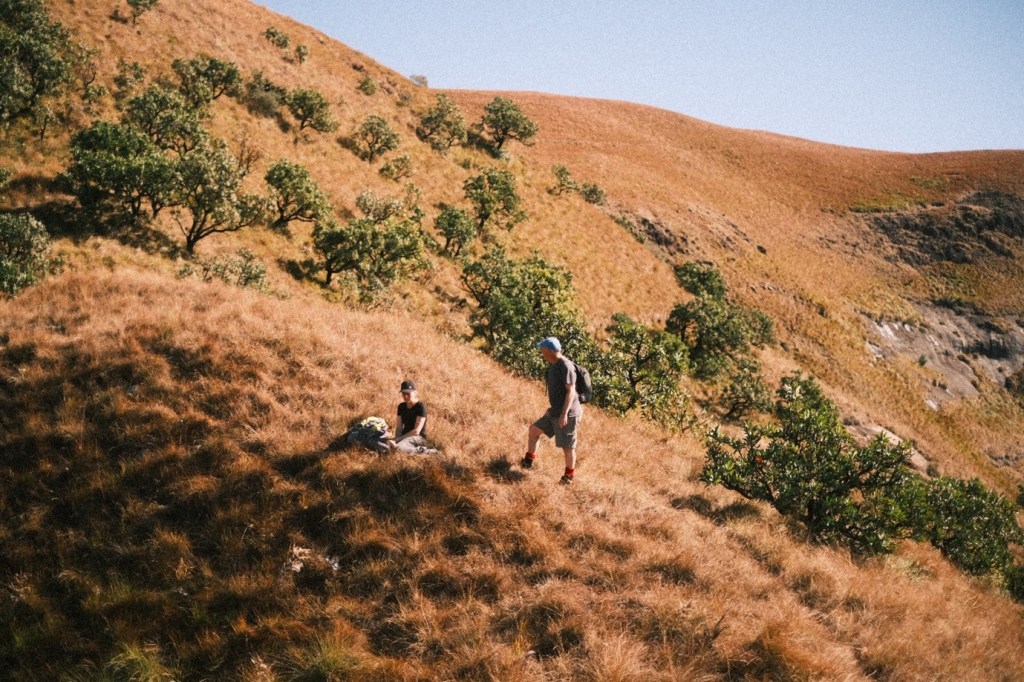
Aims: As the samples for my research had already been collected earlier by my supervisors Prof. Dr. Jemma Finch & Prof. Dr. Trevor Hill for the University of Kwa-Zulu Natal, our initial goal was to collect various samples (charcoal, sediment cores, etc) for the next students. During my time at the university of Kwa-Zulu natal, however, we realized that it would be great to collect a bunch of C3 and C4 grass species, to extract phytoliths (amorphous silica particles formed in plant tissues) from, which would help with the interpretation of our data. This then became our new focus. To achieve this goal we visited the Drakensberg twice, one day trip in the weekend, and one trip with an overnight stay.
Day 1
After a night of utterly terrible sleep (I was alone on the AirBnB property, the gate did not lock due to the cold, and our dogs started barking at something (someone!?) at 2AM), I woke up at 6AM to get ready for the long day ahead of us. Jemma came to pick me up at the, bringing coffee with her, which I really appreciated. We then picked up Trevor at their place and began our drive towards the mountains. I had not seen much of the landscape in the Kwa-Zulu Natal province, which turned out to be very compared to the Western Cape. Whereas the western cape had fynbos vegetation (very similar to the Mediterranean, KZN was more savanna like. There was grass everywhere the eye could see, except for the patches of spruce, planted by humans. Halfway through the drive the Drakensberg mountains came into view, which was stunning. We then drove through some small villages, until we finally arrived at the Berg.







 Ecology of the past