Netherlands Annual Ecology Meeting 2018 – day 1

February 13, 2018
WDG

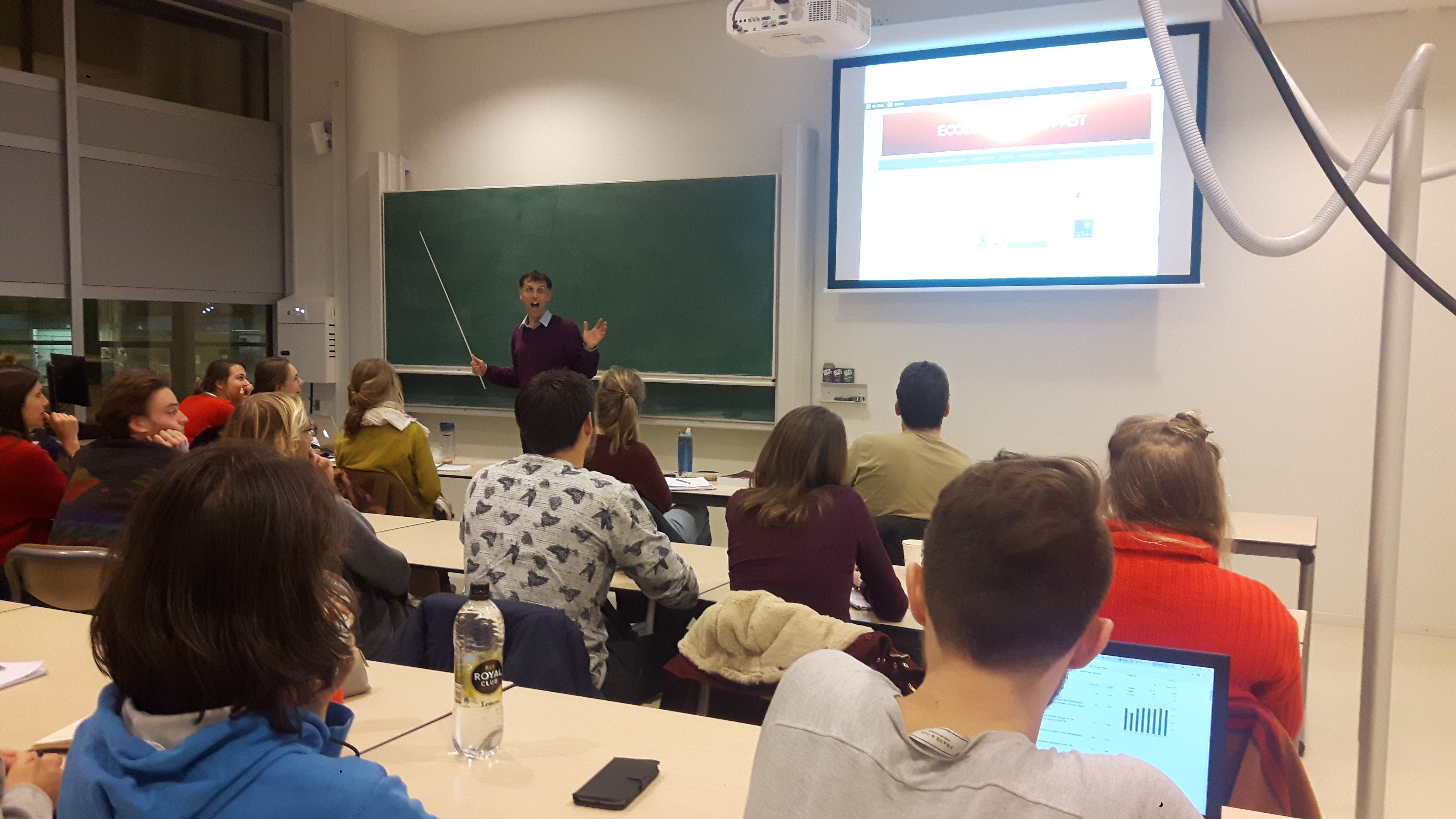
Today the Dutch ecological community has convened at the Netherlands Annual Ecology Meeting (NEAM) in the forest near Lunteren. The meeting was kicked off by plenary lectures by Trisha Atwood and Han Olff who talked to the theme of “Ecosystem functioning in a changing world”. Trisha highlighted the importance of animals in modifying plant communities and their consequent importance for understanding changes in carbon storage. Han illustrated the complexity of ecological networks and posed the significant challenge of understanding changes in competing networks. Following the plenaries I chose two sessions to follow. The first on “Plant Ecology” and the second on “Ecosystem Resilience”. There were many exciting talks in both sessions, two of which grabbed my attention. Mara Baudena (Utrecht University) highlighted the complexity of modelling forest-grassland interactions in Africa, while Sofia Gomes (Naturalis Biodiversity Centre) showed surprising (to me) variation in mychorizal fungi across the globe.Furthermore four talks were presented by researchs at my home, the Institute for Biodiversity & Ecosystem Dynamics (University of Amsterdam):

  • Crystal McMichael “Ancient human disturbances may be skewing our understanding of Amazonian ecology”
  • Milan Teunissen van Manan “Species specific responses in leaf wax n-alkane composition from six tropical tree species”
  • Kenneth Rijsdijk “Assessing the resiliance of insular species to past climate change”
  • Seringe Huisman “Characterization of phytoliths in premontance western Amazonian forests”

So an exciting day, now for food and beer, and back on it tomorrow! Follow live on Twitter 

Amazonian coring isn’t boring

February 2, 2018
WDG

By Seringe Huisman (MSc Biological Sciences, Institute for Biodiversity & Ecosystem DynamicsUniversity of Amsterdam)

Hello all! You might have been wondering if I died in the middle of Amazonian nowhere, since I haven’t come back to writing a blog after we left for fieldwork in July. Given we were in an Amazonian region full of venomous snakes that could have been the case, but the good news is I just didn’t get around writing it because I got carried away by the findings of my project! We actually had a very successful field trip – apart from some minor issues like the lake swallowing equipment, sinking waist-high into the mud each step of our 7 hour long ‘trail’ to the lakes, and almost not getting my precious samples through airport security.

Continue Reading

Off to the tropics!!

December 26, 2017
cmcmicha

On Jan 1, 2018 I (Crystal McMichael) get to ring in the New Year in the best way possible by heading off to the tropics to do fieldwork! And this time I get to take two students with me. Britte Heijink and Veerle Vink are both in the Biological Sciences MSc program (Ecology and Evolution track), and they are going to work on research projects that are associated with a recent grant that I was awarded through the Smithsonian Tropical Research Institute CTFS-ForestGEO Research Grants Program.

Continue Reading

Environments Through Time – weeks 2 & 3

November 19, 2017
WDG

Britte reconfiguring the chronology for Lake Pata

Britte reconfiguring the chronology for Lake Pata

The second and third weeks of the Environments Through Time course at the University of Amsterdam has focused on obtaining practical experience of developing chronologies, analyzing multi-variate data-sets, and conducting time series analysis. The focus of the course has been on Quaternary environmental change, however, the skills learnt can be applied to almost any time-scale so long as you have time control points you want to tie together, and multiple things you can track changing through that time.

Over the two week period the students worked on a previously published paper that they had selected that contains: (i) chronological information (at least 3 control points), and (ii) multiple variables that change through the time series (at least 9 variables). In week two they deconstructed the chronologies and generated their own revised versions. For example students have (re-)calibrated radiocarbon dates, made different decisions on dates to include/exclude, and used different approaches to constructing the age vs. depth model, e.g. contrasting linear point-to-point vs. Bayesian methodologies. In week three they have taken the data-set(s) associated with their paper and re-evaluated it in light of the revised chronologies using cluster analysis, ordination techniques, and wavelets.

The joy of wavletes

The joy of wavletes

Through this exercise students have gained experience of how to critically assess scientific literature and gained an appreciation of where re-analysis of data-sets can (and cannot) make a difference. Personally I have be delighted with the high level of engagement and enthusiasm for the material and have been excited to have a chance to delve into literature that I would not otherwise be aware of.

For more information on this course see: Environments Through Time – week 1


Environments Through Time – week 1

November 3, 2017
WDG

Me teaching human impacts on environmental change...

Me teaching human impacts on environmental change…

The first, ever, week of the Environments Through Time course at the University of Amsterdam has just finished. The course sits within the MSc Biological Sciences (Ecology & Evolution) and MSc Earth Sciences (Geo-ecosystem Dynamics) but is also avaliable to other masters students. In the first week we have thought about four main topics:

  1. Scales of change (ecological, geological, and human).
  2. Humans as drivers of environmental change.
  3. Extra-terrestrial forcing of environmental change.
  4. Earth system feedbacks.

The week was completed with each student giving a three (3) minute presentation of their favourite paper. The papers presented ranged from the extinction of giant sharks, through forest-savannah transitions, to how climate change thwarted Ghengis Kahn. Next week we continue by disecting how chronologies are constructed.

This slideshow requires JavaScript.

The Enviornments Through Time course is taught by: William Gosling, Crystal McMichael, and Milan Teunissen van Manen.

Continue Reading

Exploring the Llanos de Moxos, Bolivia

November 1, 2017
cmcmicha

By Crystal McMichael

The Llanos de Moxos in Bolivia is an area the size of England that has one of the highest densities of archaeological sites in the Amazon basin. I travelled there for the first time earlier this month for the fourth International Meeting of Amazonian Archaeology. As the airplane crossed from the Andes into the Amazon plains, I could tell this was a very different ‘Amazonia’ compared with the forests that I know from Peru, Ecuador, and western Brazil. The Llanos de Moxos is a seasonally flooded savanna and it was so…open! I immediately realized that the perception of ‘Amazonia’ varies widely among individuals, and I think that is one of the reasons why those of us who study the human history of Amazonia tend to disagree so frequently.

This slideshow requires JavaScript.

Continue Reading

An undergraduate eye-view of an Andean lake-coring expedition

August 25, 2017
WDG

Part 2: Progresso
by Molly Kingston (a BSc Biological Sciences student at Florida Institute of Technology, taking part in an expedition lead by Prof. Mark Bush)

With a fresh set of clothes and a shower after almost a week without one, it was time to set off for the next lake, Progresso.

Continue Reading

An undergraduate eye-view of an Andean lake-coring expedition

August 23, 2017
WDG

Part 1: Huayabamba
by Molly Kingston (a BSc Biological Sciences student at Florida Institute of Technology, taking part in an expedition lead by Prof. Mark Bush)

When I first heard about this class in Peru, I had no idea that I was going to experience so much in such a short period. Our goal was to visit two lakes in Peru and raise sediment cores for paleoecology. The first lake that we went to was Laguna Huayabamba, which sits at about 3250 m elevation in the La Libertad region of the Peruvian Andes.

However, getting to this lake was no easy task. Before the hike even started, we had to obtain the necessary permits and permission from the local people. After several days of visiting different town officials and waiting for approval, we could set out on our adventure.

Continue Reading

Field work in Ecuador

July 27, 2017
WDG

IBEDs Crystal McMichael hard at work sampling sediments in the Andes

IBEDs Crystal McMichael hard at work sampling sediments in the Andes

Insights into recent field work in Ecuador by a team lead by Crystal McMichael can be found in a recent blog from our collaborators at the Instituto Geofisico, Escuela Politecnica Nacional, Quito (Ecuador).

Trabajo colaborativo entre Volcanólogos y Palenólogos potenciará el conocimiento sobre el Paleoclima en el Valle de Latacunga en los últimos 20 mil años by Patricia Mothes

Blog at WordPress.com.