Abstract submission is now open for INQUA 2019 in Dublin Ireland (25-31 July 2019). Please consider submitting to the special session I am co-organizing on landscape change in the tropics. Submissions welcome from the fields of biogeography, palaeoecology, geomorphology, volcanology, and archaeology. Click here to submit your abstract.TITLE: The changing tropical landscape
ORGANIZERS: William D. Gosling and Crystal N.H. McMichael (University of Amsterdam)
Eighteenth century explorers marveled at the diversity of tropical ecosystems seemingly untouched by human activity. As a result of these observations, the notion of tropical stability, in terms of vegetation and climate, came to underpin theories of evolution, ecology, and biogeography. Gradually, however, it has become apparent that tropical landscapes have changed markedly through time in response to global climate cycles, (a)biotic factors, and human activity. For example, Continue Reading
The montane cloud forests of South America are some of the most biodiverse habitats in the world, whilst also being especially vulnerable to climate change and human disturbance.
Today much of this landscape has been transformed into a mosaic of secondary forest and agricultural fields. This thesis uses palaeoecological proxies (pollen, non-pollen palynomorphs, charcoal, organic content) to interpret ecosystem dynamics during the late Quaternary, unravelling the vegetation history of the landscape and the relationship between people and the montane cloud forest of the eastern Andean flank of Ecuador. Two new sedimentary records are examined from the montane forest adjacent to the Río Cosanga (Vinillos) and in the Quijos Valley (Huila). These sites characterise the natural dynamics of a pre-human arrival montane forest and reveal how vegetation responded during historical changes in local human populations.
Non-pollen palynomorphs (NPPs) are employed in a novel approach to analyse a forest cover gradient across these sites. The analysis identifies a distinctive NPP assemblage connected to low forest cover and increased regional burning. Investigation into the late Pleistocene Vinillos sediments show volcanic activity to be the primary landscape-scale driver of ecosystem dynamics prior to human arrival, influencing montane forest populations but having little effect on vegetation composition.
Lake sediments at Huila from the last 700 years indicate the presence of pre-Hispanic peoples, managing and cultivating an open landscape. The subsequent colonization of the region by Europeans in the late 1500’s decimated the indigenous population, leading to the abandonment of the region in conjunction with an expansion in forest cover ca. 1588 CE. After approximately 130 years of vegetation recovery, montane cloud forest reached a stage of structural maturity comparable to that seen in the pre-human arrival forest. The following 100 years (1718-1822 CE) of low human population and minimal human impact in the region is proposed as a shifted ecological baseline for future restoration and conservation goals. This ‘cultural ecological baseline’ features a landscape that retains many of the ecosystem service provided by a pristine montane forest, while retaining the cultural history of its indigenous people within the vegetation. Continue Reading
As part of the launch there will be a Thematic Session at the Birmingham meeting entitled “Advancing our understanding of long-term ecology: combining ecological and palaeoecology approaches and metrics”and organised by Althea Davies and Ambroise Baker.
To find out how to get involved and join the SIG contact the organizers Althea Davies and/or Jane Bunting.
Castilla-Beltrán, A., Hooghiemstra, H., Hoogland, M.L.P., Pagán-Jiménez, J., van Geel, B., Field, M.H., Prins, M., Donders, T., Malatesta, E.H., Hung, J.U., McMichael, C.H., Gosling, W.D. & Hofman, C.L. Columbus’ footprint in Hispaniola: a paleoenvironmental record of Indigenous and Colonial impacts on the landscape of the central Cibao Valley, northern Dominican Republic. Anthropocene. DOI: 10.1016/j.ancene.2018.05.003
Veerle and I trying to protect ourselves from the mosquitos.
Hi all!
My name is Britte Heijink and I’m doing my MSc Biological Science thesis research project with Crystal McMichael and William Gosling. I travelled with Veerle Vink and Crystal to the Colombian part of Amazonia to collect samples for my project. At Amacayacu National Park, we collected soil cores from different locations in the plot. Now that we’re back in Amsterdam, I’m analysing the soils to reconstruct the fire and vegetation history from the plot using charcoal and phytoliths. I am specifically looking to see if humans have been present in the system and how they potentially affected the vegetation at Amacayacu.
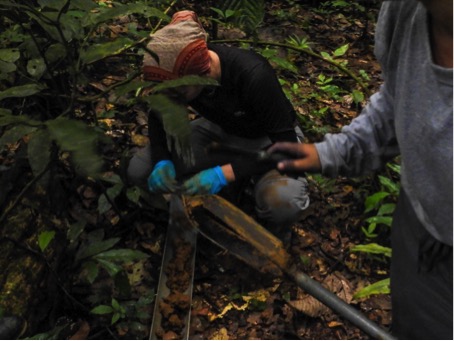
Here I’m Sampling pieces of soil cored by Louisa and checking for large pieces of charcoal
I’ve completed my bachelor thesis for Bèta-Gamma (Liberal Arts and Sciences) under the supervision of Crystal and Will here at the UvA. I’m really excited to work with them again, and already looking forward to our meetings at the Oerknal 😉 I will be finished by the end of September, and then possibly return for a literature study.
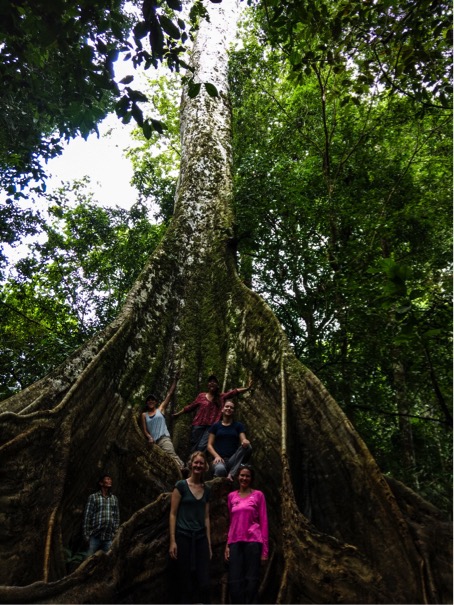
One of the most wonderful experiences in my academic career so far has been the fieldwork to Panama and Colombia with Crystal, Veerle, and Nina. It was a lot of hard work, and 90% of our time was spent covered in mud, sweat, and insect repellant, but the experience of working in a tropical rainforest was completely worth it! Veerle and I will write another blog about our fieldwork soon. Come see us in the microscope lab if you want to hear our dangerous and amazing stories before that!
Cheers,
Britte
Our last day in the Amazon was spend with some of the local students, Louisa Fernando Gomez Correa and Mariana Gutierrez Munera.
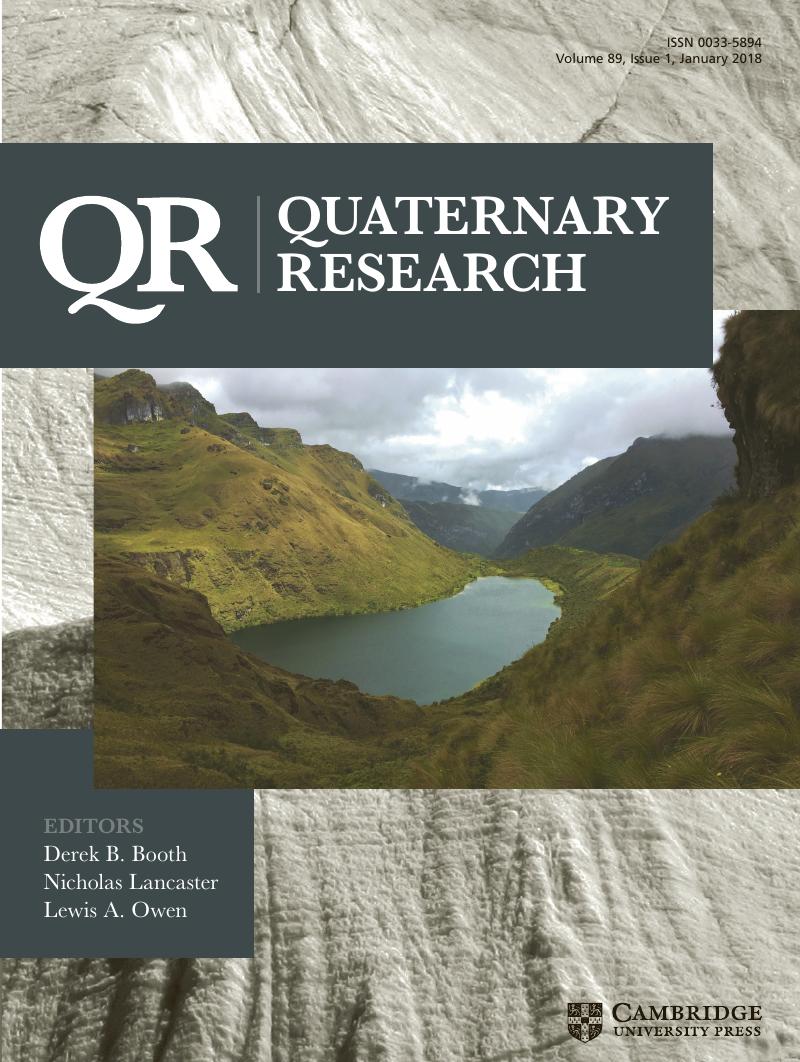
Mark Bush and I are proud to announce that a tribute to Prof. Daniel Livingston and Prof. Paul Colinvaux has recently been published in Quaternary Research. Dan and Paul were both pioneers of tropical pal(a)eoecology and both died in the spring of 2016 . To mark their passing Mark and I have guest edited ten new papers on palaeoecology drawn from researchers, and regions, of the tropics in which Dan and Paul worked (Bush & Gosling, 2018). We would like to thank Quaternary Research Senior Editor Derek Booth for giving us this opportunity and assisting greatly in the process of compiling the manuscripts. We would also like to thank all to contributing authors for their hard work and dedication to the project. We hope that you will enjoy reading the manuscripts and find them a fitting tribute to the life and work of these two great researchers.
On Jan 1, 2018 I (Crystal McMichael) get to ring in the New Year in the best way possible by heading off to the tropics to do fieldwork! And this time I get to take two students with me. Britte Heijink and Veerle Vink are both in the Biological Sciences MSc program (Ecology and Evolution track), and they are going to work on research projects that are associated with a recent grant that I was awarded through the Smithsonian Tropical Research Institute CTFS-ForestGEO Research Grants Program.
Veerle examines a cliff exposure during the Palaeoecology course, and has loved microfossils ever since!
Britte (far left) raises her first sediment core during the Palaeoecology course in 2016!

 20th Congress of the International Union for Quaternary Research (INQUA)
 TITLE: The changing tropical landscape






 Ecology of the past