Recent research into the chemistry of ancient pollen grains has revealed a pulse of elevated UV radiation may have played a role in the end Permian mass extinction event (250 million years ago). To find out more:
Original article: Liu, F., Peng, H., John, E.A.M., Lomax, B.H., Bomfleur, B., Kent, M.S., Fraser, W.T. & Jardine, P.E. (2023) Dying in the Sun: Direct evidence for elevated UV-B radiation at the end-Permian mass extinction. Science Advances9, eabo6102. DOI: 10.1126/sciadv.abo6102
Interested in African paleoecology? Want to incorporate African pollen data into your research or teaching?
If you read nothing else, please take this survey before January 25!
The African Pollen Database (APD) has been relaunched, and the Neotoma Paleoecology Database now contains over 200 APD records. Data stewards working with APD and Neotoma have been meeting regularly for the last two years to upload data, but we are now changing the format of our meetings in order to start focusing on helping people use APD data for research and teaching!
We are developing a schedule of practical tutorials on APD data workflows in R, using Rneotoma, and a few other topics to take place over next few months (see this video for general info).
This is open to anyone interested in African paleoecology (students, researchers, teachers, etc)! If you or your students might be interested in taking part in one or all of these, please take this very brief survey by January 25 to let us know. Also if you have other students or researchers you think should get this email, let Sarah Ivory (sji15@psu.edu) or Chris Kiahtipes (chris.kiahtipes@gmail.com) know.
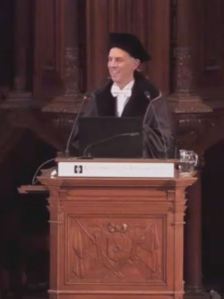
William Gosling giving his oratie “The Ecology of the Past” at the Aula (University of Amsterdam), 22 December 2022.
On the 22 December I gave my oratie (inaugural lecture), entitled “The Ecology of the Past”, related to my appointment as Professor of Palaeoecology & Biogeography at the University of Amsterdam. I really enjoyed the opportunity to mark this personal milestone with some many colleagues, friends and family. In case you missed the event you can watch it online via the universities portal by clicking here (or on the photo).
Note: (1) to flip between seeing the slides and the video feed just click on the screen, (2) running time of lecture until 50 minutes.
The seventh Mapping Ancient Africa online seminar took place on Thursday 15 December 2022. The seminar was delivered by Chantal Kabonyi (University of Bukavu) and chaired by Manu Chevalier (University of Bonn). The presentation was delivered in French with English slides.
Les trois derniers millénaires d’histoire environnementale autour du lac Kivu: De la dorsale congolaise à la dorsale congo-Nil
[The last three millennia of environmental history around Lake Kivu: From the Congolese ridge to the Congo-Nile ridge]
Chevalier, M. (2022) crestr: an R package to perform probabilistic climate reconstructions from palaeoecological datasets. Climate of the Past18, 821-844. DOI: 10.5194/cp-18-821-2022
Wei, C., Jardine, P.E., Gosling, W.D. & Hoorn, C. (2023) Is Poaceae pollen size a useful proxy in palaeoecological studies? New insights from a Poaceae pollen morphological study in the Amazon. Review of Palaeobotany and Palynology 308, 104790. DOI: 10.1016/j.revpalbo.2022.104790
I am pleased to announce that the seventh online Mapping Ancient Africa seminar will take place on 10 November 2022 (17:00-18:00 CET – please note change of clocks from summer time)
Related publication: Chevalier, M. (2022) crestr: an R package to perform probabilistic climate reconstructions from palaeoecological datasets. Climate of the Past18, 821-844. DOI: 10.5194/cp-18-821-2022
The seminar will be delivered via Zoom. The link for the seminar can be obtained from the MAA Slack channel or by contacting the chair of this seminar William Gosling. If you want to know more about the Mapping Ancient Africa project visit our web pages and please do not hesitate to get in contact if you want to get involved.
Hagemans, K., Urrego, D.H., Gosling, W.D., Rodbell, D.T., Wagner-Cremer, F. & Donders, T.H. (2022) Intensification of ENSO frequency drives forest disturbance in the Andes during the Holocene. Quaternary Science Reviews 294, 107762. DOI: 10.1016/j.quascirev.2022.107762
During the delivery of this years BSc Palaeoeclogy course at the University of Amsterdam (UvA) I discussed with a number of students about the nature and purpose of understanding the ecology of the past. This lead me to highlighting the research of Nick Loughlin (@PalaeoNick) from his PhD at The Open University and the subsequent work that he has done. I though it might be interesting to also share this here…
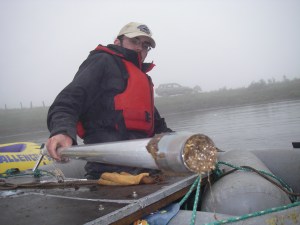
Nick Loughlin during his PhD field work in Ecuador
Nick’s study sought to understand better the ecological history of the biodiverse eastern Andean flank in Ecuador. To achieve this he went into the field and recovered sediments from a lake and a sedimentary section exposed by a road cutting. He analysed the sediments to reveal vegetation change (pollen analysis), fire histories (charcoal analysis), and past animals in the landscape (non-pollen palynomorphs, or NPPs). To extract extra ecological information from his samples he developed the methodological approach for examining NPPs in a tropical setting (Loughlin et al. 2018a). He then combined all the different palaeoecological approaches to reveal the drivers of vegetation change during the last glacial period (in the absence of humans; Loughlin et al. 2018b), and during the last 1000 years (when indigenous and European human populations radically altered the landscape; Loughlin et al. 2018c). The insights gained from Nicks research provided empirical evidence of how humans have been modifying this biodiversity hotspot on the timescales relevant to the lifecycles of tropical trees. These findings and ideas were collated in his PhD Thesis at The Open University which was supervised by Encarni Montoya, Angela Coe and myself (Loughlin, 2018a). Subsequently, Nick has been working to broaden the impact of his work and to communicate his findings to the broader scientific and conservation community. This has lead to two new publications focused on understanding baseline ecological function and conservation implications (Loughlin et al. 2022, Nogué et al. 2022).
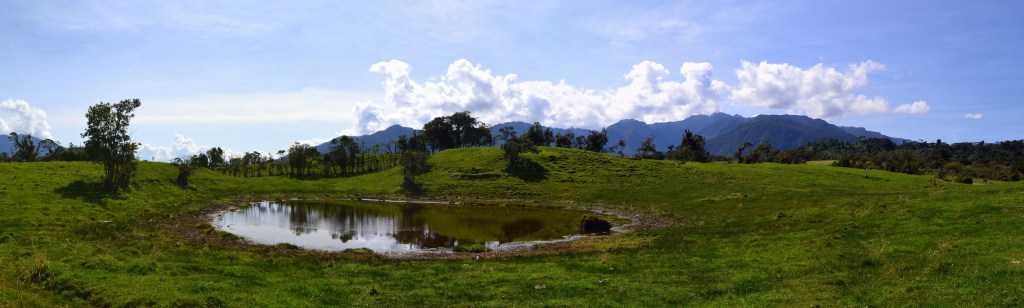
Evidence of past ecological change recovered from Lake Huila (Ecuador) revealed how past peoples had modified the landscape of the eastern Andean biodiversity hotspot.
The arch of research carried out by Nick, I think, really demonstrates the important of understanding the ecology of the past – without his detailed investigation of microfossils we could not have seen the impacts of indigenous communities on the past Andean landscape, or identify the consequences of the European depopulation; or been able to estimate the timescales of the ecological change!
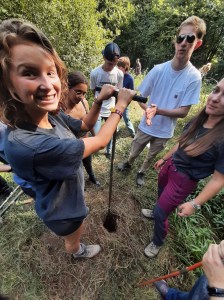
Week 1 (last week) we got everyone up to speed with the fundamentals of palaeoecology (including: key principles, depositional environments, dating methods) and laboratory skills (pollen, phytolith and macrofossil identification). This week (week 2) we are out and about (coring sediments, surveying vegetation and visiting the archaeology department). By the end of the week the students will (should!?) have generated sufficient data in the laboratory and field to be able to identify the location from which their mini-project “mystery slides” were taken. Next week (week 3) will be number crunching to generate the statistical support for their ideas and inferences.
Students collecting sediments using a Russian corer at Langenboom (September, 2022). These samples were recovered in collaboration with the BosGroep Zuid Nederland as part of an ongoing project to gain new insights into the nature of the past landscape in the Netherlands and aid conservation efforts.











 Ecology of the past