13.45-14.15: Dr Robert-Jan Wille
History Department, Utrecht University Dutch colonial science in the age of Melchior Treub: evolution, development and symbiosis as political and scientific themes in the late nineteenth century
For those of you I have not had the pleasure of meeting yet, please allow me to introduce myself. My name is Yoshi Maezumi. I have recently been awarded a Marie Curie Fellowship for my research proposal FIRE: Fire Intensity in Rainforest Ecotones. I will have the honor of working with an extraordinary team of international, interdisciplinary researchers including Will Gosling, Crystal McMichael, Emiel van Loon, and Boris Jansen from the University of Amsterdam, Boris Vannière from the Université de Franche-Comté, Jose Iriarte from the University of Exeter, and Francisco Cruz from the University of São Paulo. Together we will examine the long-term role of fire in shaping Amazon Rainforest Ecotones.
My research is focused on paleofire (fire in the past) in Neotropical savanna and rainforest ecosystems. My current post-doctoral research at the University of Exeter is investigating the role indigenous fire management practices had on shaping the composition, structure, and flammability of modern Amazonian rainforests.
Recently introduced to a book by Bill Gammage entitled The Biggest Estate on Earth: How the Aborigines Made Australia. Gammage identifies five uses of indigenous fire: 1) to control wildfire fuel; 2) to maintain diversity; 3) to balance species; 4) to ensure abundance; 5) to locate resources conveniently and predictably. Gammage argues that our current regime is struggling with number one. These stages of fire management provide some really interesting food for thought for my Marie Curie Fellowship as I aim to develop new paleoecological techniques to analyze paleofire that will be used to model natural and anthropogenic drivers of paleofire activity.
I have been thinking a lot about what we do and do not know about paleofire. One of the ways we reconstruct past fire activity is through the use of charcoal preserved in lake sediments. Charcoal can tell us a lot about what past fires were like including what kind of plants were burning, how often fires occurred, and potentially how big a fire was. One of the more elusive components is paleofire intensity, or how hot a particular fire was. The temperature of a fire has important ecological implications, as hotter fires tend to cause more ecological damage. Lots of factors can contribute to fire intensity including droughts, fuel loads, vegetation composition and structure, fuel moisture, etc. All of this is to say that, fire intensity is complicated. Nevertheless, one of the main objectives of my Marie Curie research will be to compile what we currently know about the effect of modern fire intensity on the charcoal formation to figure out how that information can be used to interpret charcoal from the palaeorecord.
If you would like to join me on this ‘intense’ paleofire journey, (punny, I know, I just couldn’t resist), I am starting a weekly science blog called Her Science that will highlight the trials, tribulations, and triumphs of my Marie Curie research over the next few years.
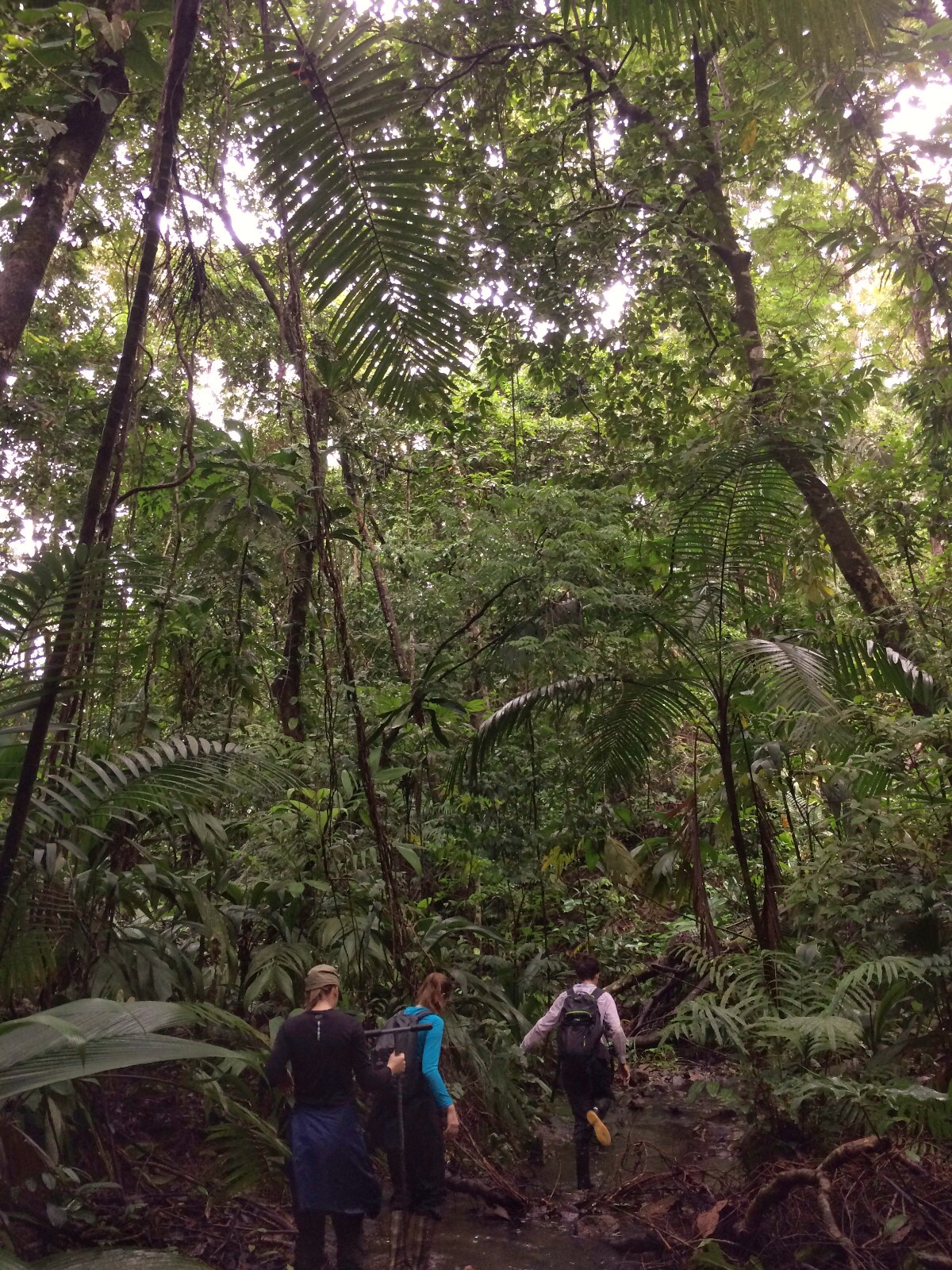
My name is Veerle, and I am in my first year of the Master in Biological Sciences, Ecology & Evolution track, at the University of Amsterdam. I also completed my BSc Biology at the University of Amsterdam, specializing in Ecology and Global Change. One of my favorite courses during my BSc was Palaeoecology, which led to a BSc research project with William Gosling and Crystal McMichael on the farming history in the Netherlands. I really enjoyed this project and it made me even more interested in palaeoecology. This year I have gotten the amazing opportunity to do another project with Crystal McMichael…. including a field expedition together with Britte Heijink and Nina Witteveen to Panama and Colombia! This was an amazing experience with a lot of fun, mud, insect repellent and most of all really nice cores! I am super excited to tell you about my field experiences, so soon we will post another blog about that!
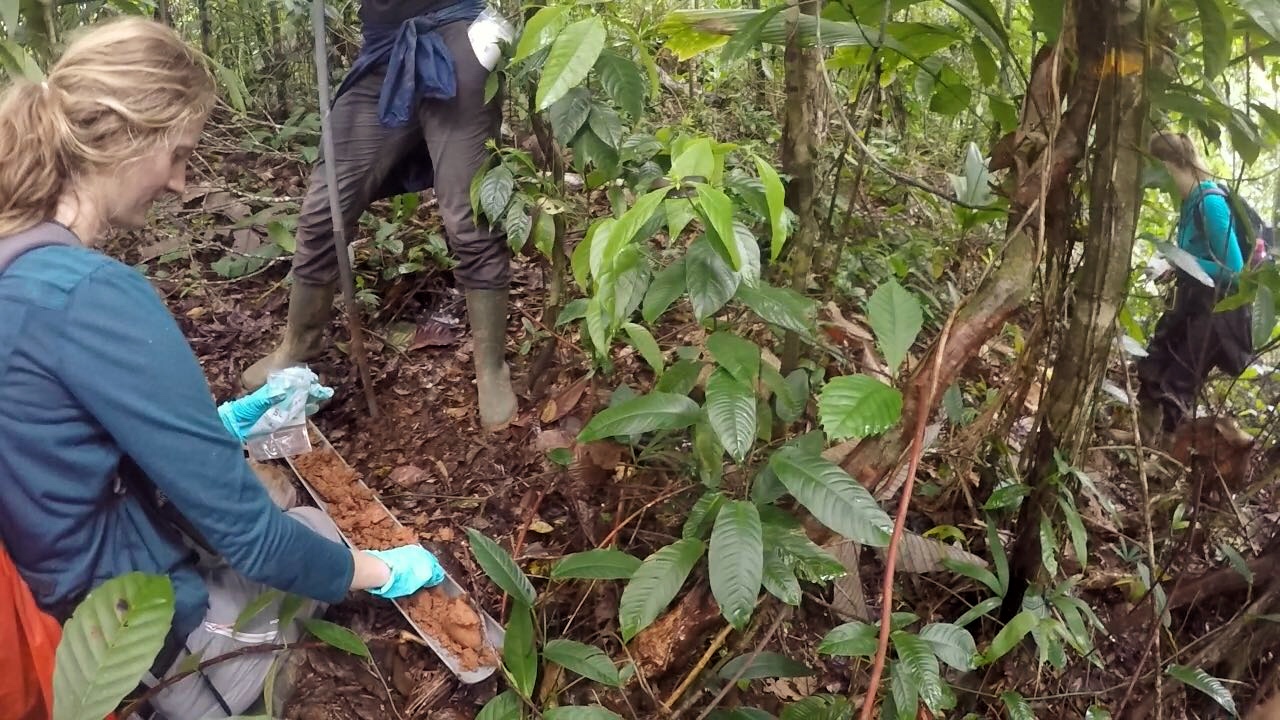
Collecting the soil
Now that we’re back in Amsterdam, I’m analyzing phytoliths from Gigante (Panama) to reconstruct the fire and vegetation history. I’m especially interested in past agriculture and forest management to see if there were humans present in the area and how they affected the vegetation. Hopefully I can show you some nice results about that in the future!
Hello all! You might have been wondering if I died in the middle of Amazonian nowhere, since I haven’t come back to writing a blog after we left for fieldwork in July. Given we were in an Amazonian region full of venomous snakes that could have been the case, but the good news is I just didn’t get around writing it because I got carried away by the findings of my project! We actually had a very successful field trip – apart from some minor issues like the lake swallowing equipment, sinking waist-high into the mud each step of our 7 hour long ‘trail’ to the lakes, and almost not getting my precious samples through airport security.
On Jan 1, 2018 I (Crystal McMichael) get to ring in the New Year in the best way possible by heading off to the tropics to do fieldwork! And this time I get to take two students with me. Britte Heijink and Veerle Vink are both in the Biological Sciences MSc program (Ecology and Evolution track), and they are going to work on research projects that are associated with a recent grant that I was awarded through the Smithsonian Tropical Research Institute CTFS-ForestGEO Research Grants Program.
Veerle examines a cliff exposure during the Palaeoecology course, and has loved microfossils ever since!
Britte (far left) raises her first sediment core during the Palaeoecology course in 2016!
Focus on Global Ecology, including: global biodiversity patterns and ecosystem functioning, human impacts on biodiversity, biogeography of species interactions, and/or global changes in ecosystems, biodiversity and ecosystem services.
The second and third weeks of the Environments Through Time course at the University of Amsterdam has focused on obtaining practical experience of developing chronologies, analyzing multi-variate data-sets, and conducting time series analysis. The focus of the course has been on Quaternary environmental change, however, the skills learnt can be applied to almost any time-scale so long as you have time control points you want to tie together, and multiple things you can track changing through that time.
Over the two week period the students worked on a previously published paper that they had selected that contains: (i) chronological information (at least 3 control points), and (ii) multiple variables that change through the time series (at least 9 variables). In week two they deconstructed the chronologies and generated their own revised versions. For example students have (re-)calibrated radiocarbon dates, made different decisions on dates to include/exclude, and used different approaches to constructing the age vs. depth model, e.g. contrasting linear point-to-point vs. Bayesian methodologies. In week three they have taken the data-set(s) associated with their paper and re-evaluated it in light of the revised chronologies using cluster analysis, ordination techniques, and wavelets.
The joy of wavletes
Through this exercise students have gained experience of how to critically assess scientific literature and gained an appreciation of where re-analysis of data-sets can (and cannot) make a difference. Personally I have be delighted with the high level of engagement and enthusiasm for the material and have been excited to have a chance to delve into literature that I would not otherwise be aware of.







 Ecology of the past