The next INQUA Congress will be held in Nagoya (Japan) on July 27 – August 2, 2015
This is a call for contributions to session P05 on ‘Climate change in the tropical South Pacific during the Late Quaternary’.
The session abstract is as follows:
Establishing well dated, quantitative, highly resolved palaeoclimate data for the major climate systems of the tropical south Pacific has become a research priority owing to the paucity of instrumental data from this critical region of the Earth. Whilst the quantity of proxy climate data for this region is increasing rapidly, compared to records from the Northern Hemisphere there is a surprising paucity especially when considering the importance of this region to global climate. Such information is vital for fully understanding inter-hemispheric climate linkages, global energy fluxes and the long-term evolution of natural climate variability such as the El Nino-Southern Oscillation. The dearth of pre-industrial climate records from this region contributes to large uncertainties associated with future climate change impacts far beyond the south Pacific. This session aims to bring together researchers working on Late Quaternary ocean/climate proxies with those whose research lies in modelling ocean-climate processes and dynamics in the tropical south pacific region, and their implications for global climate.
We hope this session will be of interest to you. If you plan to contribute to this session, please submit your abstract before December 20, 2014 click here.
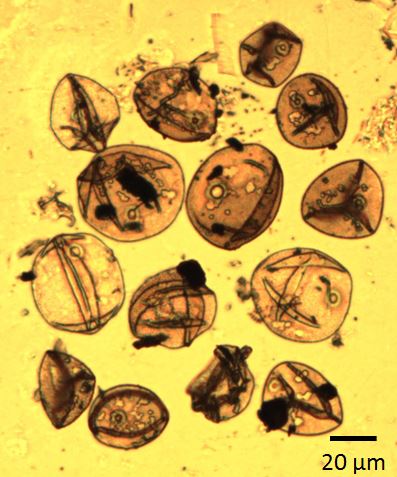
Grass pollen from Lake Bosumwti picked for individual chemical analysis
Abstract submission is now open for the XIX International Union for Quaternary Research (INQUA) Congress. “Ecology of the past” researchers will be there and are hosting a special session, entitled Organisms and environments: Frontiers in palaeoecological technique development, at which we hope to bring together a wide range of palaeoecologists working on novel proxy development. Members of the “Ecology of the past” group will be showcasing recent findings on the environmental significance of pollen chemistry change through time; linked to the 500,000 years of solar irradiance, climate and vegetation change in tropical West Africa project (Fraser et al., 2014). Please take a look at our session and consider submitting YOUR abstract today!
For information on abstract submission click here. Closing date for abstract submission 20 December 2014.
For further information on our session click here, or “Continue reading” below…
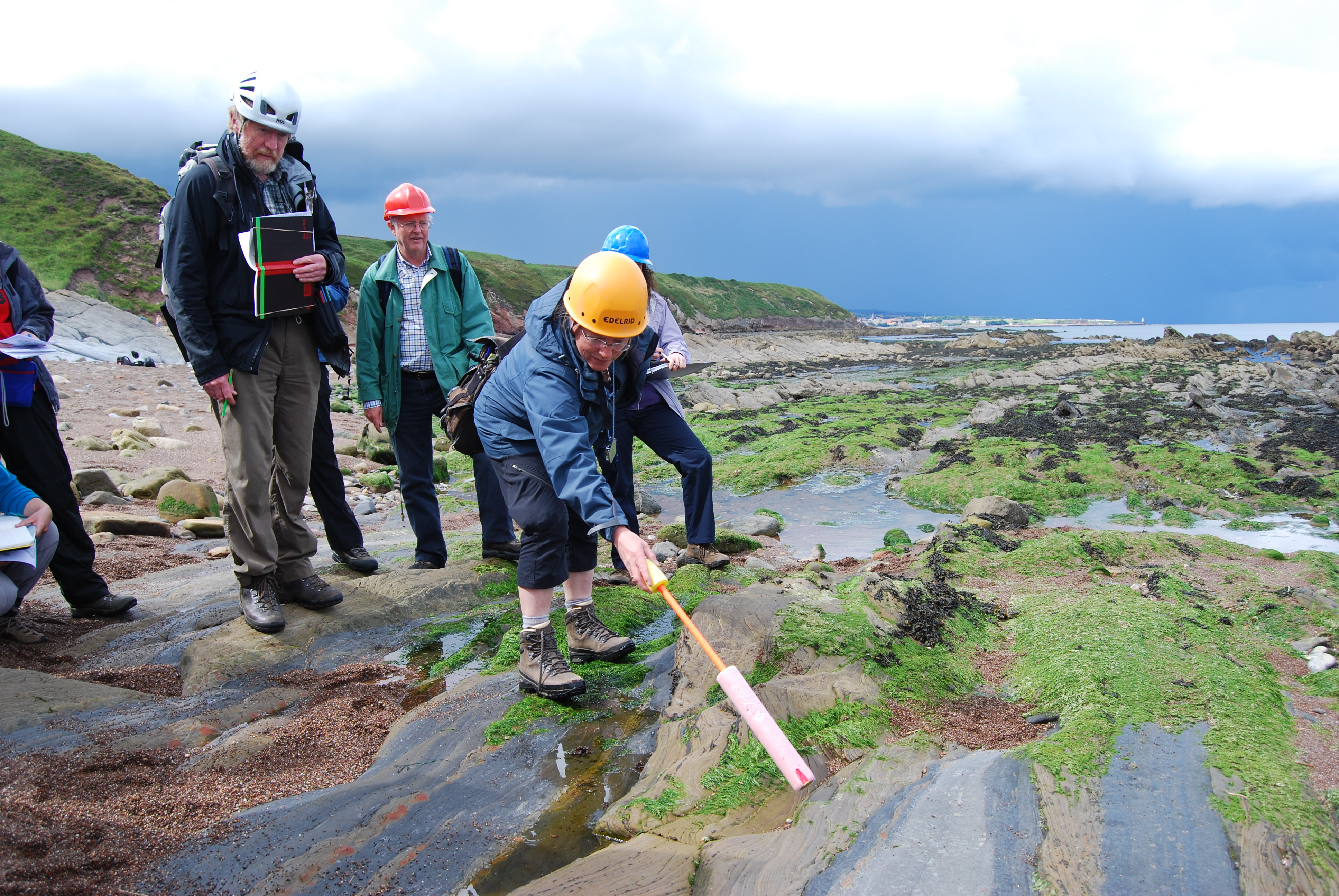
My final teaching job for The Open University was to help deliver the “Sedimentary Rocks & Fossils in the Field” section of the Level 2 Practical Science module (SXG288) offered by the Science Faculty. I have been involved in all three presentations of this section of the SXG288 module, which will now cease to be offered, and a number of other Earth and environmental science residential schools over the last 9 years.
Having the opportunity to engage directly with students and enthuse them face-to-face about the subject I specialise in is a privilege I have gained a lot from. Furthermore, my over-riding impression from the students I have taught is that they feel they benefit greatly from the opportunity to explore first hand the concepts and subjects which they have previously studied in books and online. Based on my experiences on “Sedimentary Rocks and Fossils”, and other modules as both a tutor and a student, I am convinced that to effectively teach geological, geographical, environmental and ecological subjects effectively an element of field-based teaching is required.
We’ve got a bumper crop of palaeoecological film making for you today, with three videos uploaded to our very own ‘Ecology of the Past’ Youtube channel. We’ve got an interview with Will Gosling, talking about the Bosumtwi pollen chemistry project and his own background and career (it’s a timely and somewhat poignant addition to the channel, because this is Will’s last day at The Open University before heading off to Amsterdam). Also posted are research presentations by Frazer Bird and Hayley Keen, which were filmed during the PhD student conference on 21st May. For the first time at the Open University these presentations were carried out in the Three Minute Thesis (3MT®) format.
Last month I had the opportunity of attending the 3-days non-pollen palynomorphs (NPP) workshop that was held at the Tallinn University, Estonia. It was perfectly organised by Tiiu Koff and Egle Avi among other members of the university, as it was a join workshop of Cladocera remains (XII Subfossil Cladocera workshop; 16-18th June) and NPP (18-20th June). Unfortunately, I was just present in the NPP workshop, so my comments will be focus on it.
With around 40 participants, we greatly enjoyed the discussions that came up about the state-of-the-art of this broad and interesting proxy and its implications for archaeology, palaeolimnology, and different aspects of ecology like human landscape management, biodiversity and conservation, or community assemblages. Current methodological problems like taxonomy, standardisation of lab techniques, etc., were also debated.
Opening and key lectures were from Bas van Geel and Emilie Gauthier, showing the development of this discipline over the last 40 years, and a great example of multi-proxy project aimed to study the human arrival and impact in Greenland respectively. Besides oral and poster presentations, last day there was a microscope session, very useful for sharing knowledge and uncertainties! In our specific case, Will, Hayley and I contributed with a poster titled “Non-pollen palynomorphs in Ecuador: starting from scratch”.
Personally, among the things I most like from the NPP meetings is the friendly and close environment, where everyone is more than glad to help others, regardless the experience. Following this feeling of small and scattered group of people dealing with the same issues, we used to do a final remark session every workshop raising the advances and inconveniences found so far, updating our NPP papers repository (managed by Antonella Miola), and addressing future directions as a group (for instance, we have now our own project in ResearchGate, thanks to Lyudmila Shumilovskikh!). In this particular workshop, I was very happy when I found out that Tallinn University has a green policy (paper free), and they replaced book abstracts etc., by iPads to follow the workshop schedule.
Although these meetings are normally biannual, next conference location and date is yet to be decided, but we hope to have the chance to join this very friendly and supporting community again. In addition, there will be a NPP session in the next European Palaeobotany and Palynology congress, tobe held in University of Padova (Italy), next August 2014. We encourage people with all kind of experience (or lack of) to attend further events.
Bush, M.B., Restrepo, A. and Collins, A.F. (2014) Galápagos history, restoration, and a shifted baseline. Restoration Ecology, 22, 3, 296-298.
Summary (Nick): A concise and pithy look at how a robust long-term ecological system can be transformed rapidly by human impact. The paper demonstrates how the fossil pollen record is fundamental if a near-natural vegetation state is to be restored to the Galápagos islands, to avoid restoration to a shifted baseline.




 Ecology of the past