Come study with us! New and improved Ecology & Evolution masters track within the MSc Biological Sciences at the University of Amsterdam
To find out more click here.
November 24, 2017
Come study with us! New and improved Ecology & Evolution masters track within the MSc Biological Sciences at the University of Amsterdam
To find out more click here.
November 21, 2017
 Job: Post-doctoral researcher
Location: Institute for Biodiversity & Ecosystems Dyanamics, University of Amsterdam
Duration: 3 years
Deadline for applications: 10 December 2017
Focus on Global Ecology, including: global biodiversity patterns and ecosystem functioning, human impacts on biodiversity, biogeography of species interactions, and/or global changes in ecosystems, biodiversity and ecosystem services.
For more details and how to apply click here.
November 19, 2017

Britte reconfiguring the chronology for Lake Pata
The second and third weeks of the Environments Through Time course at the University of Amsterdam has focused on obtaining practical experience of developing chronologies, analyzing multi-variate data-sets, and conducting time series analysis. The focus of the course has been on Quaternary environmental change, however, the skills learnt can be applied to almost any time-scale so long as you have time control points you want to tie together, and multiple things you can track changing through that time.
Over the two week period the students worked on a previously published paper that they had selected that contains: (i) chronological information (at least 3 control points), and (ii) multiple variables that change through the time series (at least 9 variables). In week two they deconstructed the chronologies and generated their own revised versions. For example students have (re-)calibrated radiocarbon dates, made different decisions on dates to include/exclude, and used different approaches to constructing the age vs. depth model, e.g. contrasting linear point-to-point vs. Bayesian methodologies. In week three they have taken the data-set(s) associated with their paper and re-evaluated it in light of the revised chronologies using cluster analysis, ordination techniques, and wavelets.

The joy of wavletes
Through this exercise students have gained experience of how to critically assess scientific literature and gained an appreciation of where re-analysis of data-sets can (and cannot) make a difference. Personally I have be delighted with the high level of engagement and enthusiasm for the material and have been excited to have a chance to delve into literature that I would not otherwise be aware of.
For more information on this course see: Environments Through Time – week 1
November 3, 2017
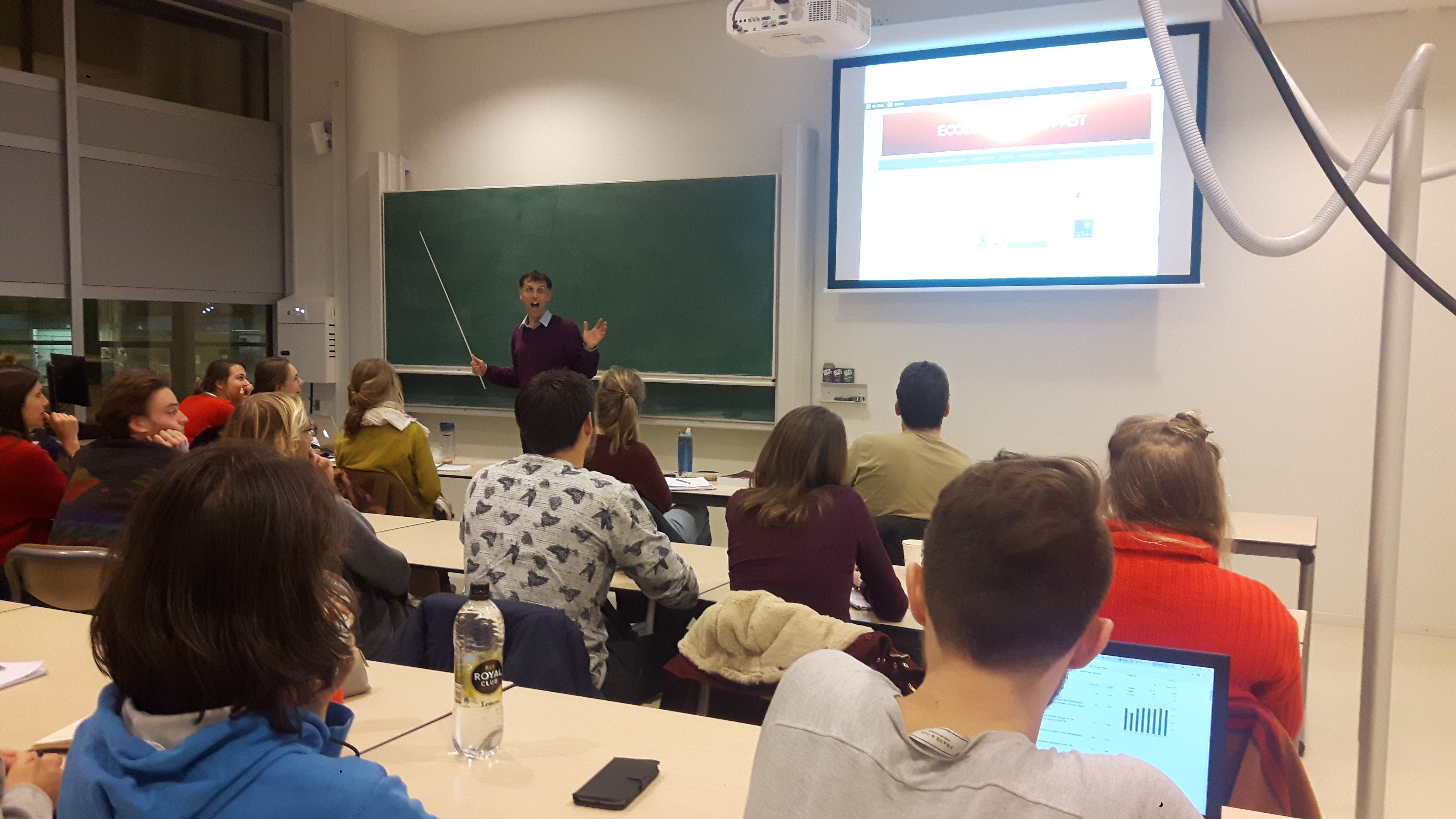
Me teaching human impacts on environmental change…
The first, ever, week of the Environments Through Time course at the University of Amsterdam has just finished. The course sits within the MSc Biological Sciences (Ecology & Evolution) and MSc Earth Sciences (Geo-ecosystem Dynamics) but is also avaliable to other masters students. In the first week we have thought about four main topics:
The week was completed with each student giving a three (3) minute presentation of their favourite paper. The papers presented ranged from the extinction of giant sharks, through forest-savannah transitions, to how climate change thwarted Ghengis Kahn. Next week we continue by disecting how chronologies are constructed.
The Enviornments Through Time course is taught by: William Gosling, Crystal McMichael, and Milan Teunissen van Manen.
November 1, 2017
By Crystal McMichael
The Llanos de Moxos in Bolivia is an area the size of England that has one of the highest densities of archaeological sites in the Amazon basin. I travelled there for the first time earlier this month for the fourth International Meeting of Amazonian Archaeology. As the airplane crossed from the Andes into the Amazon plains, I could tell this was a very different ‘Amazonia’ compared with the forests that I know from Peru, Ecuador, and western Brazil. The Llanos de Moxos is a seasonally flooded savanna and it was so…open! I immediately realized that the perception of ‘Amazonia’ varies widely among individuals, and I think that is one of the reasons why those of us who study the human history of Amazonia tend to disagree so frequently.
October 27, 2017
Researchers in the Institute for Biodiversity and Ecosystem Dynamics (IBED) at the University of Amsterdam have been studying the páramos and Andean ecosystems for over 50 years. These highly diverse ecosystems are currently restricted to mountain-tops (resembling an archipelago of islands in the sky), but in the past dominated large surface areas throughout the Northern Andes. Climate change determined the degree of páramo fragmentation and connectivity in the past, and site-specific results have been integrated into a GIS-environment (visualization) for southern Colombia and the entire Northern Andes by IBED researchers Suzette Flantua and Henry Hooghiemstra.
Watch the ‘Time machine: Ice ages in the Andes’ video and see its presentation at the recent IBED Open Day:
October 24, 2017
 Two recent articles published in the journal Vegetation History & Archaeobotany, which caught my attention as an Associate Editor, explore early cultivation in Argentina and Czech Republic:
October 23, 2017
Open acess, online:
Loughlin, N.J.D., Gosling, W.D. & Montoya, E. (2017) Identifying environmental drivers of fungal non-pollen palynomorphs in the montane forest of the eastern Andean flank, Ecuador. Quaternary Research. DOI: 10.1017/qua.2017.73
October 20, 2017
Open acess, online:
Loughlin, N.J.D., Gosling, W.D., Coe, A.L., Gulliver, P., Mothes, P. & Montoya, E. (2017) Landscape-scale drivers of glacial ecosystem change in the montane forests of the eastern Andean flank, Ecuador. Palaeogeography, Palaeoclimatology, Palaeoecology. DOI: 10.1016/j.palaeo.2017.10.011
October 20, 2017

Crytsal McMichael (University of Amsterdam)
Discussion on human impacts on Amazonian forest…
McMichael, C.H., Feeley, K.J., Dick, C.W., Piperno, D.R. & Bush, M.B. (2017) Comment on “Persistent effects of pre-Columbian plant domestication on Amazonian forest composition”. Science 358. DOI: 10.1126/science.aan8347
Junqueira, A.B., Levis, C., Bongers, F., Peña-Claros, M., Clement, C.R., Costa, F. & ter Steege, H. (2017) Response to Comment on “Persistent effects of pre-Columbian plant domestication on Amazonian forest composition”. Science 358. DOI: 10.1126/science.aan8837
 Ecology of the past