Paleoecology course University of Amsterdam

September 29, 2014
Valerie

Students examining a sediment core extracted with a Russian corer

Students examining a sediment core extracted with a Russian corer

Last week, Will – our new associate professor at the University of Amsterdam – joined us on the field residential module of the undergraduate “Paleoecology” course; 7 days exploring the sediments and vegetation of the Twente region of the Netherlands. The experience provided Will with a lot of information on Dutch language, landscapes, and students; which should be useful to him next year as he will be coordinating the course!

Students examining peat exposures.

Students examining peat exposures.

During this very intensive (4-week) paleoecology course, students get background lectures in past environmental change, learn to identify microfossils in the laboratory (pollen and chironomids), and go on the excursion to experience fieldwork. The field module involves excursions during the day, when students have to identify plant species indicative of different vegetation types in relation to soil nutrient availability and moisture content. The evenings are reserved for the students own paleoecological research investigation; this year students were reconstructing the vegetation history and climate change during the late-glacial from a lake sediment core from Germany. Once data collection was completed the students had to interpret the pollen assemblages they found using the knowledge of modern day ecosystems they gained throughout the week. On the final evening they presented their work to the whole group. The final results they achieved were quite impressive.

Students presenting findings from the days work

Students presenting findings from the days work

I am very curious as to what the course will be like next year, led by Will, and how he will tweak and turn it to his liking.


Debating the Vera hypothesis
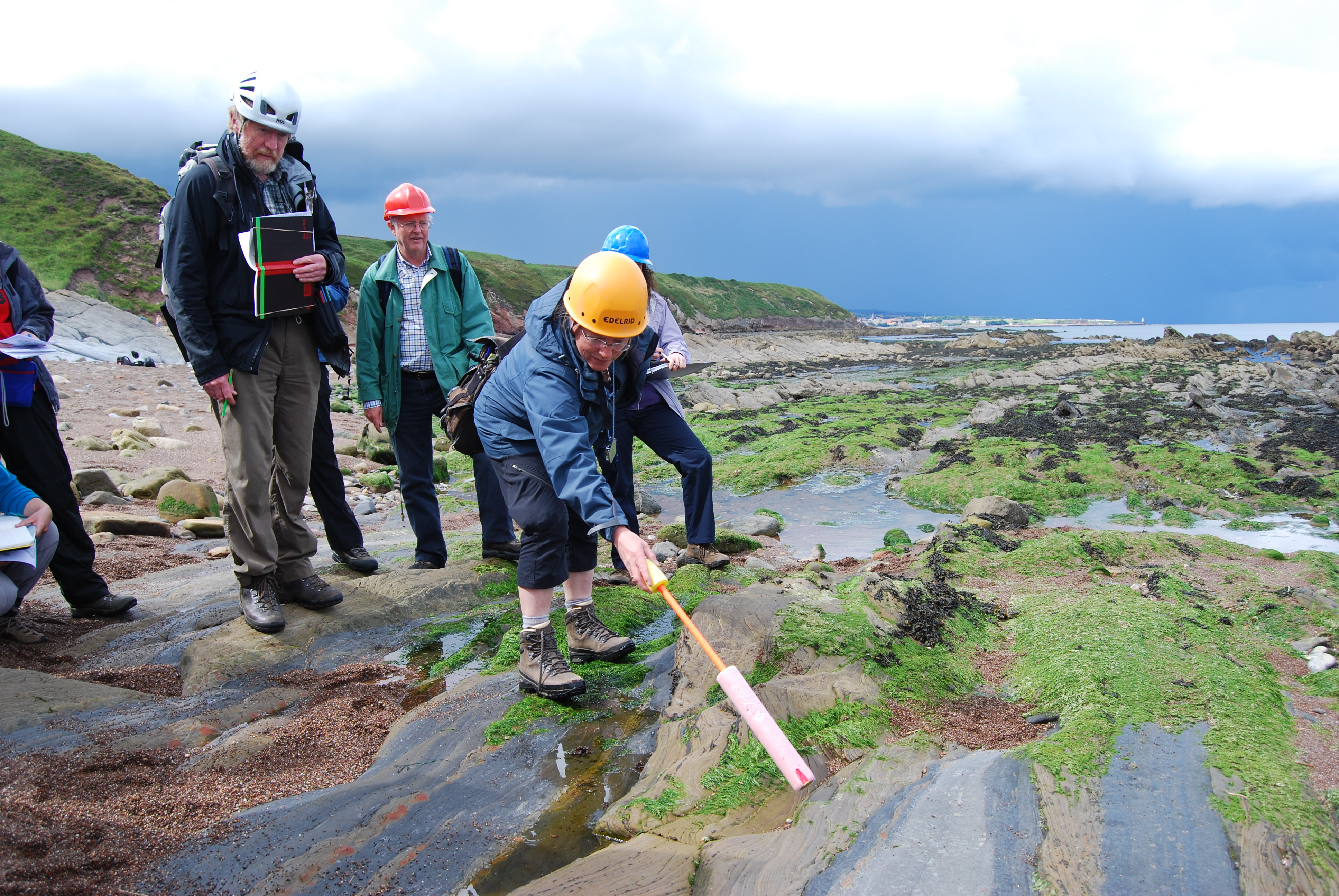
Debating the Vera hypothesis


Teaching in the field: Foundations, feedback and fun

September 16, 2014
WDG

My final teaching job for The Open University was to help deliver the “Sedimentary Rocks & Fossils in the Field” section of the Level 2 Practical Science module (SXG288) offered by the Science Faculty. I have been involved in all three presentations of this section of the SXG288 module, which will now cease to be offered, and a number of other Earth and environmental science residential schools over the last 9 years.

Showing students the rocksHaving the opportunity to engage directly with students and enthuse them face-to-face about the subject I specialise in is a privilege I have gained a lot from. Furthermore, my over-riding impression from the students I have taught is that they feel they benefit greatly from the opportunity to explore first hand the concepts and subjects which they have previously studied in books and online. Based on my experiences on “Sedimentary Rocks and Fossils”, and other modules as both a tutor and a student, I am convinced that to effectively teach geological, geographical, environmental and ecological subjects effectively an element of field-based teaching is required.

Continue Reading

In the news:

Exploding flower blasts birds with pollen, by Xochitl Rojas-Rocha Science shot. (Research article behind this story is Dellinger et al. listed below). Also:

Scientific articles:

Dellinger, A.S., Penneys, D.S., Staedler, Y.M., Fragner, L., Weckwerth, W. & Schönenberger, J. A Specialized Bird Pollination System with a Bellows Mechanism for Pollen Transfer and Staminal Food Body Rewards. Current Biology, online.

Huntley, B., Midgley, G.F., Barnard, P. & Valdes, P. (2014) Suborbital climatic variability and centres of biological diversity in the Cape region of southern Africa. Journal of Biogeography, 41 (7): 1338-1351.

Matthew, T.J., Cottee-Jones, H.E., & Whittaker, R.J. (2014) Habitat fragmentation and the species–area relationship: a focus on total species richness obscures the impact of habitat loss on habitat specialists. Diversity and Distribution, 20 (10): 1136-1146.

Rijsdijk, K.F., Hengl, T., Norder, S.J.,  Otto, R., Emerson, B.C., Ávila, S.P., López, H., van Loon, E. E., Tjørve, E. & Fernández-Palacios, J.M. (2014) Quantifying surface-area changes of volcanic islands driven by Pleistocene sea-level cycles: biogeographical implications for the Macaronesian archipelagos. Journal of Biogeography, 41 (7): 1242-1254.

Frazer on climate change & insects – AGU video

September 8, 2014
WDG

Frazer Matthews-Bird’s video on his PhD research examining long-term (>50 year) climate change from fossil insects (chironomids) has been shortlisted for the American Geophysical Union (AGU) student competition prize. Please watch Frazer’s video and “Like”; the most liked video will win free entry into the AGU Fall meeting 2014.

View all the videos on the AGU YouTube channel.

Past environmental change in the Amazon basin – AGU video

September 8, 2014
WDG

Hayley Keen’s video “Past environmental change in the Amazon basin” has been shortlisted for the American Geophysical Union (AGU) student video prize. Please watch and like Hayley’s video; top “Liked” videos will win entry to the AGU 2014 Fall meeting.

View all the videos on the AGU YouTube channel.

Three new videos on the Ecology of the Past Youtube channel

July 25, 2014
philjardine

We’ve got a bumper crop of palaeoecological film making for you today, with three videos uploaded to our very own ‘Ecology of the Past’ Youtube channel. We’ve got an interview with Will Gosling, talking about the Bosumtwi pollen chemistry project and his own background and career (it’s a timely and somewhat poignant addition to the channel, because this is Will’s last day at The Open University before heading off to Amsterdam). Also posted are research presentations by Frazer Bird and Hayley Keen, which were filmed during the PhD student conference on 21st May. For the first time at the Open University these presentations were carried out in the Three Minute Thesis (3MT®) format.

3rd BES Macroecology SIG meeting

July 23, 2014
philjardine

Last week I went to the University of Nottingham for the third BES Macroecology Special Interest Group annual meeting. Macroecology concerns itself with ecological patterns and processes at large spatial and/or temporal scales, and so is a natural place to link palaeoecological research with that of modern ecologists and biogeographers. The conference took place over two days, and comprised a mix of 5 minute lightning talks, longer invited talks (including two keynotes by Catherine Graham of Stony Brook University, New York) and discussion sessions.

The lightning talks covered a wide range of subjects, including maximising phylogenetic diversity in the Kew Seed Bank, outstanding problems with species distribution modelling, morphological variability in Madagascan tenrecs, and latitudinal gradients in pollination mechanism. The breakout discussion groups focused on questions inspired by Edge.org, such as ‘Which ecological concepts are ready for retirement?’ and ‘What should worry macroecologists most?’; I led a group discussing ‘Should macroecology be more interdisciplinary?’ (yes, but with caution was our rather non-committal answer).

There are plans to hold next year’s Macroecology SIG meeting at the Centre for Macroecology, Evolution and Climate (CMEC) at the University of Copenhagen, and I’d like to encourage palaeoecologists to consider attending. Chatting to the delegates at the Nottingham meeting, there certainly is a growing interest in ecological change over longer timescales and the role of history in shaping modern biotas, and so palaeoecologists have a lot to offer to these sorts of research areas. Copenhagen’s got to be a nice place for a conference as well…

6th Workshop on Non-Pollen Palynomorphs

July 9, 2014
encarnimontoya

POSTER: Non-Pollen Palynomorphs in Ecuador: Starting from scratch

OUR POSTER: Non-Pollen Palynomorphs in Ecuador: Starting from scratch

Tallinn University
18-20 June 2014

Last month I had the opportunity of attending the 3-days non-pollen palynomorphs (NPP) workshop that was held at the Tallinn University, Estonia. It was perfectly organised by Tiiu Koff and Egle Avi among other members of the university, as it was a join workshop of Cladocera remains (XII Subfossil Cladocera workshop; 16-18th June) and NPP (18-20th June). Unfortunately, I was just present in the NPP workshop, so my comments will be focus on it.

With around 40 participants, we greatly enjoyed the discussions that came up about the state-of-the-art of this broad and interesting proxy and its implications for archaeology, palaeolimnology, and different aspects of ecology like human landscape management, biodiversity and conservation, or community assemblages. Current methodological problems like taxonomy, standardisation of lab techniques, etc., were also debated.

Opening and key lectures were from Bas van Geel and Emilie Gauthier, showing the development of this discipline over the last 40 years, and a great example of multi-proxy project aimed to study the human arrival and impact in Greenland respectively. Besides oral and poster presentations, last day there was a microscope session, very useful for sharing knowledge and uncertainties! In our specific case, Will, Hayley and I contributed with a poster titled “Non-pollen palynomorphs in Ecuador: starting from scratch”.

Personally, among the things I most like from the NPP meetings is the friendly and close environment, where everyone is more than glad to help others, regardless the experience. Following this feeling of small and scattered group of people dealing with the same issues, we used to do a final remark session every workshop raising the advances and inconveniences found so far, updating our NPP papers repository (managed by Antonella Miola), and addressing future directions as a group (for instance, we have now our own project in ResearchGate, thanks to Lyudmila Shumilovskikh!). In this particular workshop, I was very happy when I found out that Tallinn University has a green policy (paper free), and they replaced book abstracts etc., by iPads to follow the workshop schedule.

Although these meetings are normally biannual, next conference location and date is yet to be decided, but we hope to have the chance to join this very friendly and supporting community again. In addition, there will be a NPP session in the next European Palaeobotany and Palynology congress, tobe held in University of Padova (Italy), next August 2014. We encourage people with all kind of experience (or lack of) to attend further events.

In the news:

First Farmers Were Also Sailors, by Michael Balter in Science.

John Bostock: The man who ‘discovered’ hay fever, by Justin Parkinson in BBC News Magazine.

DNA study shows yeti is real (sort of) – and Oxford scientist prepares expedition to find it, by Adam Withnall in The Independent.

Tibetan altitude gene inherited ‘from extinct species’, by Paul Rincon BBC News Website

Scientific articles:

Bonatelli, I.A.S., Perez, M.F., Peterson, A.T., Taylor, N.P., Zappi, D.C., Machado, M.C., Koch, I., Pires, A.H.C. & Moraes, E.M. (2014) Interglacial microrefugia and diversification of a cactus species complex: phylogeography and palaeodistributional reconstructions for Pilosocereus aurisetus and allies. Molecular Ecology, 23, 3044-3063.

Bush, M.B., Restrepo, A. and Collins, A.F. (2014) Galápagos history, restoration, and a shifted baseline. Restoration Ecology, 22, 3, 296-298.
Summary (Nick): A concise and pithy look at how a robust long-term ecological system can be transformed rapidly by human impact. The paper demonstrates how the fossil pollen record is fundamental if a near-natural vegetation state is to be restored to the Galápagos islands, to avoid restoration to a shifted baseline.

Froyd, C.A., Coffey, E.E.D., van der Knaap, W.O., van Leeuwen, J.F.N., Tye, A. & Willis, K.J. (2014) The ecological consequences of megafaunal loss: giant tortoises and wetland biodiversity. Ecology Letters, 17, 144-154.

Giguet-Covex, C., Pansu, J., Arnaud, F., Rey, P.-J., Griggo, C., Gielly, L., Domaizon, I., Coissac, E., David, F., Choler, P., Poulenard, J. & Taberlet, P. (2014) Long livestock farming history and human landscape shaping revealed by lake sediment DNA. Nat Commun, 5

Gillson, L. & Marchant, R. (2014) From myopia to clarity: sharpening the focus of ecosystem management through the lens of palaeoecology. Trends in Ecology & Evolution, 29, 317-325.
Comment (Will): For a good example of feeding palaeoecology into management see Bush et al. above.

An interview with Phil Jardine

July 1, 2014
philjardine

Well, we’ve heard from Wes and Adele, and now it’s my turn (Phil Jardine) for a bit of a chat on the “Ecology of the past” YouTube channel. Similar to the previous interview videos, I’m talking about my role on the Bosumtwi pollen chemistry project, and what I’ve done (academically speaking) prior to coming to the Open University. Enjoy!

For more videos check out the “Ecology of the past” YouTube channel.

Blog at WordPress.com.