By Bouwe Groeneveld (MSc Biological Sciences, track Ecology & Evolution, University of Amsterdam)
From 2 to 6 March, I joined the Mapping Ancient Africa Research and Writing Workshop at Fountainhill Estate near Pietermaritzburg, South Africa. The week brought together focused writing, interdisciplinary exchange, and time in the landscape.
We began with a speed dating session that set an open and collaborative tone. Participants introduced their research backgrounds, ranging from botany and ecology to geography. The group was highly international, with participants from Ghana, Ethiopia, Nigeria, Kenya, South Africa, and the Netherlands. This diversity quickly proved valuable, as different perspectives naturally complemented one another throughout discussions.
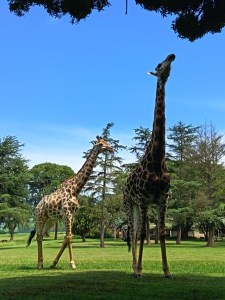
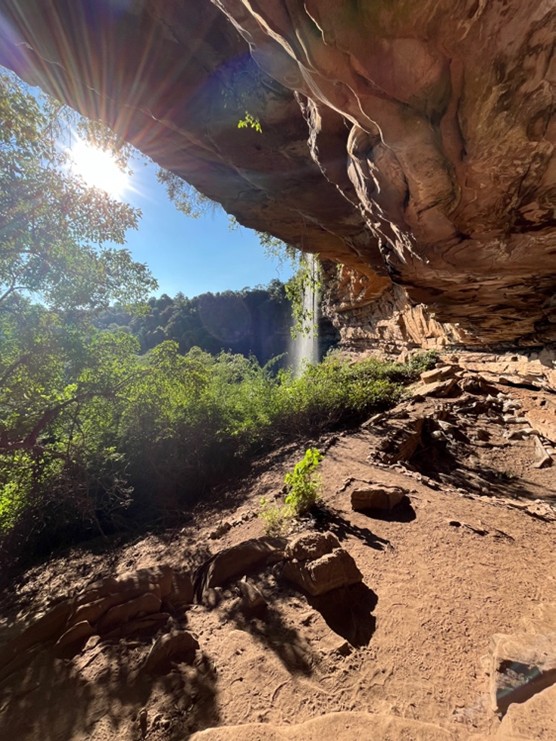
The second day centred on the challenges of academic writing and publishing. Through group conversations and smaller sessions, we reflected on common difficulties such as structuring arguments and navigating the publication process. Later that afternoon, we walked across the estate to the Holley Shelter archaeological site. During the walk, I noticed how the surrounding landscape offered a sense of calm that contrasted with the intensity of writing. Along the way, we encountered a giraffe standing only a few metres from us, quietly feeding on acacia leaves.
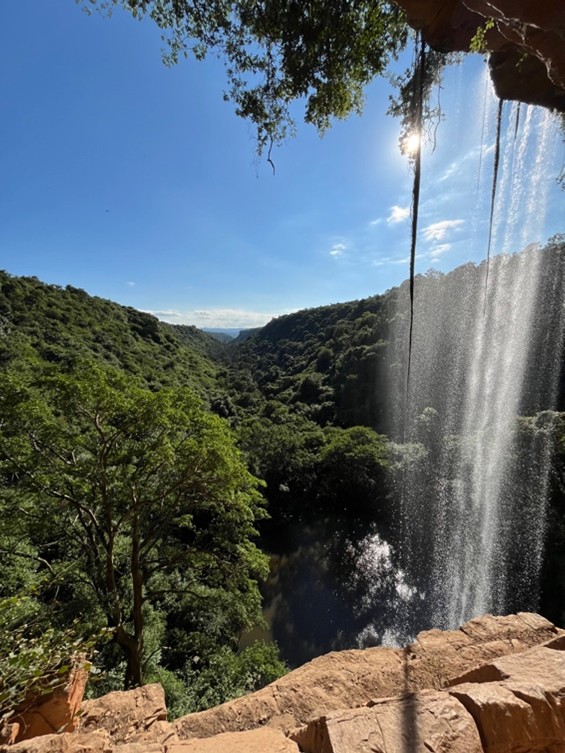
The shelter itself was striking. A clear waterfall flowed down the rock face, catching the sunlight as it filtered into the green valley below. The interplay of water, rock, and light created a remarkably beautiful and tranquil setting, making the site feel both impressive and deeply serene.
The 16th Mapping Ancient Africa seminar took place online on Friday 12th April 2024. The seminar was delivered by Stéphanie Bodin (Senckenberg Research Institute and Natural History Museum Frankfurt). In the seminar Stéphanie demonstrated how the examination of ancient charcoals found in caves used for shelter by hunter-gather populations living in Ethiopia at the end of the African Humid Period (4,000-2,000 years ago) can provide insights into vegetation and human selection of woody resources.
The next Mapping Ancient Africa seminar will take place online at 17:00 CEST on 12 April 2024.
Speaker: Stéphanie Bodin (Senckenberg Research Institute and Natural History Museum Frankfurt)
Title: Hunter-gatherers and Afromontane vegetation in the Ethiopian highlands since the end of the African Humid Period
Related publication:
Bodin, S.C., Neumann, K., Hensel, E.A., Vogelsang, R., Demissew, S., Casas-Gallego, M. & Hahn, K. (2024) Afromontane forests and human impact after the African Humid Period: wood charcoal from the Sodicho rock shelter, SW Ethiopian highlands. Vegetation History and Archaeobotany. DOI: 10.1007/s00334-023-00977-3
Casas-Gallego, M., Hahn, K., Neumann, K., Demissew, S., Schmidt, M., Bodin, S.C. & Bruch, A.A. (2023) Cooling-induced expansions of Afromontane forests in the Horn of Africa since the Last Glacial Maximum. Scientific Reports13, 10323. DOI: 10.1038/s41598-023-37135-8
The seminar will be delivered via Zoom. The link for the seminar can be obtained from the MAA Slack channel or by contacting the chair of this seminar (William Gosling). If you want to know more about the Mapping Ancient Africa project visit our web pages and please do not hesitate to get in contact if you want to get involved.
The 15th Mapping Ancient Africa seminar took place online on Friday 15th March 2024. The seminar was delivered by Bruk Lemma (Martin Luther University Halle-Wittenberg, Germany; Ethiopian Biodiversity Institute – EBI). In the seminar Bruk presented recent advances made in the application of biomarker and stable isotope techniques in revealing the climate dynamics of the Bale Mountains in Ethiopia. He showed that it is possible to identify some plant types using these approaches, but that degradation of the signal in the sedimentary environment is possible.
The fifteenth Mapping Ancient Africa seminar will take place on 15 March 2024 (17:00 CET)
Speaker: Bruk Lemma (Martin Luther University Halle-Wittenberg, Germany; Ethiopian Biodiversity Institute – EBI)
Title: Nature’s Fingerprints: Exploring the Use of Biomarkers and Stable Isotopes in Unraveling Chemotaxonomy and (Paleo-)Climate Dynamics of the Bale Mountains, Ethiopia
The seminar will be delivered via Zoom. The link for the seminar can be obtained from the MAA Slack channel or by contacting the chair of this seminar (Stefanie Kaboth-Bahr). If you want to know more about the Mapping Ancient Africa project visit our web pages and please do not hesitate to get in contact if you want to get involved.
The Mapping Ancient Africa (MAA) project has a double session of talks and a poster session at the INQUA congress in Rome 2023. Our session will be on Wednesday 19 July.
Giosan et al. When the desert was a lake: Providing context for Homo sapiens development in the northern Kalahari
Chase et al. Paleolakes and socioecological implications of glacial “greening” of the South African interior
Biddulph et al. Spatiotemporal variability in the initiation and development of peatlands across the central Congo Basin
Blinkhorn et al. Evaluating refugia in recent human evolution in Africa
Aureli et al. Homo sapiens behaviour and adaptation in East Africa. New evidence from an open-air site in a modern Ethiopian savannah environment: the GOT10 site
Dembele Climatic fluctuations during the last millenium and their impact on political history and human settlements in West Africa
Porchier et al. Annually resolved hydroclimate variability in the East African Rift Valley at a time critical for hominin dispersion
Effiom et al. Late Holocene palaeoecological studies at Lake St Lucia, KwaZulu-Natal
The 9th Mapping Ancient Africa seminar, and first of 2023, took place on Thursday 19 January. The seminar was delivered by Celine Vidal (University of Cambridge) and showcased recent work on the dating of volcanic deposits to constrain the age of hominin fossils in eastern Africa.
Vidal, C.M., Lane, C.S., Asrat, A., Barfod, D.N., Mark, D.F., Tomlinson, E.L., Tadesse, A.Z., Yirgu, G., Deino, A., Hutchison, W., Mounier, A. & Oppenheimer, C. (2022) Age of the oldest known Homo sapiens from eastern Africa. Nature601, 579-583. https://doi.org/10.1038/s41586-021-04275-8
Vidal, C.M., Fontijn, K., Lane, C.S., Asrat, A., Barfod, D., Tomlinson, E.L., Piermattei, A., Hutchison, W., Tadesse, A.Z., Yirgu, G., Deino, A., Moussallam, Y., Mohr, P., Williams, F., Mather, T.A., Pyle, D.M. & Oppenheimer, C. (2022) Geochronology and glass geochemistry of major Pleistocene eruptions in the Main Ethiopian Rift: Towards a regional tephrostratigraphy. Quaternary Science Reviews 290, 107601. https://dx.doi.org/10.1016/j.quascirev.2022.107601
Following the postponement of our previous seminar I am pleased to announce the next Mapping Ancient Africa (MAA) seminar (the new number 6 in the series) will take place on Thursday 6 October at 17:00 (CEST).
Title: Pleistocene climate variability in eastern Africa influenced hominin evolution
Related publication: Foerster, V., Asrat, A., Bronk Ramsey, C., Brown, E.T., Chapot, M.S., Deino, A., Duesing, W., Grove, M., Hahn, A., Junginger, A., Kaboth-Bahr, S., Lane, C.S., Opitz, S., Noren, A., Roberts, H.M., Stockhecke, M., Tiedemann, R., Vidal, C.M., Vogelsang, R., Cohen, A.S., Lamb, H.F., Schaebitz, F. & Trauth, M.H. (2022) Pleistocene climate variability in eastern Africa influenced hominin evolution. Nature Geoscience. DOI: 10.1038/s41561-022-01032-y
The seminar will be delivered via Zoom. The link for the seminar can be obtained from the MAA Slack channel or by contacting the chair of this seminar Stefanie Kaboth-Bahr. If you want to know more about the Mapping Ancient Africa project visit our web pages and please do not hesitate to get in contact if you want to get involved.
The recently published volume of the Palaeoecology of Africa series contains a number of different types of papers: research articles, reviews, perspectives and data papers. One of the key reasons I was motivated to become involved in the project was to help mobilise palaeoecological data from Africa towards open access datasets (African Pollen Database, Neotoma). To hopefully get greater recognition to the great work done over the years and to help facilitate synthetic work that will provide a greater understanding of spatial variance in past climate change. Ultimately, four short data papers were included in the volume: an enhanced c. 16,000 year pollen record from the Bale Mountains in Ethiopia (Gil-Romera et al. 2021), two pollen and charcoal record from the southern Cape Coast in South Africa, c. 3200 and 650 years long respectively (du Plessis et al. 2021a; du Plessis et al. 2021b), and a c. 700 year long record from Madagascar (Razanatsoa et al. 2021). The records provide new insights in to landscape scale environmental change driven by both humans and climate. To find out more check out the open access articles and the data at:









 Ecology of the past