Using phytolith analysis to detect palm enrichment in AmazoniaNina Witteveen (University of Amsterdam)
Starch grains as indicators of plant food consumption in Neanderthals and Early Modern HumansAmanda Henry (University of Leiden)
Paleoenvironmental history of an archaeological lagoon in Central Italy: Insights from diatom analysisMajoi Nacimiento, Teye Aukes & Jan Sevink (University of Amsterdam)
15:45-17:30 – Laboratory activities
Advances in topical phytolith identificationNina Witteveen (University of Amsterdam)
Finding Suitable Grounds – combining the on/off site approach through phytolith investigation in FlevolandAna Smuk (Rijksuniversiteit Groningen)
Veerle and I trying to protect ourselves from the mosquitos.
Hi all!
My name is Britte Heijink and I’m doing my MSc Biological Science thesis research project with Crystal McMichael and William Gosling. I travelled with Veerle Vink and Crystal to the Colombian part of Amazonia to collect samples for my project. At Amacayacu National Park, we collected soil cores from different locations in the plot. Now that we’re back in Amsterdam, I’m analysing the soils to reconstruct the fire and vegetation history from the plot using charcoal and phytoliths. I am specifically looking to see if humans have been present in the system and how they potentially affected the vegetation at Amacayacu.
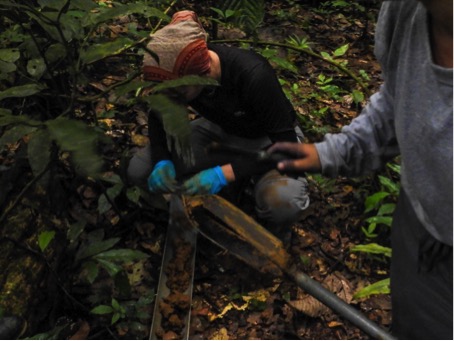
Here I’m Sampling pieces of soil cored by Louisa and checking for large pieces of charcoal
I’ve completed my bachelor thesis for Bèta-Gamma (Liberal Arts and Sciences) under the supervision of Crystal and Will here at the UvA. I’m really excited to work with them again, and already looking forward to our meetings at the Oerknal 😉 I will be finished by the end of September, and then possibly return for a literature study.
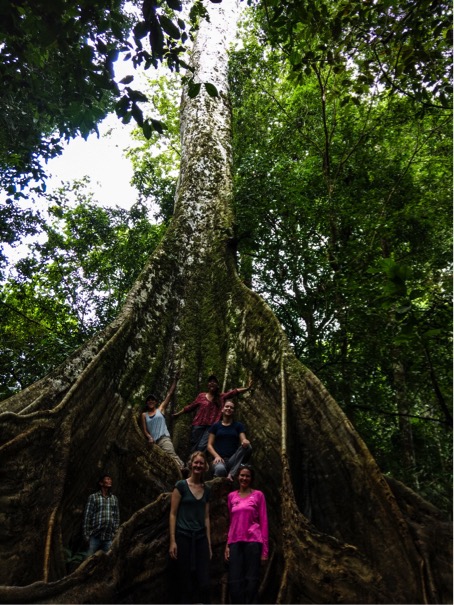
One of the most wonderful experiences in my academic career so far has been the fieldwork to Panama and Colombia with Crystal, Veerle, and Nina. It was a lot of hard work, and 90% of our time was spent covered in mud, sweat, and insect repellant, but the experience of working in a tropical rainforest was completely worth it! Veerle and I will write another blog about our fieldwork soon. Come see us in the microscope lab if you want to hear our dangerous and amazing stories before that!
Cheers,
Britte
Our last day in the Amazon was spend with some of the local students, Louisa Fernando Gomez Correa and Mariana Gutierrez Munera.
The month-long palaeoecology module at UvA is coming to an end. We have had two weeks of lectures and microscope work, an introduction to quantitative palaeoecology, and we just finished a week of fieldwork in Twente, which is in the easternmost part of the Netherlands.
Students working in the field (photo: M. Groot)
Will Gosling and I tried something new for the field excursion this year. We split the class into eight groups, and gave each group a set of pollen and phytolith samples from an ‘unknown location’. Unknown in this context means being from one of the eight primary sites that we would visit during the field excursion. The students were required to perform vegetation surveys and characterize soils at each of the primary sites that we visited. The goal of each group was to figure out which location their set of ‘unknown’ samples came from. Basically, we had them doing forensic palynology, with idea that they could then better visualize the different vegetation assemblages seen in the palaeoecological records. Continue Reading
Characterization of Neotropical ecosystems by their modern pollen spectra and organic chemical composition
Develop skills in pollen identification, pollen chemical characterization, and the analysis of organic biomarkers.
Examine ecological variation across an altitudinal gradient of nearly 4000 meters on the tropical western Andean flank.
Improve understanding of how ecosystems function in a biodiversity hotspot, and how they might be identified in the fossil record.
The considerable biodiversity of Neotropical ecosystems is under pressure from projected climate change and human activity. Modern ecosystems can be characterized by their pollen rain and organic chemistry, which can in turn provide information about ecosystem health and functioning. However, little is known about how pollen assemblage and chemical composition (of pollen and plants) vary along environmental gradients. Altitudinal transects provide an opportunity to study a range of environments and ecosystems with a relatively small geographic area. By improving our understanding of modern ecosystems we can improve our interpretation of fossil records, and consequently better understand how modern ecosystems came into being.
The main objectives of this PhD project are to:
Generate the first modern pollen assemblage and chemical data set for the Neotropics,
Characterize the landscape-scale variation in pollen assemblage and chemistry composition, and
Identify the key environmental drivers that determines pollen assemblage and chemistry composition variation.
Publication date: 27 July 2015 Closing date: 18 September 2015
Level of education: University (Masters)
Hours: 38 hours per week
Salary indication: €2,125 to €2,717 gross per month
Vacancy number: 15-286
Applications should be emailed to application-science@uva.nl, with in the subject line the position you are applying for and vacancy number (15-286). Please make sure all your material is attached in only one pdf. Applications should include a detailed CV including educational experiences, a list of research projects and/or publications, a letter of motivation, relevant work experience, and the names and contact addresses of two academic referees from whom a reference for the candidate can be obtained.
For more details, including information on how to apply, click here (UvA), or here (via academic transfer).
Students examining a sediment core extracted with a Russian corer
Last week, Will – our new associate professor at the University of Amsterdam – joined us on the field residential module of the undergraduate “Paleoecology” course; 7 days exploring the sediments and vegetation of the Twente region of the Netherlands. The experience provided Will with a lot of information on Dutch language, landscapes, and students; which should be useful to him next year as he will be coordinating the course!
Students examining peat exposures.
During this very intensive (4-week) paleoecology course, students get background lectures in past environmental change, learn to identify microfossils in the laboratory (pollen and chironomids), and go on the excursion to experience fieldwork. The field module involves excursions during the day, when students have to identify plant species indicative of different vegetation types in relation to soil nutrient availability and moisture content. The evenings are reserved for the students own paleoecological research investigation; this year students were reconstructing the vegetation history and climate change during the late-glacial from a lake sediment core from Germany. Once data collection was completed the students had to interpret the pollen assemblages they found using the knowledge of modern day ecosystems they gained throughout the week. On the final evening they presented their work to the whole group. The final results they achieved were quite impressive.
Students presenting findings from the days work
I am very curious as to what the course will be like next year, led by Will, and how he will tweak and turn it to his liking.
Frazer Matthews-Bird’s video on his PhD research examining long-term (>50 year) climate change from fossil insects (chironomids) has been shortlisted for the American Geophysical Union (AGU) student competition prize. Please watch Frazer’s video and “Like”; the most liked video will win free entry into the AGU Fall meeting 2014.
Understanding how vegetation responded to past climate change requires the development of well constrained relationships between living floras, environment and climate. This project will help constrain the great uncertainty which exists as to how tropical ecosystems are represented in the fossil record by examining the relationship between modern vegetation and the pollen it produces. The project will analyse modern pollen rain using a combination of traditional microscopic analysis [1] and cutting edge geochemical techniques [2]. We anticipate that the findings will provide new insight into past vegetation and climatic change.
For further information on the project and how to apply see the full advert: NERC PhD advert. Prior to applying please check eligibility for NERC funding by clicking here.
Closing date: 25th April, interviews will be held at The Open University during May.
Four new workstations installed in the Past Environmental Change microscope lab
Excitement in February saw the arrival of a new research grant within the PCRG, to look at pollen and spore chemistry from Lake Bosumtwi (watch this space for new post-doc and PhD studentship positions), and (just in time) the expansion of benches in the microscope lab which will ensure that the new people will have spaces to sit in! In addition, we had a paper published with long time friends and collaborators at the University of Leeds; Roucoux et al. (2013).
Despite the disruption of the lab refit Hayley and Frazer have been cracking on with pollen and chironomid analysis. Encarni and Frazer returned from field work in Ecuador and half the samples have so far made it back to The Open University; we now wait with anticipation for customs to release the other box!
Four shiny new workstations from the other side – woo








 Ecology of the past