INQUA 2015: Climate change in the tropical South Pacific during the Late Quaternary

October 27, 2014
WDG


inqua-JPPosted on behalf of Prof. David Sear (University of Southampton)

The next INQUA Congress will be held in Nagoya (Japan) on July 27 – August 2, 2015

This is a call for contributions to session P05 on ‘Climate change in the tropical South Pacific during the Late Quaternary’.

The session abstract is as follows:
Establishing well dated, quantitative, highly resolved palaeoclimate data for the major climate systems of the tropical south Pacific has become a research priority owing to the paucity of instrumental data from this critical region of the Earth. Whilst the quantity of proxy climate data for this region is increasing rapidly, compared to records from the Northern Hemisphere there is a surprising paucity especially when considering the importance of this region to global climate. Such information is vital for fully understanding inter-hemispheric climate linkages, global energy fluxes and the long-term evolution of natural climate variability such as the El Nino-Southern Oscillation. The dearth of pre-industrial climate records from this region contributes to large uncertainties associated with future climate change impacts far beyond the south Pacific. This session aims to bring together researchers working on Late Quaternary ocean/climate proxies with those whose research lies in modelling ocean-climate processes and dynamics in the tropical south pacific region, and their implications for global climate.

We hope this session will be of interest to you. If you plan to contribute to this session, please submit your abstract before December 20, 2014 click here.

We hope to see you at INQUA 2015.

Best Wishes,

David Sear, Julian Sachs, Kim Cobb, John Chiang, Peter Langdon – session conveners.

Professor David Sear
Geography & Environment
University of Southampton

Ghana Fieldwork 2014; Day 02

October 17, 2014
wesfraser

The second day of our fieldwork saw us; transfer from Accra to Fumesua where FORIG is located (approximately 20 km south of Kumasi); meet up with FORIGs deputy director Dr Stephen Adu-Bredu to discuss fieldwork and outreach plans; and settle in to FORIG for the next two weeks.

The next two days will involve building pollen traps ready for deployment next and finalising the detailed day-to-day plan of work.

Ghana Fieldwork 2014; Day 01

October 17, 2014
wesfraser

The latest round of fieldwork in Ghana is underway. Adele and myself are travelling out to collect pollen traps deployed last year as part of Adeles PhD research. We will be revisiting the sites in Ankasa, Bobiri and Kogyae that Adele and Phil visited last year. This time we are also accompanied by Lottie who will be delivering workshops on outreach activity engagement and the palaeoecology represented in the sediment record of Lake Bosumtwi.

Flying into land at Accra in the twilight we passed over a storm cell, with some fantastic convective clouds illuminated by flashes of lightning within. Once out of the airport, we were taken through the hustle and bustle of Accra streets, alive with evening activity. Finally reaching our destination for the night, the FORIG guesthouse. All three members of our party readily made for bed to get a good nights sleep before tomorrows journey to Kumasi.

Organisms and environments: Frontiers in palaeoecological technique development

October 16, 2014
WDG

inquaXIX INQUA Congress
NAGOYA, JAPAN 27 July-2 August, 2015

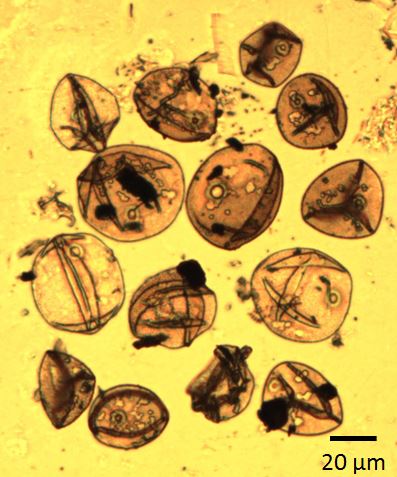
Grass pollen from Lake Bosumwti picked for individual chemical analysis

Grass pollen from Lake Bosumwti picked for individual chemical analysis

Abstract submission is now open for the XIX International Union for Quaternary Research (INQUA) Congress. “Ecology of the past” researchers will be there and are hosting a special session, entitled Organisms and environments: Frontiers in palaeoecological technique development, at which we hope to bring together a wide range of palaeoecologists working on novel proxy development. Members of the “Ecology of the past” group will be showcasing recent findings on the environmental significance of pollen chemistry change through time; linked to the 500,000 years of solar irradiance, climate and vegetation change in tropical West Africa project (Fraser et al., 2014). Please take a look at our session and consider submitting YOUR abstract today!

For information on abstract submission click here. Closing date for abstract submission 20 December 2014.

For further information on our session click here, or “Continue reading” below…

Continue Reading

Predicting the future by understanding the past: Climate change

October 9, 2014
WDG

As part of the 500,000 years of solar irradiance, climate and vegetation changes” Natural Environments Research Council funded (NE/K005294/1) project we have produced a wall chart explaining the type of research we do and how it can help to place on-going, and projected, climate change in context. The wall chart is designed for use in schools and universities. To obtain a copy of this, and other wall charts, please contact the British Ecological Society (direct wall chart link here).

Understanding Climate Changes

Paleoecology course University of Amsterdam

September 29, 2014
Valerie

Students examining a sediment core extracted with a Russian corer

Students examining a sediment core extracted with a Russian corer

Last week, Will – our new associate professor at the University of Amsterdam – joined us on the field residential module of the undergraduate “Paleoecology” course; 7 days exploring the sediments and vegetation of the Twente region of the Netherlands. The experience provided Will with a lot of information on Dutch language, landscapes, and students; which should be useful to him next year as he will be coordinating the course!

Students examining peat exposures.

Students examining peat exposures.

During this very intensive (4-week) paleoecology course, students get background lectures in past environmental change, learn to identify microfossils in the laboratory (pollen and chironomids), and go on the excursion to experience fieldwork. The field module involves excursions during the day, when students have to identify plant species indicative of different vegetation types in relation to soil nutrient availability and moisture content. The evenings are reserved for the students own paleoecological research investigation; this year students were reconstructing the vegetation history and climate change during the late-glacial from a lake sediment core from Germany. Once data collection was completed the students had to interpret the pollen assemblages they found using the knowledge of modern day ecosystems they gained throughout the week. On the final evening they presented their work to the whole group. The final results they achieved were quite impressive.

Students presenting findings from the days work

Students presenting findings from the days work

I am very curious as to what the course will be like next year, led by Will, and how he will tweak and turn it to his liking.


Debating the Vera hypothesis

Debating the Vera hypothesis


Teaching in the field: Foundations, feedback and fun

September 16, 2014
WDG

My final teaching job for The Open University was to help deliver the “Sedimentary Rocks & Fossils in the Field” section of the Level 2 Practical Science module (SXG288) offered by the Science Faculty. I have been involved in all three presentations of this section of the SXG288 module, which will now cease to be offered, and a number of other Earth and environmental science residential schools over the last 9 years.

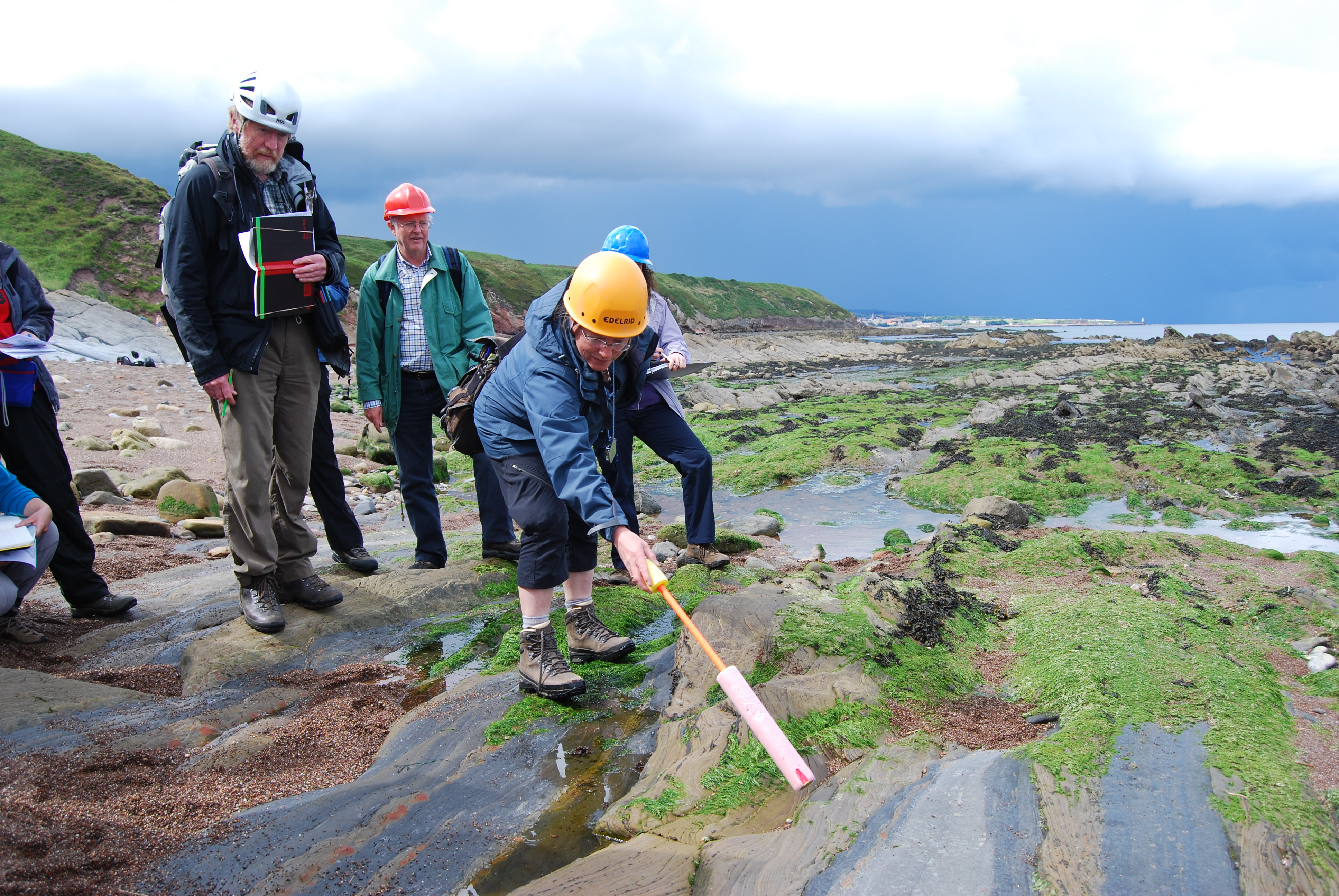
Showing students the rocksHaving the opportunity to engage directly with students and enthuse them face-to-face about the subject I specialise in is a privilege I have gained a lot from. Furthermore, my over-riding impression from the students I have taught is that they feel they benefit greatly from the opportunity to explore first hand the concepts and subjects which they have previously studied in books and online. Based on my experiences on “Sedimentary Rocks and Fossils”, and other modules as both a tutor and a student, I am convinced that to effectively teach geological, geographical, environmental and ecological subjects effectively an element of field-based teaching is required.

Continue Reading

In the news:

Exploding flower blasts birds with pollen, by Xochitl Rojas-Rocha Science shot. (Research article behind this story is Dellinger et al. listed below). Also:

Scientific articles:

Dellinger, A.S., Penneys, D.S., Staedler, Y.M., Fragner, L., Weckwerth, W. & Schönenberger, J. A Specialized Bird Pollination System with a Bellows Mechanism for Pollen Transfer and Staminal Food Body Rewards. Current Biology, online.

Huntley, B., Midgley, G.F., Barnard, P. & Valdes, P. (2014) Suborbital climatic variability and centres of biological diversity in the Cape region of southern Africa. Journal of Biogeography, 41 (7): 1338-1351.

Matthew, T.J., Cottee-Jones, H.E., & Whittaker, R.J. (2014) Habitat fragmentation and the species–area relationship: a focus on total species richness obscures the impact of habitat loss on habitat specialists. Diversity and Distribution, 20 (10): 1136-1146.

Rijsdijk, K.F., Hengl, T., Norder, S.J.,  Otto, R., Emerson, B.C., Ávila, S.P., López, H., van Loon, E. E., Tjørve, E. & Fernández-Palacios, J.M. (2014) Quantifying surface-area changes of volcanic islands driven by Pleistocene sea-level cycles: biogeographical implications for the Macaronesian archipelagos. Journal of Biogeography, 41 (7): 1242-1254.

Frazer on climate change & insects – AGU video

September 8, 2014
WDG

Frazer Matthews-Bird’s video on his PhD research examining long-term (>50 year) climate change from fossil insects (chironomids) has been shortlisted for the American Geophysical Union (AGU) student competition prize. Please watch Frazer’s video and “Like”; the most liked video will win free entry into the AGU Fall meeting 2014.

View all the videos on the AGU YouTube channel.

Past environmental change in the Amazon basin – AGU video

September 8, 2014
WDG

Hayley Keen’s video “Past environmental change in the Amazon basin” has been shortlisted for the American Geophysical Union (AGU) student video prize. Please watch and like Hayley’s video; top “Liked” videos will win entry to the AGU 2014 Fall meeting.

View all the videos on the AGU YouTube channel.

Blog at WordPress.com.